
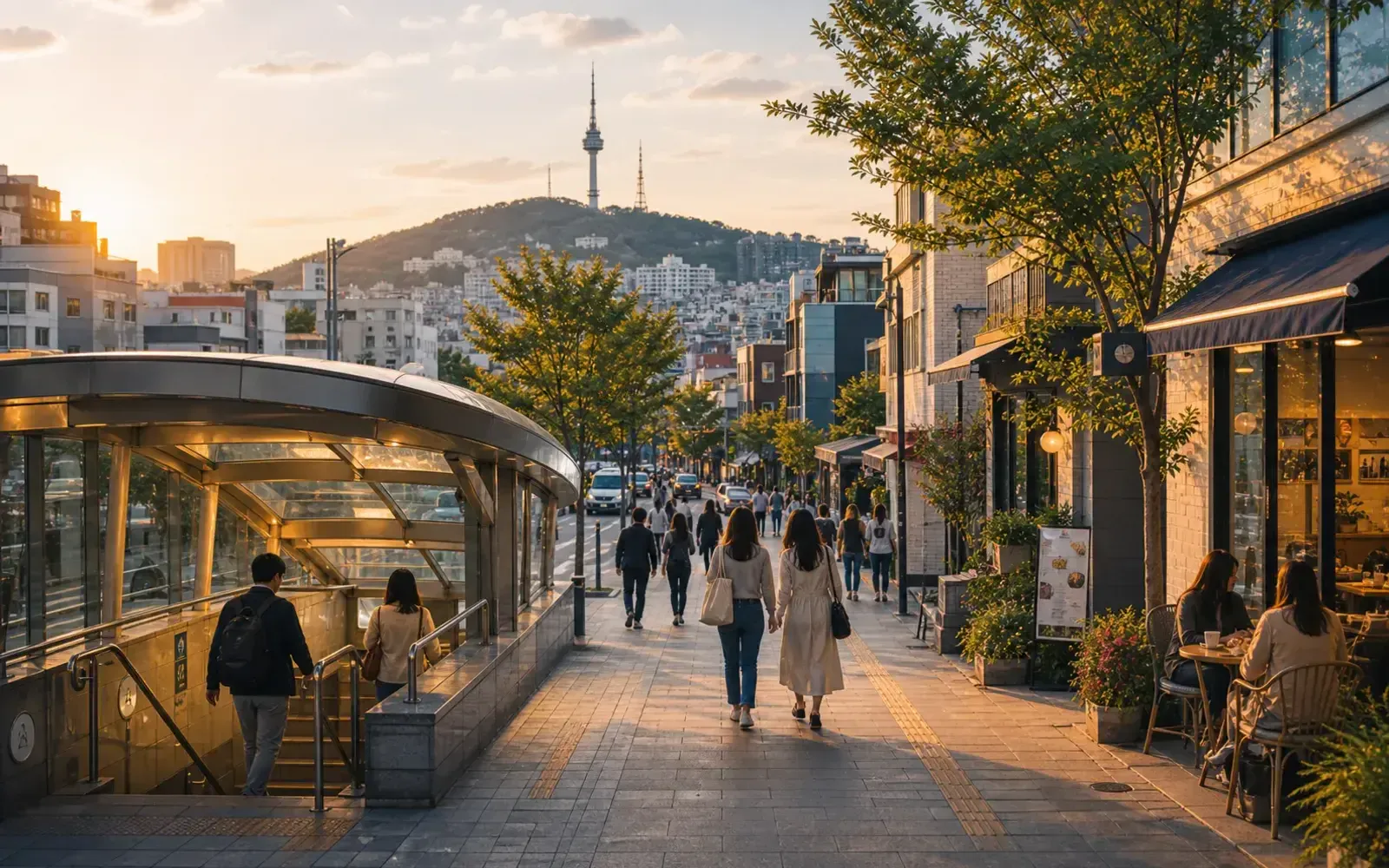
Checked July 27, 2026. The best Seoul base is not the neighborhood with the longest attraction list. It is the place that removes friction from the plans you will actually keep. Myeong-dong is convenient for a short, central trip; Hongdae suits late arrivals and evenings; Jongno puts historic Seoul within walking distance; Gangnam and Jamsil work when most appointments are south of the river.
This guide compares those four bases by airport transfer, subway effort, evening atmosphere and the kind of traveler each one serves. It is desk-researched from official tourism and transport information. Hotel quality and street conditions change block by block, so check the exact address—not only the neighborhood name—before paying.
Quick decision: choose the base that fits your itinerary
| Base | Strongest reason to stay | Main trade-off | Best fit |
|---|---|---|---|
| Myeong-dong / Euljiro | Central position and straightforward sightseeing transfers | Busy retail streets; rooms can feel small for the price | First visit of three to five nights |
| Hongdae | Direct AREX all-stop access and a late-running district | Noise varies sharply by street | Late arrivals, younger travelers, western Seoul plans |
| Jongno / Insadong | Palaces, traditional streets and museums close together | Airport transfer usually needs more planning | History-focused travelers and walkers |
| Gangnam / Jamsil | Efficient for COEX, sports, business and east-Seoul plans | Longer cross-city rides to many old-Seoul sights | Repeat visitors or a south-of-river itinerary |
Myeong-dong: the low-friction first base
Myeong-dong works because it sits between several useful areas rather than because every attraction is on one street. Line 4 reaches Seoul Station and Dongdaemun; nearby Euljiro entrances add Line 2; buses cover palace and Namsan directions. The official Visit Seoul area guide identifies the district as a major shopping area, but the practical advantage is that a traveler can split a day into north-side history, central shopping and an evening walk without repeatedly crossing the city.
Inspect the map around your exact hotel. “Myeong-dong” listings may be closer to Chungmuro, Euljiro 3-ga or Hoehyeon. That is not automatically bad, but the nearest station and exit determine how the stay feels with luggage. For a 6 a.m. departure, check the airport-bus stop and first service rather than assuming the subway will be running.
Hongdae: useful when arrival time and evenings matter
Hongik University Station is served by the AREX all-stop train, which makes it a practical landing point from Incheon Airport without changing at Seoul Station. The district stays active late and has abundant food, cafés and shops. The downside is very local: accommodation near the busiest nightlife lanes can be loud, while streets toward Yeonnam-dong are calmer but may add a walk.
Hongdae is less compelling if every morning begins at Gyeongbokgung, Bukchon or Jamsil. Those trips are possible, but repeated transfers consume the convenience gained on arrival day. It is strongest for a west-Seoul plan, a late flight, or travelers who value an easy dinner after returning to the hotel.
Jongno and Insadong: historic Seoul on foot
Jongno is not one compact hotel zone. A room near Jongno 3-ga, Anguk or Gwanghwamun can create a very different route. Around Anguk and Insadong, Gyeongbokgung, Changdeokgung, museum districts and traditional streets are close enough to combine without treating every move as a subway journey. Around Jongno 3-ga, three subway lines offer more network flexibility.
This is a good base for early palace starts and museum-heavy days. It is a weaker choice if shopping in Gangnam or events in Jamsil dominate the trip. Some older lanes have uneven pavement, and the shortest map route may involve stairs. Check the station-exit elevator on Seoul’s official transport map if step-free access matters.
Gangnam and Jamsil: choose them for a south-side trip
Gangnam is often recommended as though it were universally central. It is central to many business, shopping and medical districts south of the Han River, not to Seoul as a whole. Stay here when COEX, Apgujeong, Seongsu connections or business appointments are the anchor. Jamsil is more logical for Lotte World, the lake, stadium events and east-Seoul plans.
A first-time visitor who wants two palace days, a DMZ pickup near central Seoul and a Myeong-dong evening may spend too much time commuting from Jamsil. Conversely, a concert traveler with an event at Jamsil and a flight after two nights can save energy by staying nearby. Start from the fixed appointment, then build outward.
A five-minute booking test
- Pin the hotel’s exact entrance, not the neighborhood label.
- Route the hotel to your first two morning destinations and your latest evening destination.
- Check whether the closest station exit has an elevator if you carry large luggage.
- Compare airport routes for your arrival time. The last useful train or bus matters more than daytime frequency.
- Read recent room reviews specifically for street noise, elevator access and hill gradient.
Sample choices for common trips
Three-night first visit: Myeong-dong or Euljiro minimizes cross-city planning. Late-night arrival plus nightlife: Hongdae is easier if the flight still connects to AREX service. Palaces, crafts and museums: Anguk or Jongno keeps several stops walkable. Concert or conference: choose Jamsil or Gangnam near the venue, then accept one central-Seoul day trip.
If rain is likely, pair your base decision with our rainy-day Seoul plan. For airport costs and route trade-offs, use the airport transport comparison.
Official planning links
- Visit Seoul: Myeong-dong area guide
- AREX: airport railway information
- Seoul Metropolitan Government: public transportation
Editorial method: KoriPicks compared official transport and tourism information and did not accept payment from any hotel or district. Verify the exact accommodation address and your travel date before booking.