
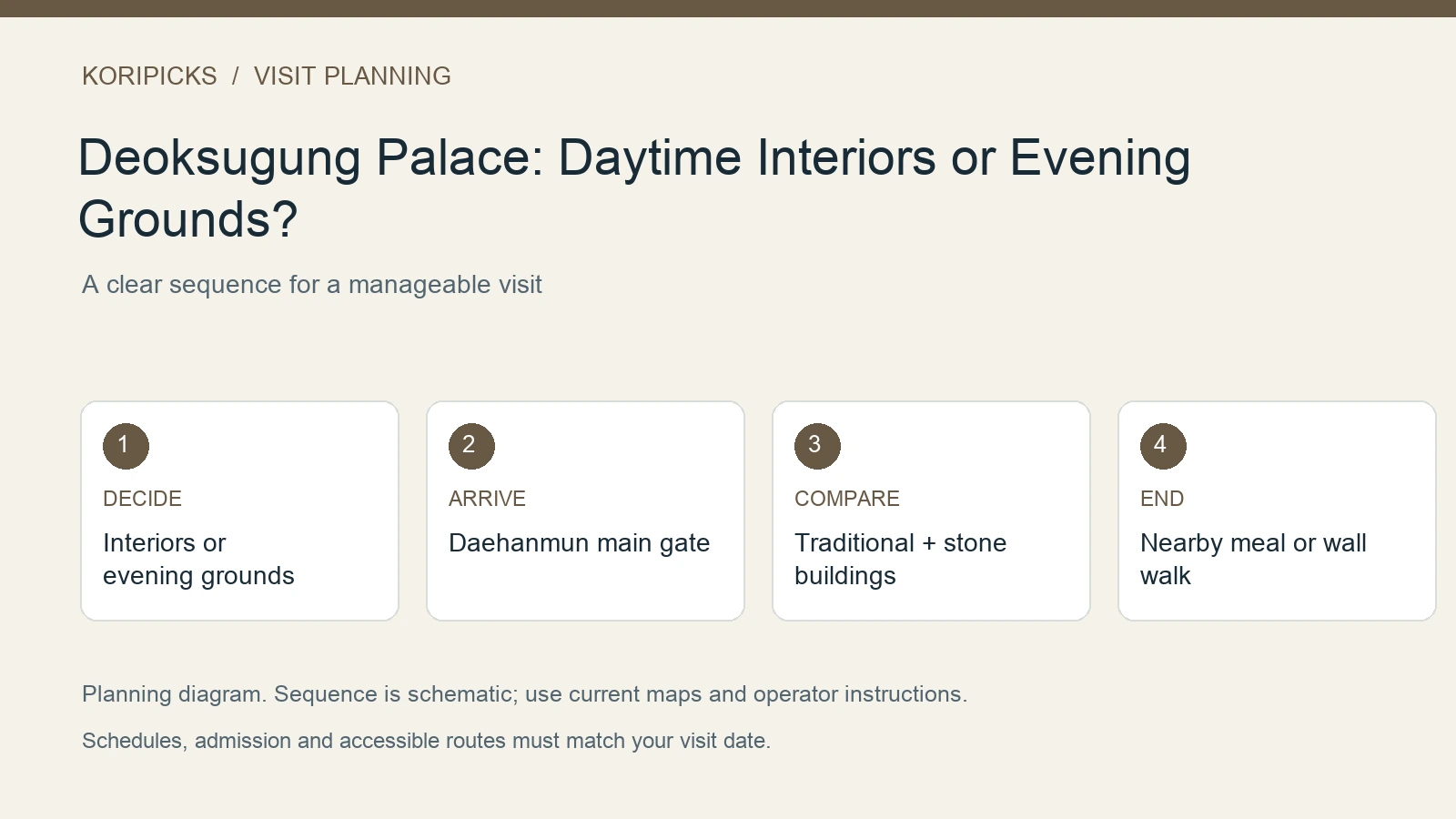
Deoksugung is a practical palace choice when you want an evening in central Seoul without relying on a seasonal night-tour ticket. Its ordinary palace hours extend into the evening, but the exhibitions and reserved interiors inside the complex follow different schedules. Choose whether your goal is the outdoor palace atmosphere or a particular building visit before you decide when to arrive.
A compact plan is City Hall area → Daehanmun gate → permitted palace circuit → dinner nearby. Allow around 90 minutes to two hours with rests. This is an editorial planning estimate; it excludes a separately reserved guided interior program and does not guarantee entry to every building.
The actual palace circuit
Use Daehanmun → Junghwajeon area → Seokjojeon exterior → Dondeokjeon if its daytime access is still available → return to the chosen palace exit. The sequence compares the ceremonial hall with the stone architecture and gives a daytime interior or exhibition an optional role. It does not assume that an evening grounds ticket opens every building.
Begin by reading the palace map at the entrance. Find Junghwajeon and the stone-building zone, then decide whether Dondeokjeon fits the remaining time. In an evening-only visit, leave the earlier-closing interiors outside the plan and use the permitted outdoor circuit instead.
| Visit choice | Suggested order | What to book or verify separately |
|---|---|---|
| Daytime architecture visit | Main hall, stone-building exterior, an available exhibition | The desired interior’s actual access and final admission |
| Dusk-to-evening grounds | Main hall and permitted outdoor stone-building views | Ordinary palace closure and the return journey |
| Reserved Seokjojeon interior | Confirmation’s session first, grounds afterward | The actual guided reservation, not general palace admission |
Allow roughly 90 minutes for a selective grounds circuit and more time for a confirmed interior session. These are editorial allowances. A group using longer rests should keep fewer stops rather than interpreting the route as a demand to finish every named building.
How the comparison changes the visit
At Junghwajeon, look at the relationship between a traditional hall, its raised platform and the open space in front. At Seokjojeon, compare the stone frontage, repeated columns and more formal exterior composition. The two settings ask you to approach and look differently.
The value of the route is seeing those differences in one complex. You can make a useful comparison from permitted exterior positions without inventing an interior visit. If a guided session is available and interests you, it adds another layer; it should not be treated as automatic access included in the grounds ticket.
Give each view a wide composition and one detail. That produces a coherent set of images rather than a sequence of disconnected façades. Follow restrictions around platforms and entrances, and leave space for visitors who are passing through rather than photographing.
Add a City Hall program only as a separate appointment
The official Tong-Tong City Hall tour page describes a guided route through the City Hall establishment and Seoul Metropolitan Library, with its own reservation and on-site participation timetable. It can complement a palace visit for someone interested in civic architecture.
It is not permission to wander through every office floor independently. Use the actual confirmed course and meeting point. If you want both programs, choose one as the fixed appointment and keep the palace grounds block flexible around it.
A palace plus City Hall architecture day can be rewarding, but a short evening plan should not silently include a long guided civic-building tour as well. The program duration and route must be added to the day’s actual allowance.
Leave the stone-wall walk optional
After the palace, use a short Jeongdong-side walk only if it serves your meal and return. The street has its own destinations and openings; it is not a covered museum extension or another admission entitlement.
Choose one seated meal and one station route before leaving the grounds. That gives the evening an ending and preserves the practical advantage of Deoksugung’s central location.
Separate the palace from its interiors
| Place or activity | Published rule | What to protect |
|---|---|---|
| Ordinary palace visit | 09:00–21:00; last admission 20:00 | Enough time inside before closing |
| Regular closing day | Monday, with holiday exceptions | The actual calendar date |
| Seokjojeon interior | Restricted, reserved guided viewing | Your specific reservation and session |
| Dondeokjeon | Earlier daytime closing than the grounds | Arrive before its own admission cutoff |
The heritage authority’s hours table supplies those distinctions. An evening palace ticket does not keep all interior exhibitions open until 21:00. The official admission table lists the standard adult palace charge as KRW 1,000; verify the category that matches your age and status.
Start with Daehanmun, not a wall-side shortcut
Save 덕수궁 대한문 as the entrance and 99 Sejong-daero, Jung-gu as the palace address. City Hall Station serves the area on Lines 1 and 2. Use the live map to pick a suitable surface exit, especially if you need an elevator rather than stairs.
The stone-wall streets are part of the attraction, but they do not turn every point along the wall into an entrance. Keep your first destination at Daehanmun. If a road crossing or temporary public event changes the approach, follow current pedestrian directions before joining the ticket area.
For a group meeting from different hotels, choose an unmistakable street-level landmark and agree which side of the gate area you mean. “City Hall exit” is too vague when there are multiple exits, nearby buildings and busy crossings.
A palace circuit with two architectural questions
Once inside, read the current grounds map and follow a permitted route toward the main ceremonial hall area. Then compare the traditional palace buildings with the Western-style architecture around Seokjojeon. You do not need interior access to recognize that the complex contains different architectural languages.
Look first at how the structures address open space. A hall raised above a courtyard asks you to approach differently from a stone façade facing a more formal garden. Then notice material and proportion: timber brackets and tiled rooflines versus masonry, columns and a symmetrical frontage.
These are observation prompts, not claims of having toured the buildings recently. The official Deoksugung history supplies the historical context. Use it to distinguish the palace’s Korean Empire associations from the much broader history of Seoul’s other palaces.
Choose daytime for exhibitions, evening for grounds
If a specific interior matters, organize the day around its admission or reservation first. Add the palace walk after that visit, with time for a break. Do not assume that a late-afternoon ticket will let you see all interior galleries before they close.
If the main attraction is the evening atmosphere, visit while there is still enough light to read the layout, then remain into dusk if the day’s conditions suit you. Moving from daylight to evening can be more useful than arriving in complete darkness and searching for the first signboard.
A late arrival should have a shorter objective: one permitted circuit and a main-hall view. Last admission is not a recommended start time for a leisurely two-hour visit.
Use the stone-wall street as an optional second act
After leaving, consider a short stone-wall-side walk only if your return route and energy make sense. The street can contain restaurants, galleries and public buildings with their own schedules. It is not an all-weather indoor itinerary.
Choose your dinner area before beginning the wall walk. If you are headed toward another central district, look at the complete surface route rather than doubling back to the same station out of habit. A flexible meal near the end of the walk keeps the outing easier than a reservation requiring you to rush through the palace.
For rain, select a confirmed indoor institution separately. The rainy-day guide compares museum anchors. A palace roof in a photograph should not be treated as an open visitor shelter or a guarantee of indoor access.
Guard ceremonies and special events need their own check
A changing-of-the-guard photograph is not proof that a ceremony runs at the time you intend to visit. Programs can be affected by weather, public events and operational notices. Start from the current operator information if the ceremony is your main reason for going.
Likewise, cultural performances and seasonal installations can have separate tickets or dates. Keep the normal palace walk as the base plan; add an event only after its current notice matches your visit day.
If the event is canceled, the surrounding City Hall district can still support a short urban outing. The official Tong-Tong City Hall tour page is useful for a different, guided architectural option, but its session and access rules must be checked independently.
A small budget and a realistic exit
Keep palace admission, transport and dinner on separate budget lines. Optional guided interiors or experiences belong on an additional line. A low entrance fee makes this a modest-cost cultural stop, but it says little about restaurant prices or the cost of adding another district afterward.
Save the route back before the palace visit, including the accommodation’s Korean address. In an evening plan, the best exit is the one that serves dinner and your journey home, not the farthest point on the grounds map.
Our night-view comparison helps decide whether you want this central palace atmosphere or a hill, lake or river view instead. Choose one main evening experience and let the rest remain optional.