
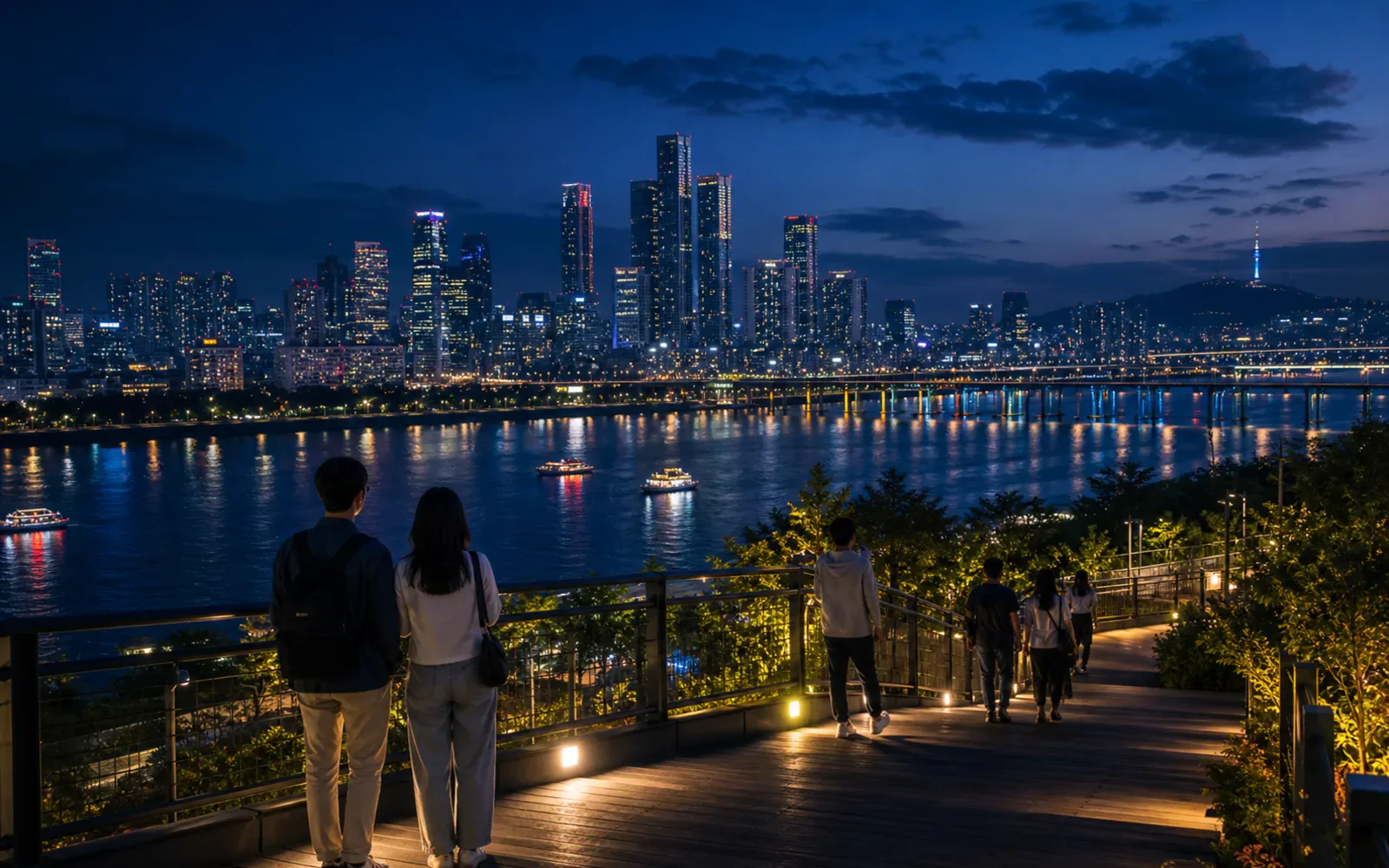
The easiest Seoul night view is not automatically the tallest one. For a first evening, choose a viewpoint that fits your walking ability, the weather and the trip back to your accommodation. Naksan Park works well for a city-wall walk, Namsan gives the iconic central panorama, Seokchon Lake keeps the route mostly level, and a Hangang stop is best when the river itself is the plan.
This guide compares the effort behind the photograph. It is based on Seoul Metropolitan Government visitor information, not an unverified promise that every light, fountain or facility will operate on a particular night.
Four arrival routes, with a definite final stop
Use the route that matches your walking ability, accommodation and dinner plan. The station exits below are source-based orientation points, not certified accessible routes. If you need an elevator, retain the same destination but choose the operator’s suitable station and surface approach.
Naksan from Hyehwa: a climb with a clear return
The city’s Naksan access information identifies Hyehwa Station Exit 2 as an approach to Naksan Park, whose address is 41 Naksan-gil, Jongno-gu. Start from Hyehwa, orient toward the park, follow the signed public route uphill, and choose a permitted wall-side viewing section. Return toward the same station area for dinner unless you have explicitly planned a longer wall walk.
Allow an outdoor block of roughly 60–90 minutes with rests; that is an editorial allowance, not a measured climb. Do not call Naksan a flat route. The reward is the changing city-wall view, while the trade-off is gradient and the descent after dark. A short there-and-back visit is more manageable than joining the entire Hyehwa-to-Dongdaemun trail by accident.
Namsan by an officially operating access service
Choose the actual bus, cable-car or walking approach before saving the tower as the destination. The city’s Namsan district transport information includes the Chungmuro Station Hanok Village/Korea House stop and 01A shuttle reference. Use the current service route for the summit journey; do not copy a retired bus number from an older itinerary.
The practical sequence is your subway arrival → the selected access stop → summit outdoor area or a separately ticketed observatory → the confirmed return service. Outdoor views and observatory admission are different purchases. If you only want the outdoor panorama, do not count the paid tower ticket as an inevitable part of the evening.
The main risk is letting the tower name conceal the approach. A steep walking option, a waiting queue and a bus ride ask different amounts of effort. Choose one, record its operating condition, and make the return part of the same decision.
Seokchon Lake from Jamsil: the level-walk option
The city’s Seokchon Lake page identifies Jamsil Station Exit 3 and Seokchon Station Exit 8 as approaches. Use the one that fits your train route, then choose the lake side you want to visit rather than beginning an automatic full circuit.
A useful sequence is station → chosen shoreline section → one seated rest or meal nearby → return station. Allow about 45–75 minutes outside, with extra time for dinner. This is easier to shorten than a summit outing: if the group is tired, enjoy one shoreline view and leave instead of treating both lake sections as compulsory.
Jamsil is a stronger choice when your day already includes east-Seoul activities. It is a weaker value when you cross the whole city only for a brief reflection photograph after a long museum day.
Banpo: a river entrance rather than a bridge pin
Save 반포한강공원 for the park and the fountain reference separately. Use a current pedestrian route to the southern-bank park entrance, then locate a permitted riverfront viewpoint near the bridge. Do not navigate to a vehicle point in the middle of the bridge.
The fountain’s operator page controls current operation. If no session is confirmed, use the river and skyline as the base outing. Eat before entering if your group has no practical picnic or delivery arrangement, and return toward the preselected station after one main stop.
Which route loses the least if the weather changes?
Seokchon is relatively easy to shorten around a station and meal area. Naksan requires more attention to the downhill return. Namsan requires the actual access service to be understood. Banpo can involve a broad, exposed riverfront and a longer surface approach.
That comparison is more useful than ranking photographs alone. Choose the route with a satisfying base experience and the simplest fallback for your group. If the desired view depends on a paid tower, fountain or special illumination, treat that feature as an additional condition rather than proof the whole evening will work.
Keep the evening to three decisions
Decide the viewpoint, the meal and the journey home. Give each a location and an approximate block of time. Do not add a second cross-city night view after dinner unless that travel is itself part of the outing you want.
Save the final station route before the first photograph. Then you can spend the viewing time looking at Seoul rather than using the last of your battery to work out how to leave.
Choose by effort, not fame
| View | Why choose it | Effort to plan for | Best match |
|---|---|---|---|
| Naksan Park | City wall, tiled roofs and a close view over central Seoul | Uphill streets and steps; the descent matters after dark | Travelers who want a walk rather than an observatory |
| Namsan | The classic central skyline and N Seoul Tower landmark | Access changes by route; check current bus, lift and walking information | A first Seoul trip with one iconic evening |
| Seokchon Lake | Reflections, skyline and an easy loop near Jamsil | Longer cross-city travel if you are staying north of the river | Level walking and a Jamsil-based day |
| Hangang parks | Open river horizon, bridges and picnic space | Large parks have multiple entrances; facilities and events are seasonal | A flexible sunset, food and river plan |
The blue-hour timing test
- Check sunset and weather visibility, not only the chance of rain.
- Arrive before full darkness so the final path is familiar.
- Choose one main viewpoint and one nearby dinner area.
- Confirm the last useful train or bus before settling into a long café stop.
- Keep a level, indoor or riverside backup on the same line.
A hazy evening is not necessarily a failed evening, but it changes the value of a paid observatory. Strong wind also matters on exposed ridges and bridges. If the weather is unstable, a lake or river route with an indoor backup is safer than a hill reached only for the panorama.
Photography without making the route difficult
A phone camera usually handles Seoul lights better when it is steady and exposure is reduced slightly. Do not block stairs, bicycle lanes or narrow wall paths for a long setup. Tripod rules can vary by facility and event, so check before carrying one across the city. The most useful photograph is not worth missing the last comfortable route home.
For a first trip, combine the night view with a daytime plan already in the same district. Our Seoul neighborhood comparison helps choose the right side of the city, while the rainy-day Seoul guide supplies an indoor fallback.
Official pages to check before leaving
- Seoul Metropolitan Government: ten night-view locations
- Seoul Metropolitan Government: Namsan Seoul Tower
- Seoul Metropolitan Government: Hangang observation facilities
Editorial method: KoriPicks compared official city information and route trade-offs. This is desk research, not a claim that the editor visited every viewpoint. Access, construction, lighting and event operations should be rechecked on the visit date.