
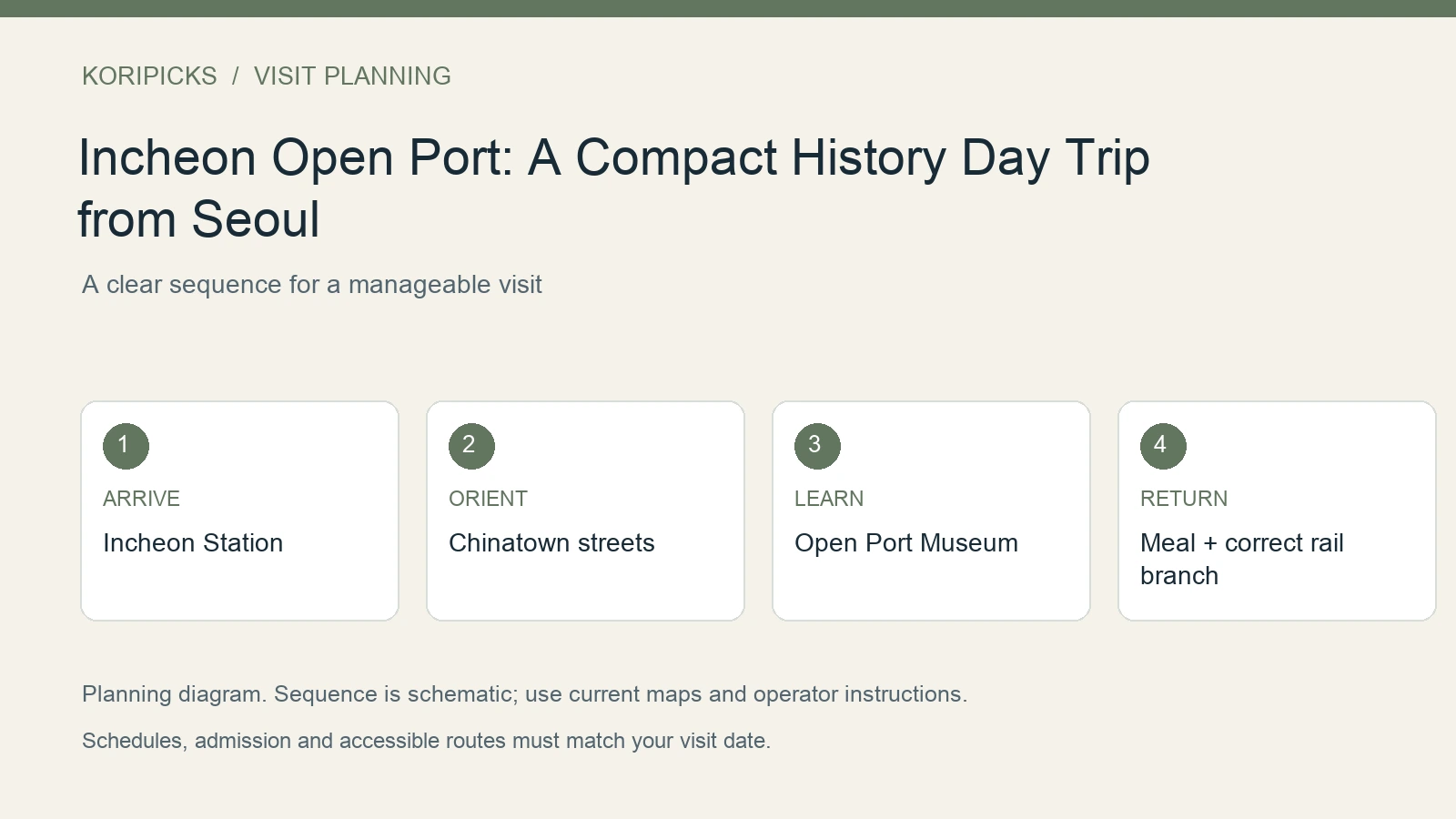
Incheon Open Port makes a straightforward history-focused day trip when you separate it from Incheon Airport and Songdo. Your destination is the older port district near Incheon Station, with Chinatown, historic commercial streets and small museums. It is not the airport terminal area, and adding Songdo turns a compact walking visit into a second transport plan.
Use one museum and one street route as the anchors. A half-day on site, including lunch, is a useful planning allowance. The train journey from your Seoul accommodation is additional, and this guide does not claim a fixed travel time or a recently tested train departure.
The complete old-port walking sequence
Use Incheon Station as the rail gateway, then follow Chinatown → the historic port streets → Incheon Open Port Museum → a meal in the same district → return to Incheon Station. Jayu Park is an optional uphill addition after the meal, not a necessary link in the compact route. Songdo and the airport remain outside this plan.
For a central-Seoul departure, look up Line 1 service specifically bound toward Incheon. The Gyeongin branch is the relevant reference, not a train continuing south toward Suwon. An example starting at Seoul Station can use Line 1 toward the Incheon branch, with any transfer shown by the actual planner. This article does not replace the live destination display or publish an unverified fixed journey time.
At Incheon Station, the Chinatown-side surface exit is the useful orientation point. KTO’s Chinatown food article places its featured Chinatown area near Exit 1. Save 인천 차이나타운 and the actual museum pin before leaving the station, so that the gateway streets become a beginning rather than an open-ended search.
| On-site allowance | Part | What it contributes |
|---|---|---|
| First 30–45 minutes | Chinatown streets | Orientation and the neighborhood’s contemporary commercial life |
| Next 45–60 minutes | Open Port Museum and nearby historic streets | Context for the architecture and port-era change |
| Next 45–60 minutes | Meal in the same district | A deliberate seated break without another transfer |
| Optional 30–45 minutes | Jayu Park approach | A hill-side extension only if it suits the group |
| Departure margin | Return to Incheon Station | Correct train branch and journey back to Seoul |
These are suggested blocks, not measured walking times. They deliberately separate the museum from wandering through the streets, because reading labels and finding a building entrance take time that a distance-only map does not count.
A museum stop that explains the streets outside
The Open Port Museum occupies a former bank building. Begin by looking at the exterior and entrance arrangement, then use the museum’s display to understand what changed after the port opened. A building’s present cultural use and its earlier commercial purpose are different layers of the same site.
After the museum, choose a short adjacent street section and compare scale, façade rhythm and doorway placement. Do not describe every decorative feature as surviving from the same historical period. The district contains original fabric, later alteration and current tourism-oriented presentation.
A useful visit alternates between evidence inside and observations outside. That makes the walk more than a food stop, while avoiding a long list of buildings you see only from the pavement. The current KTO museum listing gives the address, fee, visitor hours and the linked local operator.
Use the actual admission window
The museum listing displays 09:00–18:00, last admission 17:30, with Monday and specified holiday closures. Its ordinary individual adult charge is KRW 500. If your train reaches the area late, the museum should come before an extended lunch rather than after it.
The last-admission time is a limit, not a recommendation. A hurried entry shortly before closure gives you little opportunity to connect the exhibits with the streets. Arrive early enough to read selectively and retain the outdoor portion as the flexible block.
If the museum is closed on your selected date, decide whether a street-and-meal visit still justifies the rail journey. Do not describe the full museum-led plan as available simply because Chinatown restaurants remain open.
Lunch without pretending to have tested a restaurant
Chinatown’s jajangmyeon association gives lunch a clear regional theme, but a dish reputation is not a current review of every restaurant. Choose one business using its own menu and opening information, then keep an alternative nearby. The bill should reflect the actual noodle dish, shared side and drinks you choose.
For two diners, decide whether you want two individual dishes or one shared addition as well. Check portion size before ordering a large shared plate. For dietary needs, ask about sauce, stock and toppings rather than assuming a vegetable-looking noodle dish contains no meat.
The meal should finish in the district where the walk takes place. Adding a restaurant across Incheon creates another journey and undermines the compact-plan advantage. If your first choice has a long queue, choose the alternative instead of allowing lunch to consume the museum’s admission window.
The optional hill and the definite end
Jayu Park can add a landscape and viewpoint dimension, but inspect its approach before taking a group uphill. A tired arrival-day traveler or a group with unsuitable footwear can omit it and still complete the old-port visit.
The final fixed point is Incheon Station. Before leaving the restaurant, save the return route, any transfer and the destination direction. If the trip ends with an evening appointment in Seoul, keep the optional park outside the schedule until you know the return margin is comfortable.
This version has a beginning, a museum, a meal and an ending. It is a separate day from Songdo’s modern landscape or an airport stopover, and it can stand on its own without attempting all of Incheon in one afternoon.
Start the walk with the port story
A manageable sequence is Incheon Station → Chinatown entrance and streets → Open Port Museum → nearby historic streets → lunch or a return toward the station. This is an editorial route, not an official guided circuit. Use the current map to decide the precise connections.
The KTO Open Port Museum listing identifies the museum as occupying a former bank building and displaying objects associated with the port’s opening. That gives the street architecture context rather than reducing the district to decorative façades.
Read the museum’s labels before judging the nearby streets as a single period or a single national style. Port districts contain different layers of commerce, occupation, adaptation and later tourism. A colorful shopfront may be current retail decoration rather than preserved nineteenth-century fabric.
Museum hours and a small but real admission charge
The current KTO listing gives the Open Port Museum hours as 09:00–18:00 with last admission at 17:30. It lists Monday and specified New Year and Chuseok holidays as closures. Individual adult admission is shown as KRW 500.
The address is 89 Sinpo-ro 23beon-gil, in the currently listed Jemulpo-gu district. Save the building pin and Korean name; administrative names can differ from older guidebooks. The listing links to the local cultural foundation, which should resolve a special closure or program change.
A low admission fee does not make the museum optional if it is the reason for your trip. Check the open day before taking the train. If it is closed, decide whether a street-only visit still meets your interests rather than arriving and inventing a substitute indoors.
Decide whether to climb toward Jayu Park
Jayu Park can be an additional hill-side stop, but it changes the walking effort. Look at the elevation and route before adding it for everyone in the group. A district described as walkable can still contain slopes and stair routes.
For a lower-effort version, stay with the station, Chinatown streets and museum area, and omit the climb. For a longer visit, add the park only after a rest and only when the weather and shoes suit it. Avoid planning a steep detour simply because the viewpoint appears next to Chinatown on a tourist map.
KTO’s Wolmi tourist-zone overview helps distinguish nearby attractions. It does not mean Wolmido, the park, the museum and every historic street fit comfortably into one short walk.
Rain and return plans
The museum is an indoor anchor, but the rest of this route is mainly outside. In heavy rain, reduce the street walk and verify that your chosen restaurant can provide a seated break. Do not count decorative covered entrances as public shelter.
Before leaving lunch, open the return train route and confirm the destination of the train you need. If you have a same-evening appointment in Seoul, retain a buffer instead of adding Songdo or Wolmido at the last minute.
For a different rail day trip, our Seoul day-trip comparison weighs Incheon against Suwon and Chuncheon. The strongest version of this outing is compact: one district, one museum, one meal, and a return you have already understood.