
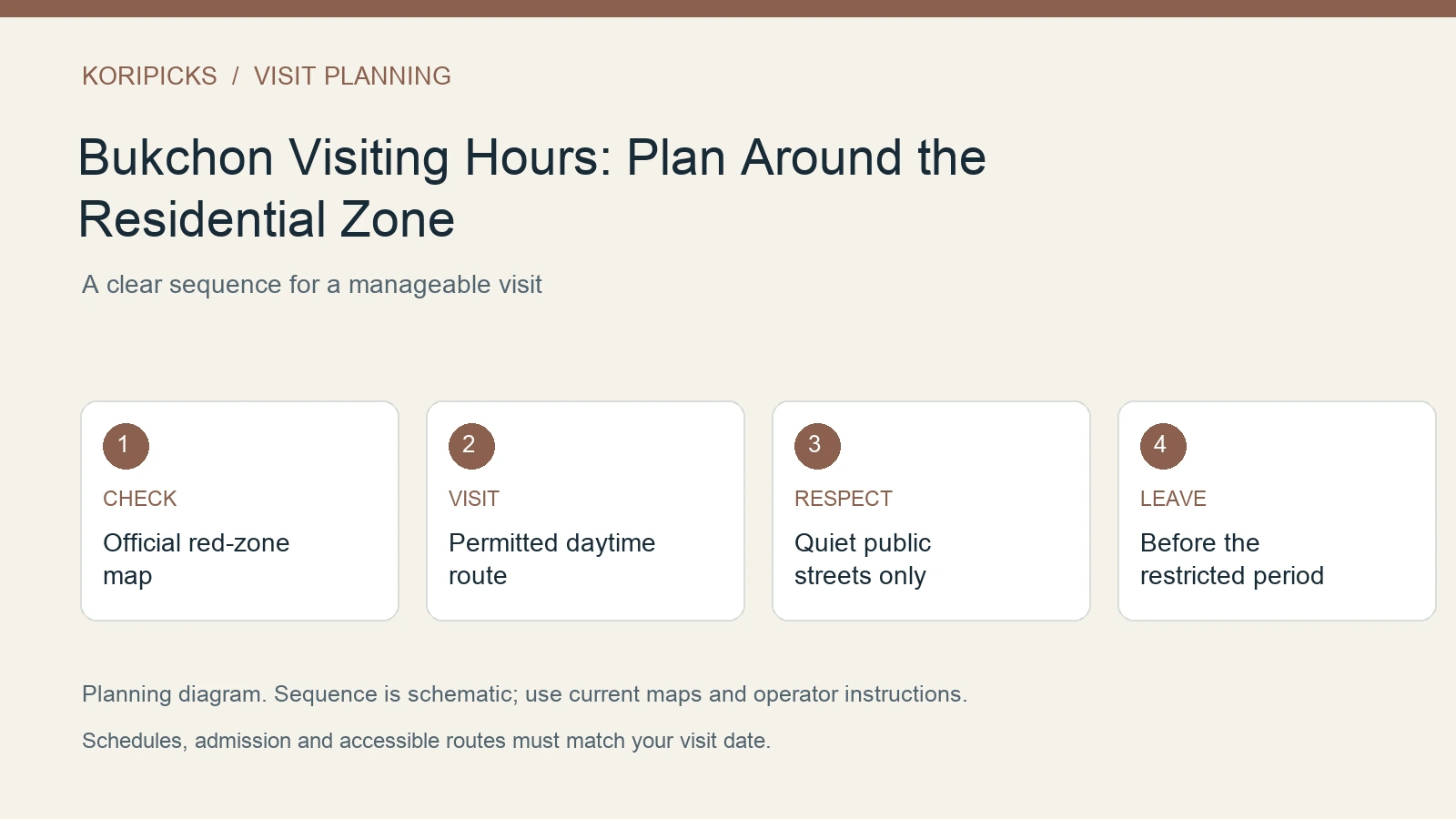
Bukchon is a residential neighborhood with visitor restrictions, not an attraction you can freely photograph at any hour. The practical first decision is whether your intended route enters the designated red zone. A general pin for “Bukchon Hanok Village” is not precise enough to answer that question.
Plan a short daytime visit, keep voices low, and choose a public cultural stop or café as the second part of the outing. Do not plan sunrise or late-evening photography in the restricted residential area simply because an older itinerary recommends it.
Use a public cultural destination before the residential lanes
Begin at Anguk Station and go first toward Bukchon Cultural Center at 37 Gyedong-gil. The city’s hanok information page identifies that address as a public reference point for the neighborhood. It is a better orientation anchor than a private doorway copied from a photo post.
From the cultural-center area, choose a permitted public route using the official zone map. Keep the residential section short, then return toward a commercial or public cultural destination outside it. This gives the visit a sequence: station → public orientation stop → permitted daytime streets → rest → departure.
The cultural venue and the red-zone boundary are separate things. A center being open does not authorize sightseeing in a restricted residential lane at another hour. A venue closure also does not mean the entire broader Anguk district closes on that day.
| Part | Specific planning task | Why it helps |
|---|---|---|
| Arrival | Save Anguk Station and 37 Gyedong-gil separately | The venue pin finishes the station journey |
| Orientation | Open the actual official zone map | A general Bukchon pin does not identify a boundary |
| Residential walk | Select one permitted public street section | Keeps the visit selective and quiet |
| Rest | Return to a named public venue or commercial stop | Avoids using private steps or doorways as seating |
| Departure | Leave the restricted section before its cutoff | Prevents an evening photo plan from conflicting with visiting hours |
The table is a planning sequence rather than a certified accessible route. The streets have gradients and varying surfaces, so the exact path should fit the people in your group.
A daytime version with room for culture
Start after the permitted daytime window opens if the red-zone section is part of your route. Allow a brief orientation stop, around 30–45 minutes for a selective residential streetscape walk, and a separate block for the cultural venue or café. Those are editorial allowances, not an official neighborhood tour.
Choose the streetscape for what you can see respectfully from public space: rooflines across a slope, the relationship between lane and wall, and gates opening onto narrow streets. You do not need to enter a private courtyard or photograph a resident to understand the architecture.
When a popular viewpoint is crowded, retain the quiet-visit objective and leave the bottleneck. The purpose is a considerate cultural outing, not obtaining an empty street photograph at the expense of the people living there.
How to pair the route with a palace
For Gyeongbokgung, keep the palace as a separate morning block and use the actual exit and surface connection toward your Bukchon destination. For Changdeokgung, protect a confirmed garden session first and give the neighborhood a flexible block afterward only if the visiting window still fits.
Do not assume a palace’s evening grounds hours extend the residential sightseeing window. They are different operators and different types of space. If the remaining time is too short, use a public cultural destination or commercial street outside the restricted route instead.
A two-attraction plan is better when it has a real break between them. Choose lunch before the neighborhood walk, carry water, and avoid treating steep residential lanes as a hurried connection between two fixed bookings.
A meaningful visit without entering the red zone
A public hanok cultural stop and a short permitted surrounding walk can still form a complete visit. This is useful for someone with limited time, a group that prefers fewer hills, or a day when the residential streets are congested.
Use the official map to keep the route in permitted public areas. Do not describe a lane as exempt merely because it looks quiet or because another tourist enters it. The goal is a clear cultural experience with an address, a public route and a respectful ending.
The restriction to check before walking uphill
The Seoul Metropolitan Government notice identifies the red zone around Bukchon-ro 11-gil. It restricts tourist visits from 17:00 until 10:00 the following day and lists a KRW 100,000 fine. The notice distinguishes this from other management zones and from separate charter-bus restrictions.
Use the official English neighborhood map to see the boundary. The restriction is not a statement that every street in the wider Anguk or Samcheong area is closed at the same time. Conversely, an open nearby business does not automatically authorize a sightseeing detour through the restricted zone.
This is a summary of published visitor guidance, not individualized legal advice. Current posted signs and Jongno’s operator guidance should resolve a changed boundary or specific access situation.
A respectful visit has a time limit
| Stage | Suggested approach | Avoid |
|---|---|---|
| Arrival | Start near Anguk and open the official zone map | Following a photo pin without checking its street |
| Residential section | Keep to permitted daytime paths | Blocking doorways or gathering as a large noisy group |
| Rest | Move to a public cultural venue or commercial street | Treating private steps as seating |
| Departure | Leave the red zone comfortably before 17:00 | Planning your last photograph at the cutoff |
Allow roughly an hour for a selective neighborhood walk, with extra time for a cultural venue or café. That is an editorial allowance rather than a measured route duration. A shorter visit is preferable if the streets are congested or your group cannot keep a quiet pace.
Start from Anguk, then choose a specific route
Save 안국역 as the subway starting point and 북촌로11길 only if your permitted route actually includes that street. Anguk Station on Line 3 is useful orientation, but the station name alone does not tell you where the red zone begins.
Choose the first cultural stop and the final café before climbing into residential streets. This keeps the walk purposeful and reduces the temptation to wander into every picturesque lane. If your map app sends you toward a private-looking passage or a posted restriction, use the signed public alternative.
The neighborhood contains hills. For a stroller or wheelchair user, compare the route gradient, crossings and entrance access, not merely the straight-line distance from the station. If the residential section is unsuitable, a public venue closer to the main streets can still provide a meaningful visit.
What to look at without intruding
From a permitted public street, notice how rooflines follow the slope and how walls and gates mediate between house and lane. These observations help explain why the area feels different from a palace courtyard or a purpose-built tourist complex.
Keep the camera pointed toward the public streetscape rather than through windows, over walls or into private courtyards. A resident opening a gate is not an invitation to photograph the interior. Do not ask someone to move away from their own doorway for your composition.
One or two carefully framed street views are enough to record the visit. Repeatedly stopping a group across a narrow lane can make the neighborhood harder to use for residents and other pedestrians. If the popular viewpoint is crowded, continue rather than creating a second queue beside someone’s house.
Choose a public cultural stop as the anchor
Use the Seoul hanok information portal to identify publicly accessible cultural spaces and current programs. A public venue supplies opening hours and an access arrangement; it is different from an attractive private house that happens to appear on a map.
Check the exact venue’s day and reservation conditions. A workshop, exhibition or guided activity may need a separate booking, and a commercial hanok café may require a purchase. This guide does not guarantee walk-in entry to every named building in the neighborhood.
The cultural stop can replace part of the residential walk when it is raining or when crowding makes photography unpleasant. That gives the visit a clear purpose beyond collecting a familiar roofline image.
Pairing Bukchon with a palace
If you visit a palace first, do not assume Bukchon remains available afterward at any hour. The palace may have longer grounds hours than the residential red zone. Treat the two access windows as separate constraints.
A reasonable sequence is a morning palace, lunch, then a short permitted Bukchon visit that finishes well before the restriction. Another is Bukchon after 10:00, a cultural stop, and a separately confirmed afternoon palace visit. Neither sequence should involve rushing up hills immediately before the cutoff.
Our neighborhood comparison helps keep central districts connected sensibly. The palace and museum alternatives are useful if weather makes an outdoor residential walk a poor choice.
Sunset alternatives outside the residential red zone
If your main goal is an evening photograph, choose a public square, a permitted palace session, or another public-space route with confirmed access. Do not simply relabel a Bukchon residential photo stop as a “quiet evening walk.” The same visitor restriction still applies to sightseeing there.
For a late afternoon in the broader district, select a commercial destination outside the restricted residential route and navigate directly to it. Check its actual opening time. The presence of a restaurant nearby is not a reason to make an additional prohibited detour.
Before leaving your accommodation, save the zone map, the cultural venue address, a return station, and the time by which you will leave the residential section. Those four items make this a considerate visit with a clear end rather than an open-ended search through people’s living streets.