
Seoul’s official guided walking tours are a useful alternative to an expensive general sightseeing package when you want interpretation of one area. The guiding service is free, but palace admission and optional cultural experiences may still cost money. The main logistical challenge is securing the correct course, date and language, then finding its actual meeting point.
Choose a tour because its subject interests you, not because “free” makes every route interchangeable. A city-wall course, a palace course and a modern architecture course ask different things of your stamina, schedule and admission budget.
A real course example: the central Cheonggyecheon walk
The official Cheonggyecheon course page publishes a two-hour route beginning at Gwanghwamun Station Exit 5. Its listed sequence includes Cheonggye Plaza, Gwangtonggyo, Samilgyo, Supyogyo, Saebyeokdari and Gwangjang Market. This is a named course with a meeting point and an ending, not a general invitation to find a free guide near the stream.
Choose it when urban transformation and a central-Seoul walk interest you. The stream setting and market ending can fit a larger day in Jongno, but optional museum programs and meals are separate activities. A tour ending near food does not mean lunch is included in free guiding.
Use the current booking and confirmation for the actual date and language. The published course describes the route; it does not establish that a guide place remains available on the day you want.
| Reservation item | What to record for the selected course | Avoid confusing it with |
|---|---|---|
| Course | The actual Cheonggyecheon course name | A similarly named independent night walk |
| Start | Confirmed time and meeting instruction | General station opening or an attraction’s hours |
| Meeting | Gwanghwamun Exit 5 if that remains in your confirmation | Any exit carrying the Gwanghwamun name |
| Finish | The course ending and onward journey | A promised included meal or transport back |
| Language | The booked session language | A guide translating every listed language simultaneously |
A booking workflow from selection to a useful confirmation
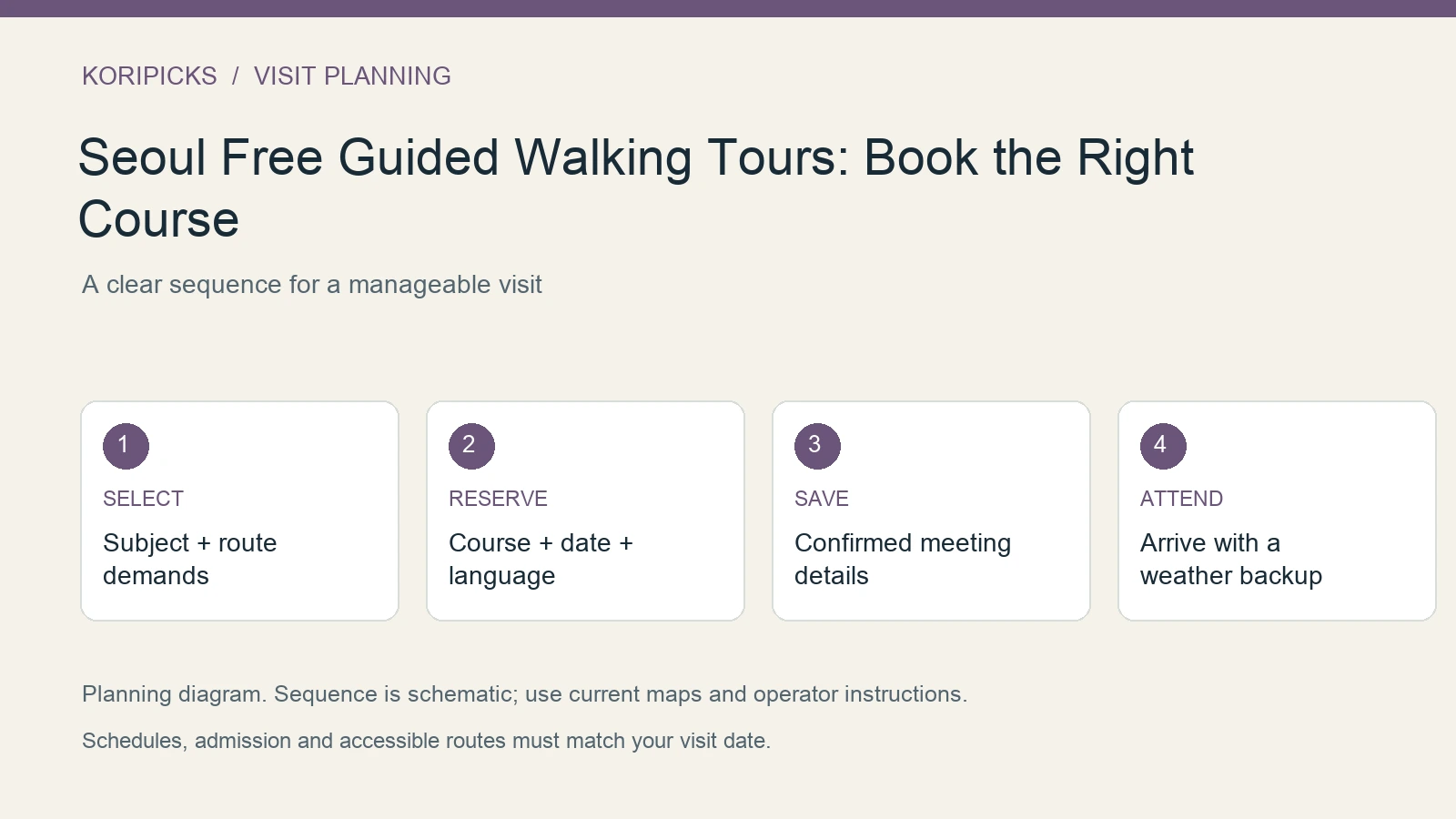
First choose the subject and route. Next select the actual date and language session. Enter the legitimate visitor and contact details required by the current form, then review the course, party size and meeting arrangement before completing a booking.
Afterward, retain the confirmation and any follow-up status. If the operator still needs to assign or confirm a guide, do not treat the timetable as a secured appointment. Use the official viewing or cancellation function when you need to inspect the record.
The workflow described here identifies the decisions to resolve; it is not a claim that KoriPicks has tested a current transaction. Interfaces and contact verification can change. A particular foreign phone number or card should not be declared usable without the actual process establishing that result.
Choose City Hall for a different architectural subject
The Tong-Tong City Hall course page describes a route through the City Hall establishment and Seoul Metropolitan Library, with a distinct timetable for reservations and on-site participation. It suits visitors interested in civic architecture and the former and current administrative buildings.
Treat its listed access as part of that program. A guided itinerary through a building does not establish that every office floor is freely available for independent wandering. Use the actual session, meeting place and participation rules.
The City Hall and stream courses have different purposes and durations. Choose one that fits your interests rather than reserving whichever free slot happens to appear first. A focused subject will make the guiding more valuable than a route you join only to fill time.
Build the meal and next journey around the ending
For a course ending at a market or another district, choose lunch there or save a direct return route. Do not book a fixed meal across the city immediately after the nominal tour duration. Questions, group movement and the final street connection need margin.
If a guide session is unavailable, an independent version can still use the public landmarks when access and weather permit. Keep that status clear: a self-guided route is an alternative outing, not a confirmed official tour. This gives the day a workable fallback while respecting the operator’s limited places.
What the free offer covers
The Seoul Tourism Organization’s general information page describes a volunteer-led, multilingual walking program. It distinguishes free guiding from separately paid palace entry and experience fees. It also states that ordinary reservations should be made at least three days ahead and that guide availability can limit booking.
Those details explain why a calendar slot is not the same as a guaranteed guide. Use your confirmed reservation as the operational record. This article has not completed a booking or verified that a particular date or foreign phone number is accepted by the current form.
Select the course before selecting the time
| Interest | A useful course type | Check carefully |
|---|---|---|
| Palace history | Palace route | Admission charge, closure and meeting gate |
| Traditional neighborhood | Hanok or village route | Resident restrictions and slopes |
| Urban transformation | Stream or regeneration route | Path closures and outdoor exposure |
| Buildings and design | Architecture route | Interior access and current program |
| Lower mobility demands | Specifically described accessible course | Accompaniment and earlier reservation rules |
Use the official current course directory to choose. Do not infer that a tour is easy because it covers a familiar neighborhood. Elevation, stairs and standing time matter more than the attractiveness of the destination photographs.
Pick one course as your first choice and one alternative that truly fits your interests. Reserving an unrelated route only to obtain a free booking can use a limited place without delivering the experience you wanted.
Build the day around one fixed meeting
Treat the tour start as a fixed appointment. Lunch, shopping and another attraction should fit around it with generous travel margin. Do not place a restaurant reservation immediately before a course in another district and assume the subway ride is the only time involved.
Save the meeting point from the confirmation, including the station exit or building entrance and the guide’s identifying instructions. The attraction name alone is insufficient: a palace can have several gates, and a large station can have exits facing different streets.
Plan to arrive early enough to orient yourself and use a toilet before meeting. The exact buffer should reflect your journey; around 15–20 minutes at the meeting area is a sensible editorial allowance, not an official rule for all tours.
Keep reservation and contact details together
Record course name, language, date, start time, meeting point, booking reference and the operator contact in one offline note. Add the accommodation address and return route. A screenshot of a course description without the date is not a useful reservation record.
After submitting the actual form, inspect the confirmation and any follow-up email. If the operator says confirmation is pending, do not describe the tour as secured. If you cannot find a completed booking, use the official viewing or cancellation function or contact the walking-tour office.
The general information page lists walkingtours@sto.or.kr and +82-2-6925-0777 as the office contacts. Use those for program questions rather than sending personal booking information to an unofficial guide account found in search results.
Foreign visitor questions worth asking
Check whether the selected session’s language matches your booking and whether every person in the group is eligible to join it. A multilingual program does not mean one guide will translate simultaneously into every listed language.
If you cannot receive the current form’s verification message, use the official office contact. Do not substitute a stranger’s identity or assume a hotel phone number can receive the confirmation without the hotel’s agreement.
For a group with children, inspect the accompaniment rule and expected route. For mobility needs, choose the operator’s specific accessible course information and explain the actual requirement before booking. The directory’s general availability does not guarantee an accessible substitute on arrival.
Weather and cancellations belong in the plan
The operator’s published reservation information describes cancellation in weather-warning conditions. A route that is pleasant under ordinary rain may still be canceled for a warning involving heat, storms or other hazards. Check the current notice on the visit day.
Have one independent indoor alternative in the same broader area. It should be a venue with confirmed opening, not a vague assumption that you can enter a café or museum somewhere nearby. Our rainy-day guide can help identify an anchor.
If you cannot attend, use the official cancellation instructions promptly. A free session still consumes a guide’s time and a limited reservation place. Do not simply miss the meeting because the payment amount was zero.
City Hall’s program has its own timetable
Some named programs have specific arrangements beyond the general walking-tour pattern. The Tong-Tong City Hall tour page, for example, publishes a distinct reservation and on-site participation schedule.
That is a reason to read the actual selected course rather than applying the general timetable to everything in the directory. An on-site English session mentioned for one program does not imply walk-in English guiding at every palace or neighborhood.
If your schedule is too short for an advance reservation, inspect a currently operating on-site option and keep an independent walk as the fallback. Never present a walk-in place as guaranteed merely because a historical FAQ once described it.
Make the guided time worthwhile
Prepare one or two questions tied to the place: how its use changed, why a building faces a particular direction, or how a restored feature differs from original fabric. Those questions make a small-area tour more rewarding than asking the guide to cover all of Korea’s history.
Follow the group pace, keep space on narrow paths, and ask before leaving early. Afterward, choose one nearby meal or independent stop rather than another fixed tour immediately across the city.
Our weekend planning workflow helps distinguish confirmed programs from discovery listings. The reliable outcome here is one chosen subject, one confirmed session, and a day that leaves room to enjoy it.