
The easiest way to improve a Seoul photo outing is to decide what should be in the frame before choosing a station. DDP supplies building form. Seokchon Lake gives water and a tall skyline. Seoul Forest offers trees and paths. Seonyudo brings planting into the remains of a water-treatment facility. Those differences are more reliable than a promise that any famous place will be uncrowded.
Choose one of these four settings for a deliberate session. They sit in different parts of the city; combining all four turns a photography idea into a transport day. The suggestions below concern composition from permitted public areas. They are not surveyed camera positions or reports of a recent shoot.
Pick the background, then the amount of walking
| Setting | Useful visual subject | First composition to try | Reason to change the plan |
|---|---|---|---|
| Dongdaemun Design Plaza | Curves, panels and people for scale | A person separated from the building’s edge | An event has restricted your chosen public area |
| Seokchon Lake | Water with the Jamsil skyline | A clear foreground and the tower beyond it | Wind or glare makes the intended water effect unworkable |
| Seoul Forest | Paths, trees and changing foliage | A path leading toward a subject rather than cutting through them | Weather or an event makes the chosen section unsuitable |
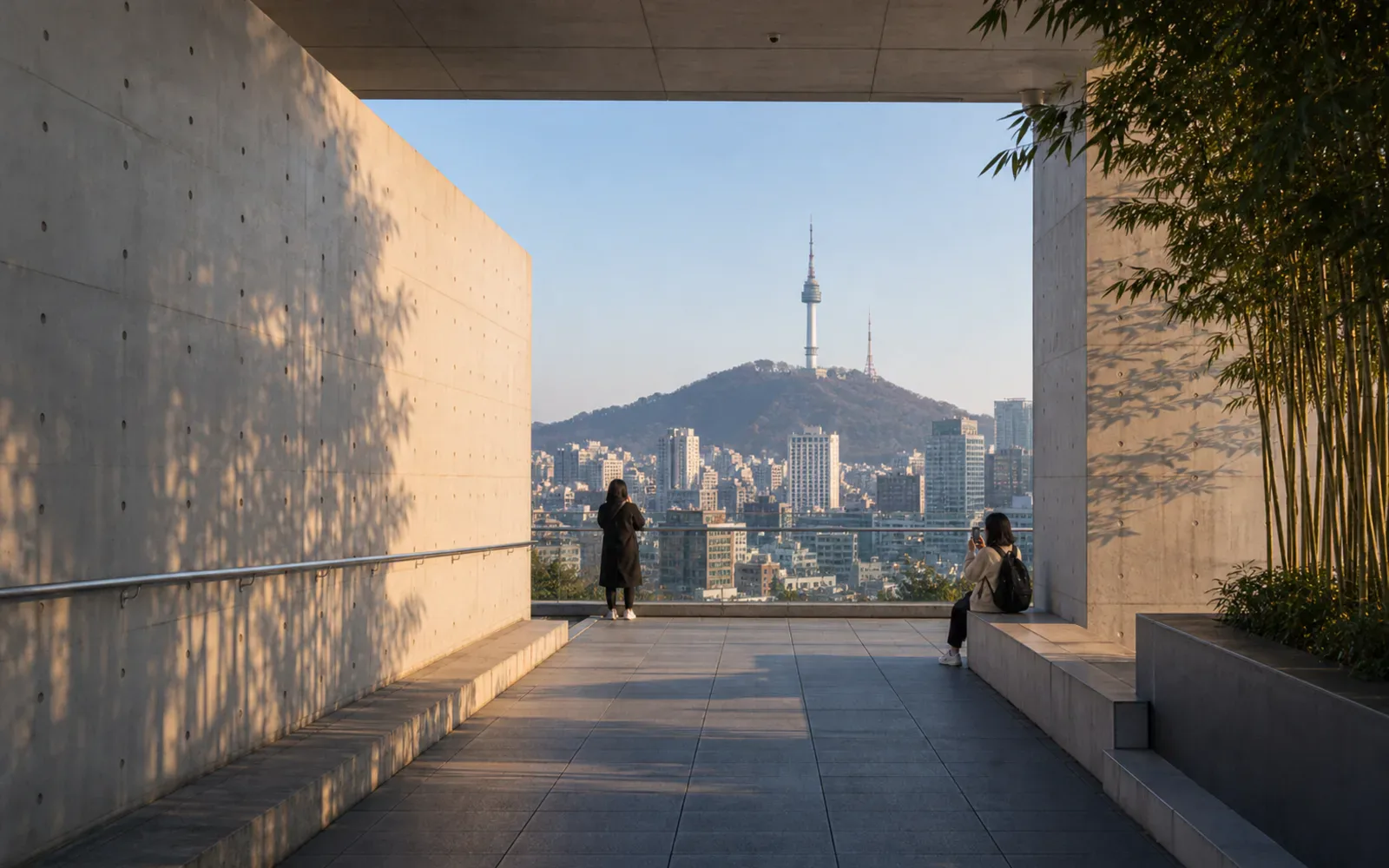
| Seonyudo Park | Concrete structures, planting and river surroundings | One structural opening framing vegetation | The exposed approach is uncomfortable or a route is closed |
DDP: photograph the shape without needing an exhibition
Dongdaemun Design Plaza is at 281 Eulji-ro. Visit Seoul identifies Dongdaemun History & Culture Park Station on Lines 2, 4 and 5, with Exit 1 as an approach. Its official location page describes the cultural complex and distinguishes individual spaces and programs. A public-space architecture visit is different from buying admission to an exhibition.
Begin with one view of the curved exterior from a permitted public approach. Before taking a portrait, look at where the building outline crosses the person’s head and shoulders. A small change in your own position can separate the subject from a distracting edge. For an architecture-only photograph, compare a wider view that shows the building’s relation to the square with a closer view of panel lines and changing reflections.
Make the camera adjustment before asking someone to stand in place. That reduces the time a companion spends posing and the chance that you block a moving pedestrian route. A stair or ramp is circulation space, even when it creates an attractive diagonal in the picture.
Do not arrive expecting a particular Seoul Light projection, installation or branded sign from an old image. Temporary programs need their own date and access check. Our DDP visit plan separates architecture, exhibitions and timed events.
Seokchon Lake: work with water rather than expecting a mirror
Seokchon Lake is the appropriate choice when the desired subject is a Jamsil tower-and-water composition. The official lake page identifies the park, its lakeside setting and a designated Photo Island. Use that location information to orient yourself; the actual public path and signs decide where you can stand.
Start with the part of the lake that gives a clear view of the skyline you want. Look for a foreground that adds depth without filling half the picture with an unrelated railing. On a calm day a reflection can be part of the composition. With moving water, use the ripples as texture instead of waiting for a perfect reflection that conditions are not producing.
A tall building presents a phone-camera choice: keep the phone more level and include less foreground, or tilt upward and accept converging verticals. Try both before deciding that the lens has failed. For a portrait, take a wider version that includes the setting and a closer version that gives the person more space in the image.
Cherry-blossom season and event days can change the atmosphere dramatically. A lakeside loop is not proof of an empty background. If people remain in the frame, choose a composition that accommodates public life or wait without taking over the path. There is no need to complete both lake sections to make a short photo stop worthwhile.
Seoul Forest: choose a path, not a seasonal promise
The official Seoul Forest listing places the park at 273 Ttukseom-ro. Choose it for a wooded urban-park background and combine it with the surrounding Seongsu outing only if that suits the day. The presence of trees is dependable; a particular blossom, autumn color or unoccupied bench is not.
Find a public path where the direction of the walkway supports the picture. For a portrait, keep the subject on the accessible path rather than stepping into planting to manufacture a forest scene. Try moving yourself so the background is farther behind the person. That often produces a cleaner result than changing the pose repeatedly.
In bright sunlight, compare an open patch with an evenly shaded position. Avoid a face crossed by alternating patches of strong sun and shadow unless that pattern is intentional. Under overcast skies, look for separation through color and distance rather than expecting dramatic shafts of light.
Photograph one small section carefully and then continue the visit. The park-first half-day route provides an actual surrounding plan; this article is about choosing and using the visual setting.
Seonyudo: let the old structure explain the garden
Seonyudo’s reused water-treatment structures are the reason to travel here rather than simply choosing the nearest riverbank. The city’s park introduction explains the ecological transformation, while its location information gives 343 Seonyu-ro and Seonyudo Station Exit 2 on Line 9 as an approach.
Look for one contrast: a hard concrete boundary against leaves, a repeated structural shape interrupted by planting, or an opening that frames part of the garden. Start with a wide image that explains the relationship, then make a detail picture. That pair tells a clearer story than several disconnected close-ups of leaves.
Remain on open paths and keep out of planted or water-treatment features that are not visitor routes. If a favored position is occupied, choose another angle. The landscape has more visual possibilities than a single copied photo, and waiting beside a narrow passage can make the visit worse for everyone.
Leave with a small, coherent set
A useful set might contain an establishing view, a person or object that shows scale, and one detail. Review those three images before leaving the location. Check focus, unwanted edge intrusions and whether the subject is actually visible on the screen. Correcting one problem while you are still there is more useful than collecting dozens of nearly identical frames.
For night scenes rather than these daytime settings, use the separate Seoul night-view comparison. It accounts for slopes, access services and the return after dark.
Primary location information checked October 17, 2026. Composition suggestions are KoriPicks editorial guidance. No crowd levels, lighting measurements, drone permissions or current on-site conditions were tested.