
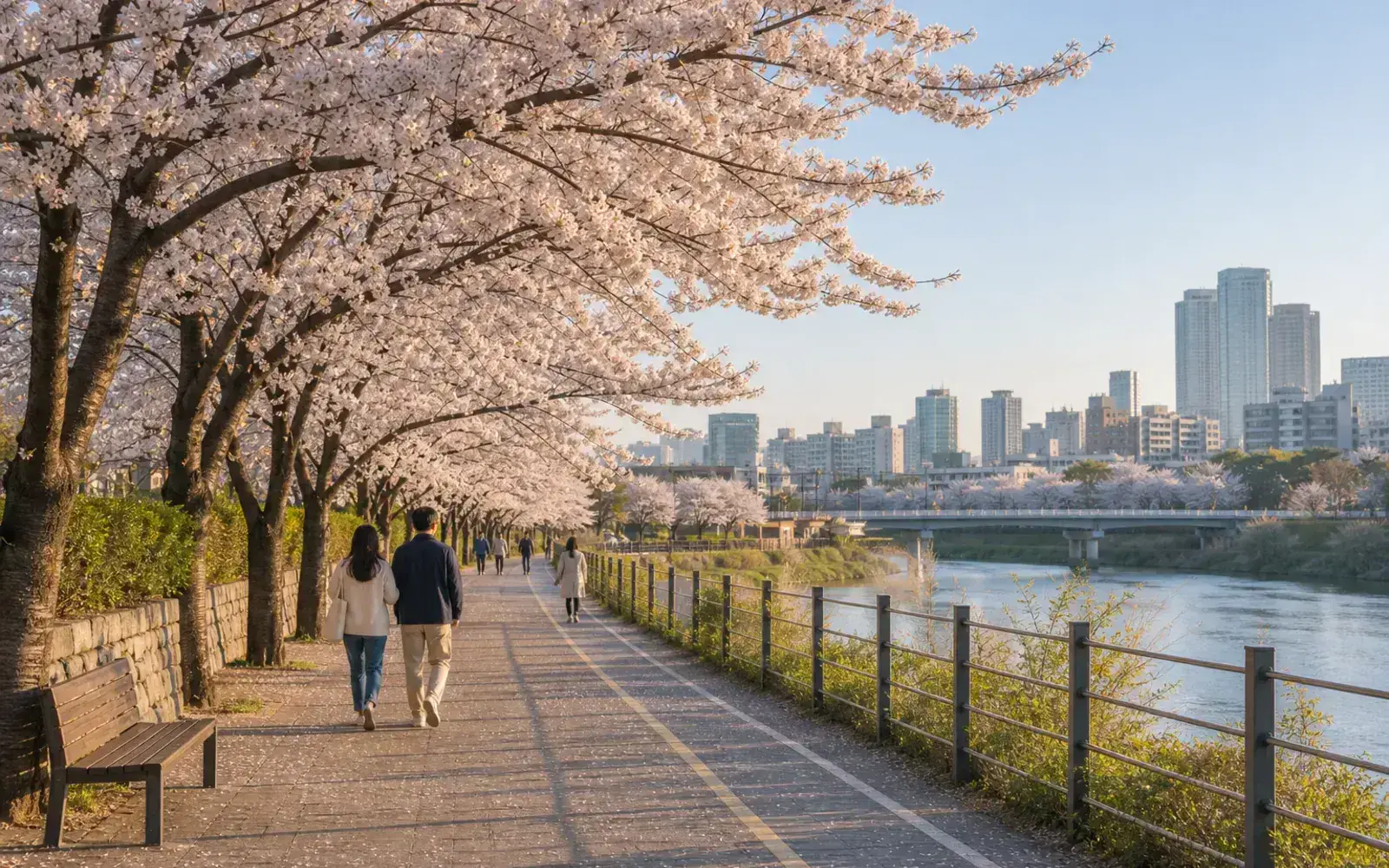
Desk-researched and fact-checked October 17, 2026. Korea’s 2026 cherry-blossom season has finished. The official pages linked here provide useful destination evidence and past examples; they do not establish 2027 flowering dates or festival schedules. For a spring 2027 trip, choose a flexible base now and commit to a blossom excursion only when that year’s announcements and conditions are available.
Separate the flowers, the festival and the journey
Three clocks determine whether a blossom day works. Trees flower according to conditions. Organizers schedule performances, traffic control and special access. Trains and hotels follow their own availability. An advertised festival can run before or after the most photogenic period, and a peak-bloom forecast does not reserve transport.
Choose which part matters most. If you want an ordinary walk beneath flowering trees, remaining in Seoul may be enough. If you want Jinhae’s festival program or a particular landscape, give the regional visit its own travel allowance. Do not buy a long nonrefundable journey solely because a previous year’s calendar used the same weekend.
Four destinations with different reasons to go
| Destination | What distinguishes it | Best planning use | What still needs confirmation |
|---|---|---|---|
| Yeouido Yunjung-ro, Seoul | A concentrated cherry-tree road near the Hangang | A city blossom outing without an intercity journey | Current access, festival traffic controls and flowering |
| Seokchon Lake, Seoul | A lakeside walk in the Jamsil area | A partial lake walk paired with a Jamsil day | Event arrangements and which shore is comfortable to enter |
| Yeojwacheon, Jinhae | A stream-side blossom setting | The main stop for a Jinhae visit focused on walking and views | Local access, crowds and that edition’s lighting/program |
| Gyeonghwa Station, Jinhae | Blossoms beside the former railway setting | A distinct second Jinhae view if local transport permits | Access rules and the time needed between viewing areas |
Korea Tourism Organization’s 2026 spring guide describes Yeouido’s Yunjung-ro blossom road and identifies Yeojwacheon and Gyeonghwa Station as different Jinhae settings. Seoul’s 2026 spring destination guide also names Seokchon Lake. Those location references remain useful even when the accompanying seasonal programs are over.
Yeouido: make the arrival point precise
A pin for Yeouido can mean a large business district, a subway station, a river park or the blossom road. Save Yunjung-ro and the current festival entrance information separately. Select your station using the actual permitted approach, not a promise that one station name always gives the shortest or easiest entrance during an event.
For a simple outing, choose a section of blossom road, a rest and a meal, then leave additional riverside walking optional. The purpose is seeing the trees rather than completing the entire island. If a route becomes too crowded for the group, shorten it at a permitted exit rather than pushing toward a particular photo angle.
Keep the final walk distinct from the subway ride when traveling with a stroller, wheelchair or heavy bags. Event crowd barriers can change the route you would otherwise use. The organizer’s current access map matters more than an old account of which exit another traveler preferred.
Seokchon Lake: one section can be a complete visit
Choose this option when your accommodation or other plans already place you in Jamsil. Start with one accessible lake entrance, walk a manageable section and keep a known route back to street level. A complete circuit is optional. That makes the outing easier to shorten if weather, crowding or tiredness changes the day.
Schedule any paid attraction separately. A nearby tower, theme park or exhibition does not become part of the blossom visit simply because it appears in the same photograph. If blossoms are sparse, the lake setting and a meal can still make the stop worthwhile; if neither interests you without flowers, retain a different Seoul plan instead.
Jinhae: choose an overnight stay for the right reason
The official Jinhae Gunhangje listing records March 27–April 5 for the completed 2026 edition. It describes programs around the city’s naval heritage as well as blossom locations. Those dates are a past example only. A military-area opening or performance available during one edition must not be treated as ordinary year-round access.
Begin a regional plan with Yeojwacheon or Gyeonghwa Station as the main reason to travel. Check arrival into the region, the local transfer, accommodation if needed and the return before adding a second viewing area. A rail ticket to the wider Changwon area does not finish the journey to a stream-side walkway.
An overnight stay can provide a less compressed viewing day, but it does not guarantee better flowering or empty paths. Compare its cost with the value of having more time. Someone with only one spare day in Seoul may get a more satisfying result from a city blossom walk than from a long regional excursion with a fixed return.
Build a decision calendar instead of guessing a peak date
- When selecting the trip: choose the region and keep accommodation terms flexible where practical. Treat historical flowering patterns as context.
- When the current-year program appears: verify the year, venue, access map and the exact activity you want. Save the official notice.
- Before buying the regional journey: check current flowering information and the full local transfer. Confirm the ticket’s change and refund terms.
- On the morning: recheck weather and access restrictions. Decide whether the walk still appeals without a perfect blossom canopy.
A rainy or blossom-light day needs a real alternative
In Seoul, replace the outdoor anchor with an open museum in the same part of the city; our rainy-day guide compares indoor options. In Jinhae, decide whether the confirmed cultural program and historic district still justify the regional travel. Do not substitute another distant blossom destination on the strength of an undated social photograph.
At the trees, stay on permitted paths, keep tripods and queues out of moving pedestrian space, and avoid shaking branches or entering planted areas for a picture. A shorter walk with room to stop is a successful blossom visit. The season is temporary; the plan should allow that uncertainty instead of promising a flowering date no source can guarantee.