
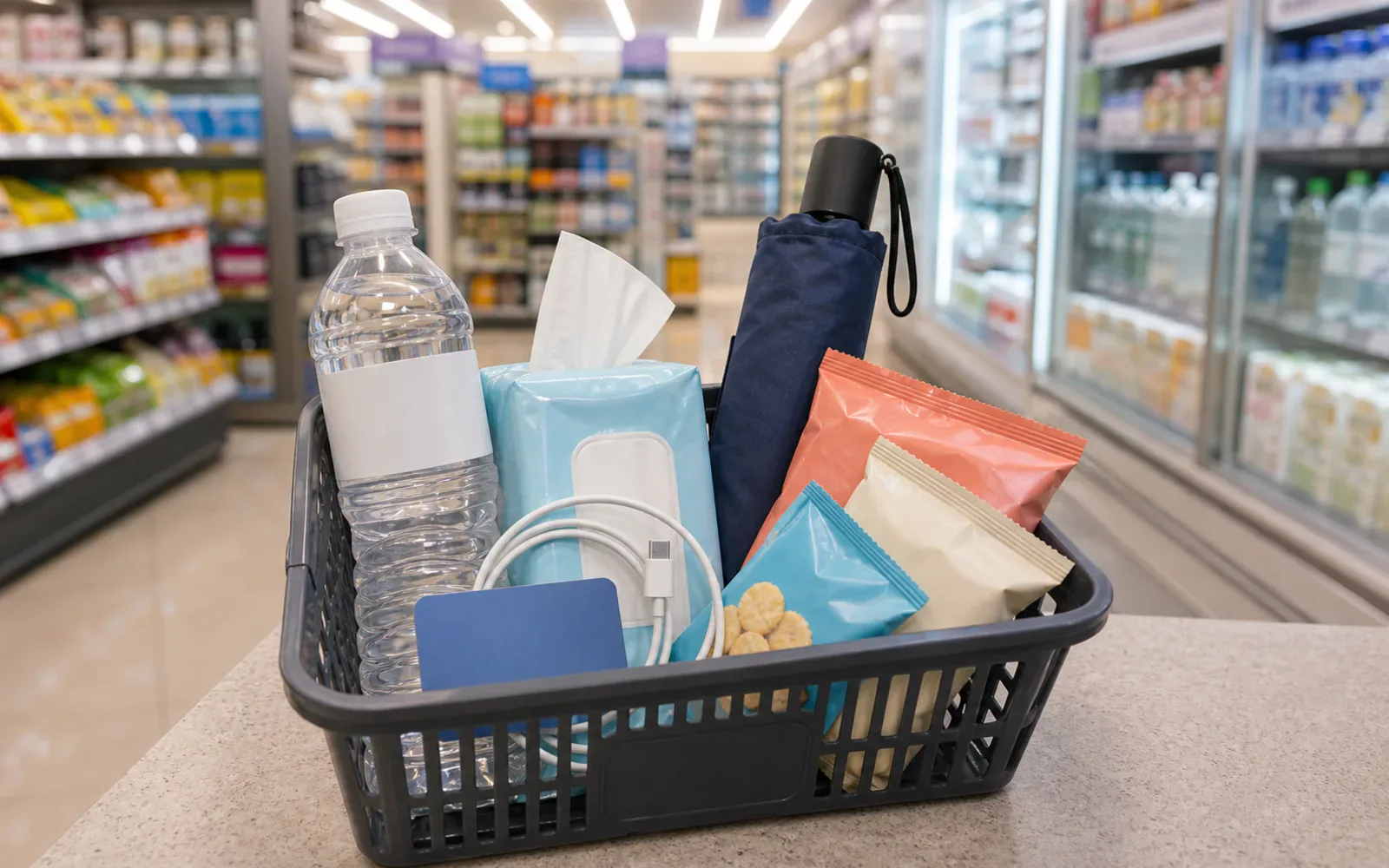
A Korean convenience store can solve several small travel problems, but each service is a separate transaction. Paying for a drink with a bank card does not prove that the same card can top up Tmoney. A visible microwave does not prove there is seating. A parcel-service sign does not mean that an overseas visitor can complete the service without the required account or contact details.
Use this sequence: identify the service you need, confirm that the branch offers it, then pay using the method accepted for that transaction. This guide covers the counter and facilities. For choosing gimbap, lunch boxes and preparation methods, see convenience-store meals and food labels.
Check the branch before collecting items
Look inside the actual location rather than relying on the chain’s general reputation. A branch in a station, office building or small neighborhood space can have different opening hours and equipment from a large roadside store. If your meal depends on heating or sitting down, check the preparation area and any usage notices first.
| What you see | Reasonable next step | Avoid assuming |
|---|---|---|
| Microwave or hot-water area | Read the equipment and food instructions and check that customers may use it. | That every container is microwave-safe or that a table is available. |
| Tmoney logo | Ask whether this branch can perform your purchase, top-up or refund. | That a retail card payment and a transit-card top-up use identical payment rules. |
| ATM | Check international-network logos and the machine’s fee screen. | That it accepts every foreign-issued card or charges the same fee as your bank. |
| Parcel-service equipment | Read registration, destination and contact requirements before making plans. | That it is an international shipping counter or hotel luggage service. |
| Outdoor tables | Check the store’s notices and permitted use. | That they are a public rest area or that every activity is permitted there. |
At checkout: keep the first transaction simple
Bring the products you want to buy to the counter and let the cashier scan them. Present any coupon or eligibility document before payment if its instructions require that sequence. Check the total on the screen before approving the transaction.
If a contactless attempt fails, ask whether inserting the physical card is possible. If that also fails, use an accepted alternative rather than repeatedly attempting the same payment. Carrying a little Korean-won cash gives you another option when a particular card, terminal or service is incompatible. This is a backup recommendation, not a claim that all branches reject foreign cards or that all cards work.
Keep the receipt when you need to check the charged amount or resolve a problem. If the terminal shows a failed payment but your bank app shows a pending entry, ask the cashier whether a completed sale and receipt exist before paying again. A pending authorization is not by itself a store receipt; the merchant and card issuer may need to clarify its status.
Read promotions before expecting the reduced total
A shelf promotion attaches to specified products, quantities and a period. Match the barcode or exact product name and size with the sign. Similar packaging or a different flavor does not necessarily qualify. A “1+1” offer generally means one eligible item plus another under that offer; a “2+1” offer involves a different quantity. Let the checkout establish which items qualify rather than assuming any products in the same aisle can be combined.
Read the small print for membership, app, card or payment requirements. A traveler without the relevant domestic service may still buy the product at its ordinary price. If you only need one item, compare that single-item total with the offer’s required purchase rather than treating extra food as an automatic saving.
Tmoney top-up: show the card and separate the cash
The operator’s foreign-user guide instructs customers to present a Tmoney card and Korean-won cash at top-up locations. It lists convenience-store chains among those locations. For an ordinary physical Tmoney top-up, preparing cash avoids confusing a grocery card payment with a prepaid transit transaction.
- Ask for 티머니 충전, “Tmoney chungjeon,” and show the physical card.
- Indicate the amount to add, not the balance you want the card to show.
- Keep the cash for the top-up separate from money or a bank card used for shopping.
- Wait until the terminal process finishes and check the resulting balance.
Do not treat Tmoney, a Climate Card pass, a mobile transit product and a prepaid tourist payment card as interchangeable. The same operator page directs Climate Card users to separate guidance. Ask for the service belonging to the actual card in your hand.
The operator also explains that a Tmoney balance refund does not return the original card purchase cost and that a service fee applies. Refund options and limits can depend on the channel. If you are about to leave Korea, read the current refund section before loading a large balance you might not use. A branch being able to top up the card is not sufficient proof that it can process every refund request.
Facilities: ask once, then use the posted method
Pay for food before opening or preparing it unless staff explicitly direct another process. Use the preparation instructions on the purchased product. Equipment wattage, hot-water operation and cooking bowls can differ. In particular, a dedicated noodle cooker is different from a microwave; do not improvise a container or fill level.
If a seating area is full or closed, take an appropriate ready-to-eat purchase elsewhere rather than eating in the aisle. A restroom is a separate facility question: a small shop may not have one available to customers, and a building restroom may require directions or access permission.
For trash, follow the branch’s actual signs. Empty liquid only into a designated place; do not pour it into a recycling bin. Separate packaging and food waste as instructed. Where no disposal point is provided, keep the waste with you until an appropriate bin is available.
Three service requests worth preparing on your phone
- 카드로 결제할 수 있나요? — Can I pay by card? Show the actual card if a payment method is uncertain.
- 티머니에 만 원 충전해 주세요. — Please add 10,000 won to Tmoney. This is an example request, not a recommended balance for every trip.
- 여기서 먹어도 되나요? — May I eat here? Useful when there is equipment but no obvious seating policy.
Put the essential information on one screen rather than handing over a long translated paragraph: the requested service, the amount if relevant, and the card or product. If the service cannot be completed, move to a staffed station facility or another appropriate provider. Buying something unrelated does not oblige the branch to solve a different travel task.