
Banpo Hangang Park is easiest to enjoy when the river is the main plan and a fountain or festival is an optional addition. Choose the correct park entrance, leave time for the walk from the subway, and know how you will get back after dark. “Banpo Bridge” on a map can point to the structure rather than the riverside area where you intend to sit.
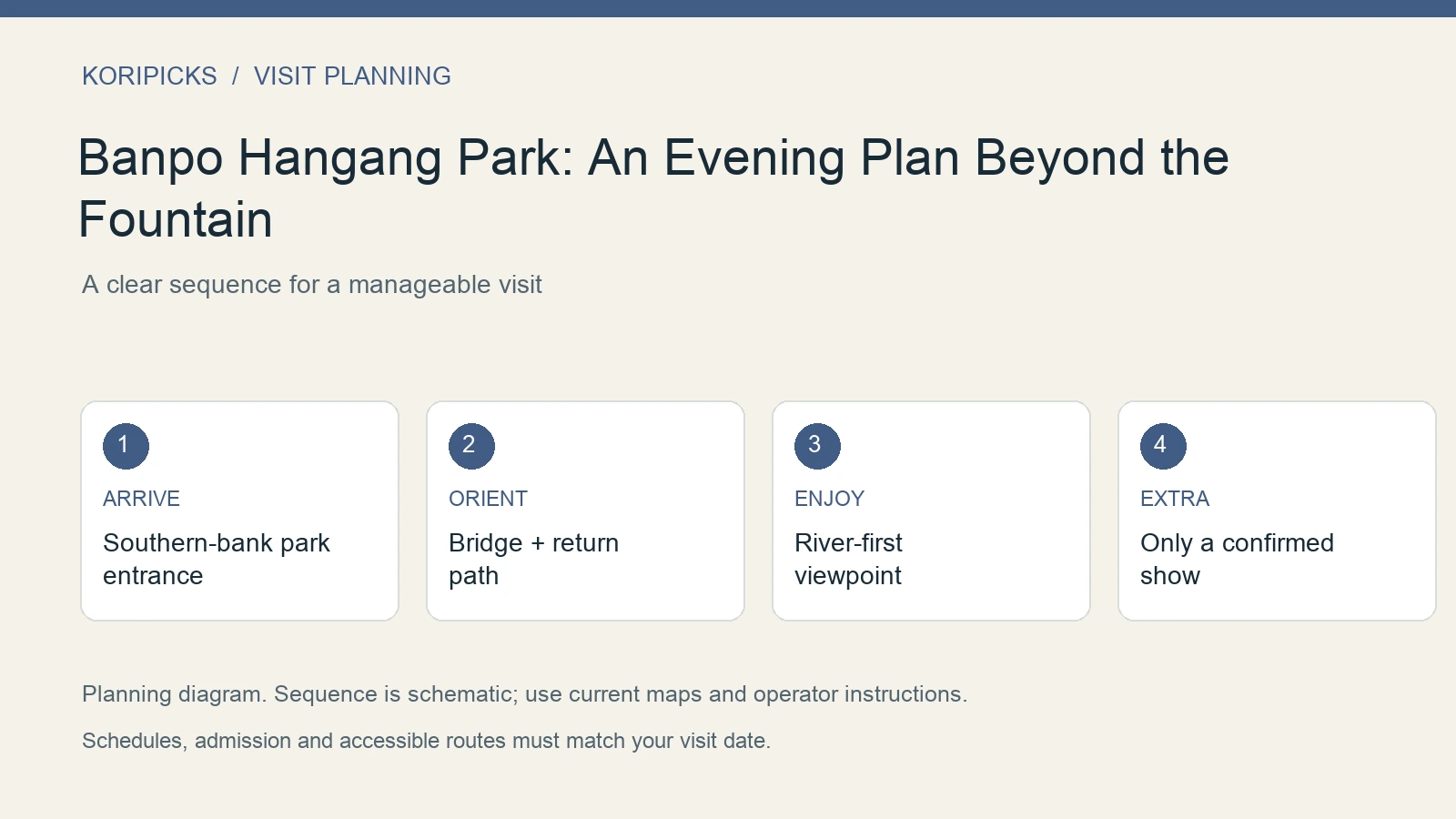
For a first evening, allow around 90 minutes to two hours in the park, excluding dinner and subway travel. This is an editorial allowance, not an official event duration or a measured walking route. The suggested sequence is a southern-bank arrival, a permitted riverfront viewpoint near the bridge, a rest, and a return toward the station.
Hangang operator winter status checked November 23, 2026 (Korea time).
The 2026 fountain season ended October 31. The Hangang operator’s closing notice says it returns after winter maintenance. Until a new schedule is published, use the river and bridge views as the reason to visit. The 19:30 itinerary below is an example for an operating season, not a current winter session.
The actual station approach and fountain times
Use 반포한강공원 and 반포대교 달빛무지개분수 as separate map searches. Confirm which bank the result sits on and whether the pedestrian route reaches the park entrance you want. A vehicle route onto a bridge is not a walking route to the fountain viewing area.
The Hangang operator’s Banpo directions page identifies Express Bus Terminal Station Exits 8-1 and 8-2, or Goto Mall exit G1, as approaches toward Banpo Bridge. It describes about a 15-minute walk. That is the operator’s estimate, not a measured journey for your group or a guarantee of step-free access.
Save the park entrance and fountain viewing area before leaving the station. The complete evening route is Express Bus Terminal park-side exit → southern-bank Banpo Hangang Park approach → permitted fountain-side riverfront area → one rest or short walk → return toward the selected station exit.
The current fountain page publishes the following seasonal pattern, with each session lasting 20 minutes:
| Season in the published timetable | Sessions | How to use the evening part |
|---|---|---|
| June–September | 12:00, 19:30, 20:00, 20:30, 21:00, 21:30 | Choose one session and leave margin for arrival |
| March 15–May and October | 12:00, 19:30, 20:00, 20:30, 21:00 | Do not carry the extra 21:30 summer session into October |
Weather, maintenance and event arrangements can alter operation. The operator specifically lists rain and wind-related suspension conditions. The useful planning result is a selected session with a river-first fallback, not a promise that water will run at every published time.
For an accessible outing, examine the actual ramp or underpass route. A riverfront path can be level while the approach contains steps or a complicated crossing. If the route is unclear, choose a different entrance rather than arriving with a stroller and improvising beside traffic.
How to plan around a 19:30 session in season
Eat before the park if you want a predictable seated meal. Aim to reach the riverfront with enough time to locate the correct viewpoint before the chosen session. An arrival around 19:00 gives an editorial margin for orientation and a short rest, but the actual daylight and travel conditions depend on your date.
Watch one session if it operates, then decide whether to remain for a short riverfront walk. Do not automatically wait for every following session. One successful viewing and a calm return usually fit a first evening better than repeatedly postponing departure.
If the fountain does not run, use the planned river viewpoint, take a short walk and return to the station area. That is still the base visit you selected. If the whole riverfront is restricted, leave rather than looking for a way around a safety barrier.
Pick the viewpoint from the actual riverbank
Confirm the bridge and the permitted path on arrival. A bridge photograph taken from another bank may not describe the view from where you are standing. Choose the location that gives your group a comfortable sightline without blocking a pedestrian or cycling route.
For photographs, begin with a wider view including the bridge and river. Then take one closer composition if the session operates and the crowd allows it. Keep enough battery for the map and journey home; a night outing needs navigation after the photo block ends.
The festival version needs another timing decision
Seoul’s fall 2026 festival announcement gives Sunday festival dates from September 6 through October 25, 14:00–22:00. It describes a six-session fountain pattern in September and five in October, with 20-minute sessions.
For a quiet river evening, an ordinary visit can be more suitable than the busiest festival session. For a performance-focused visit, the festival should become the fixed anchor and the rest of the walk should stay flexible. Those are two different purposes, even though the geographical destination is similar.
Food should not take over the evening
Buy only what you can comfortably carry and clean up afterward. Choose a designated area for eating, keep the path clear, and use the current park disposal rules. A picnic is a different commitment from stopping for a view; it adds bags, seating needs and cleanup.
Food delivery is not a dependable default for every foreign visitor. Accounts, phone numbers, payments and pickup zones can create friction. If you have not arranged that system, a meal before the park or a simple purchase from a currently operating facility is easier.
Water levels and weather can override the route
River conditions deserve more attention than a general city forecast. A pleasant-looking evening can still involve wind, closed paths or flood-related restrictions. Follow the operator’s current notice and every posted barrier.
Do not assume Jamsugyo is always open to your intended pedestrian route because a car-free festival exists. The bridge and riverside zones have their own safety and traffic arrangements. A lower crossing should never be used as an improvised shortcut around a closed approach.
Wear a layer suited to sitting by water after sunset and keep the return route visible on your phone. If weather worsens, leave the riverfront and go to the preselected indoor meal area rather than searching for cover under unfamiliar structures.
Finish with the route back to the actual platform
Before leaving the restaurant or station area, save the return walk and the train connection that reaches your accommodation. If a transfer is required, the last useful journey is the one completing that connection, not merely the last departure from the first line.
Keep a permitted roadside taxi pickup alternative if needed. The riverfront footpath is not a vehicle pickup point. A clear station approach, one selected viewing block and a known return are what make the evening manageable.
For other evening settings, compare the Seoul night-view options. The visitor payment guide helps prepare for a meal or return-journey payment.