
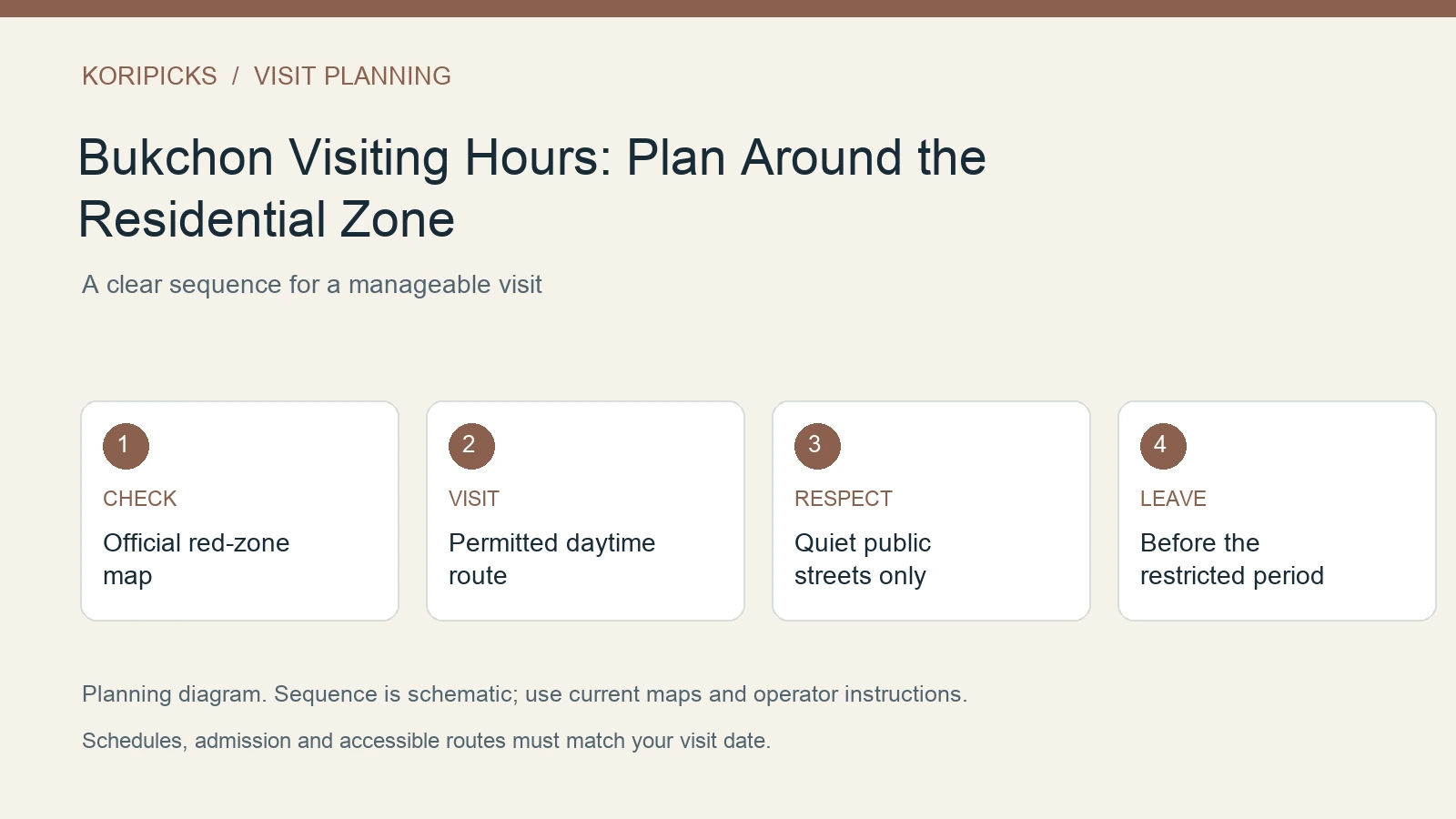
Bukchon is a residential neighborhood with visitor restrictions, not an attraction you can freely photograph at any hour. The practical first decision is whether your intended route enters the designated red zone. A general pin for “Bukchon Hanok Village” is not precise enough to answer that question.
Plan a short daytime visit, keep voices low, and choose a public cultural stop or café as the second part of the outing. Do not plan sunrise or late-evening photography in the restricted residential area simply because an older itinerary recommends it.
The restriction to check before walking uphill
The Seoul Metropolitan Government notice identifies the red zone around Bukchon-ro 11-gil. It restricts tourist visits from 17:00 until 10:00 the following day and lists a KRW 100,000 fine. The notice distinguishes this from other management zones and from separate charter-bus restrictions.
The same city notice identifies Sunday as a rest day for the alleyways. Respect that request by leaving residential-lane sightseeing out of a Sunday itinerary. Choose an independently operated public cultural venue only after checking its own opening arrangements. The Sunday rest-day guidance is distinct from the stated time-based red-zone restriction and fine; it should not be read as a claim that all of Anguk or Samcheong closes on Sundays.
Use the official English neighborhood map to see the boundary. The restriction is not a statement that every street in the wider Anguk or Samcheong area is closed at the same time. Conversely, an open nearby business does not automatically authorize a sightseeing detour through the restricted zone.
Use a public cultural destination before the residential lanes
Begin at Anguk Station and go first toward Bukchon Cultural Center at 37 Gyedong-gil. The city’s hanok information page identifies that address as a public reference point for the neighborhood. It is a better orientation anchor than a private doorway copied from a photo post.
From the cultural-center area, choose a permitted public route using the official zone map. Keep the residential section short, then return toward a commercial or public cultural destination outside it. This gives the visit a sequence: station → public orientation stop → permitted daytime streets → rest → departure.
The cultural venue and the red-zone boundary are separate things. A center being open does not authorize sightseeing in a restricted residential lane at another hour. A venue closure also does not mean the entire broader Anguk district closes on that day.
| Part | Specific planning task | Why it helps |
|---|---|---|
| Arrival | Save Anguk Station and 37 Gyedong-gil separately | The venue pin finishes the station journey |
| Orientation | Open the actual official zone map | A general Bukchon pin does not identify a boundary |
| Residential walk | Select one permitted public street section | Keeps the visit selective and quiet |
| Rest | Return to a named public venue or commercial stop | Avoids using private steps or doorways as seating |
| Departure | Leave the restricted section before its cutoff | Prevents an evening photo plan from conflicting with visiting hours |
The table is a planning sequence rather than a certified accessible route. The streets have gradients and varying surfaces, so the exact path should fit the people in your group.
Start after the permitted daytime window opens if the red-zone section is part of your route. Allow a brief orientation stop, around 30–45 minutes for a selective residential streetscape walk, and a separate block for the cultural venue or café. Those are editorial allowances, not an official neighborhood tour.
The neighborhood contains hills. For a stroller or wheelchair user, compare the route gradient, crossings and entrance access, not merely the straight-line distance from the station. If the residential section is unsuitable, a public venue closer to the main streets can still provide a meaningful visit.
Check the exact venue’s day and reservation conditions. A workshop, exhibition or guided activity may need a separate booking, and a commercial hanok café may require a purchase. This guide does not guarantee walk-in entry to every named building in the neighborhood.
A public hanok cultural stop and a short permitted surrounding walk can still form a complete visit. This is useful for someone with limited time, a group that prefers fewer hills, or a day when the residential streets are congested.
What to look at without intruding
From a permitted public street, notice how rooflines follow the slope and how walls and gates mediate between house and lane. These observations help explain why the area feels different from a palace courtyard or a purpose-built tourist complex.
Keep the camera pointed toward the public streetscape rather than through windows, over walls or into private courtyards. A resident opening a gate is not an invitation to photograph the interior. Do not ask someone to move away from their own doorway for your composition.
One or two carefully framed street views are enough to record the visit. Repeatedly stopping a group across a narrow lane can make the neighborhood harder to use for residents and other pedestrians. If the popular viewpoint is crowded, continue rather than creating a second queue beside someone’s house.
How to pair the route with a palace
For Gyeongbokgung, keep the palace as a separate morning block and use the actual exit and surface connection toward your Bukchon destination. For Changdeokgung, protect a confirmed garden session first and give the neighborhood a flexible block afterward only if the visiting window still fits.
Do not assume a palace’s evening grounds hours extend the residential sightseeing window. They are different operators and different types of space. If the remaining time is too short, use a public cultural destination or commercial street outside the restricted route instead.
A two-attraction plan is better when it has a real break between them. Choose lunch before the neighborhood walk, carry water, and avoid treating steep residential lanes as a hurried connection between two fixed bookings.
Sunset alternatives outside the residential red zone
If your main goal is an evening photograph, choose a public square, a permitted palace session, or another public-space route with confirmed access. Do not simply relabel a Bukchon residential photo stop as a “quiet evening walk.” The same visitor restriction still applies to sightseeing there.
For a late afternoon in the broader district, select a commercial destination outside the restricted residential route and navigate directly to it. Check its actual opening time. The presence of a restaurant nearby is not a reason to make an additional prohibited detour.
The Seoul neighborhood comparison helps connect this outing with your base. For an indoor alternative, use the rainy-day museum guide.