
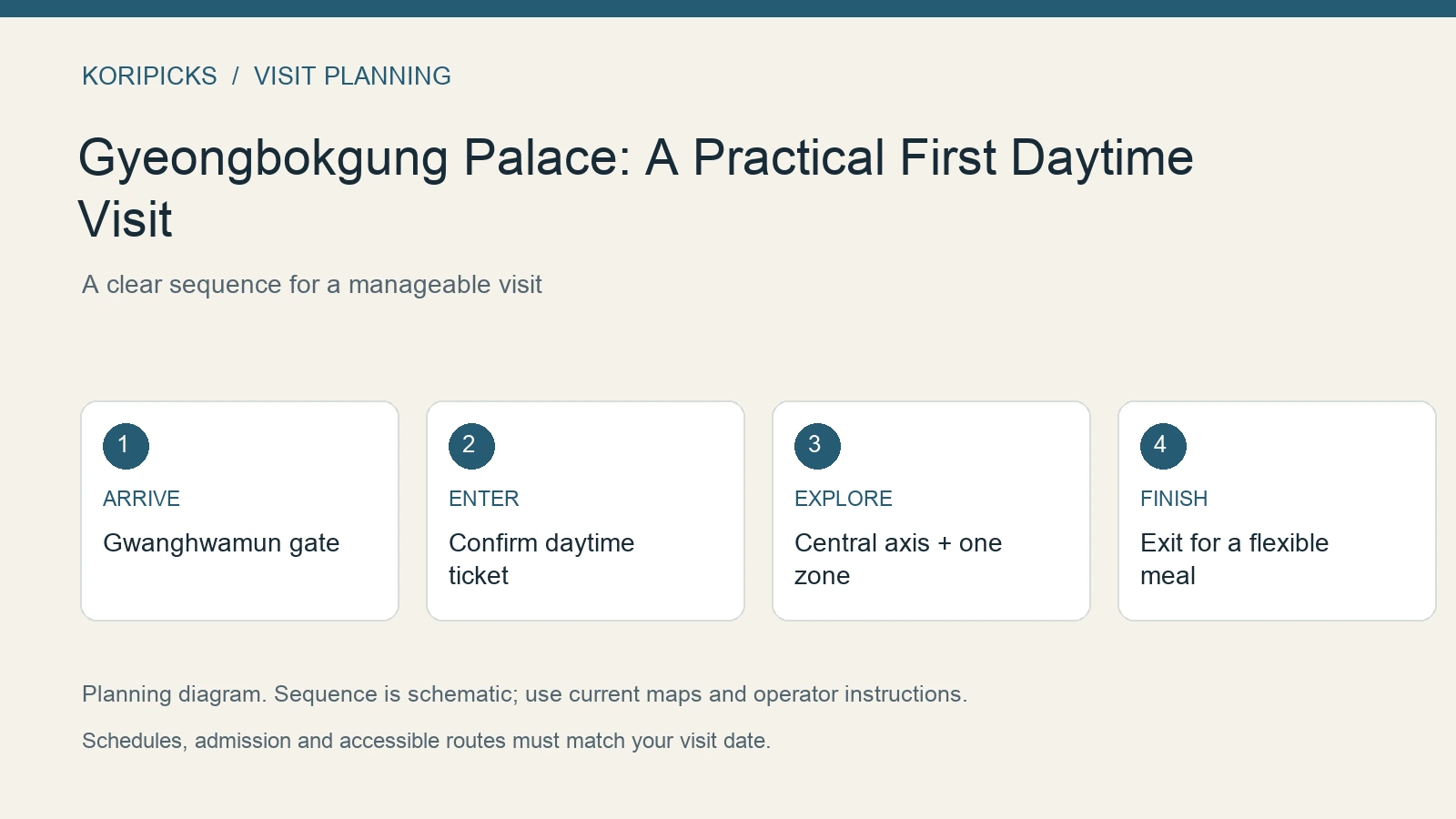
Gyeongbokgung is a better first palace visit when you give it a morning of its own. Enter through the main gate, follow the central ceremonial axis, then choose one quieter side of the grounds rather than racing toward every pavilion. The practical difficulty is not buying the standard daytime ticket; it is choosing the right day, protecting enough time before last admission, and keeping daytime entry separate from seasonal night programs.
For a visitor staying in central Seoul, this plan combines a palace visit with a meal outside the grounds. Allow roughly two to three hours for the palace and breaks. That is an editorial planning allowance, not an official tour duration or a measured walking time.
The complete first-visit circuit
Use Gwanghwamun → Heungnyemun → Geunjeongjeon → the permitted Gyeonghoeru viewing area → return through the public grounds to your chosen exit. This gives the morning a ceremonial sequence and then a contrasting waterside setting. It does not include restricted pavilion interiors or a separate seasonal night session.
The heritage authority’s directions page lists Gyeongbokgung Station Exit 5 as an approach, and Gwanghwamun Station Exit 2 among its other subway references. Choose the train route that fits your accommodation, then retain the main-gate pin so the surface journey ends where you intend to enter.
| Suggested morning block | Stop | Why spend time here |
|---|---|---|
| Arrival to about 20 minutes | Gwanghwamun and ticket orientation | Read the grounds map and separate regular entry from special programs |
| Next 20–30 minutes | Heungnyemun and the approach to Geunjeongjeon | Understand the sequence of gates and courtyards |
| Next 25–35 minutes | Geunjeongjeon area | Compare hall, platform and court rather than only the roof |
| Next 25–40 minutes | Permitted Gyeonghoeru surroundings | See how a waterside setting differs from the central ceremonial axis |
| Final 15–25 minutes | Rest and return to exit | Leave room for facilities and a calm transition to lunch |
These are editorial blocks, not a measured guided tour. Reduce the waterside portion if a path is closed or if you need a shorter visit. The central gate-and-hall sequence is the core, so the plan remains complete even when you omit an optional side area.
Look at the courtyard before crossing it
At each gate, pause where you are permitted to stand and look through the opening before moving. Then turn back after crossing. The two views explain how the palace regulates approach and frames movement. A gate is not only an object to photograph; it creates a relationship between the space you leave and the space you enter.
At the throne-hall area, compare the building with the size of the court. Notice the raised platform and how the architecture directs attention toward the hall. Reading the court as a whole gives you a more coherent understanding than moving immediately to the closest roof detail.
At the waterside stop, use one wide composition that includes the setting. A reflected roof isolated in a close photograph can be attractive, but it leaves out the part that makes this stop different from the ceremonial court. The suggested observation sequence does not imply access to a restricted pavilion.
End the visit with a meal that fits the exit
Choose the meal area before the last palace section. A plan returning through Gwanghwamun can continue toward the Gwanghwamun or Seochon side; an outing continuing toward Anguk needs a separately checked permitted exit and surface route. Do not let a restaurant pin on the far side of the palace make you assume a closed or restricted gate is usable.
Keep lunch flexible unless the reservation is the most important appointment of the day. The palace route includes admission, orientation, photographs and rests that a subway travel-time estimate does not count. A comfortable morning ends with time to eat, not with a sprint from the last pavilion to a restaurant across the district.
The facts that determine your visit
| Decision | Current official information | What it means for your plan |
|---|---|---|
| Where to go | 161 Sajik-ro, Jongno-gu; main gate Gwanghwamun | Save the palace entrance, not just the district name |
| September–October daytime hours | 09:00–18:00; last admission 17:00 | A late ticket still leaves only a short visit |
| Regular closure | Tuesday, with public-holiday exceptions | Check the next working day after a holiday too |
| Standard foreign adult daytime ticket | KRW 3,000 for ages 19–64 | Night programs and special reservations are separate |
The Royal Palaces and Tombs Center hours page and admission table control those details. Do not use an old screenshot of a different season’s hours. The ticket counter should decide any age-based exemption or discounted category; carry identification if you intend to claim one.
Choose the entrance before choosing a subway exit
Use the Korean search names 경복궁 and 광화문 in your map app. The former is the palace; the latter is the main gate and also appears in the name of a nearby station and square. A route to a station bearing the palace name does not necessarily finish at the exact entrance you intended.
For Line 3, select Gyeongbokgung Station and examine the final walking route to the gate. For Line 5, select Gwanghwamun Station and look north toward the palace through the square. Compare the complete journey from your accommodation. Saving two transfers to achieve a marginally shorter final walk rarely makes a first morning easier.
If you need elevators, choose an accessible station exit in the live map rather than following a numbered stair exit from an itinerary. Construction barriers, demonstrations and temporary traffic control can alter the surface approach. The important arrival milestone is the ticket area at Gwanghwamun, not the moment your train reaches the station.
A route with a clear stopping point
Begin by looking back through Gwanghwamun toward the city. The contrast between the ceremonial gateway and modern traffic makes the layout easier to understand before you enter. Inside, follow the main sequence toward Geunjeongjeon, the throne hall. Read the grounds map there and select the side area you care about most.
A workable order is Gwanghwamun → Heungnyemun → Geunjeongjeon → one permitted side route → exit for lunch. This is a suggested sequence, not a guided program. Paths and individual buildings may be restricted, and an attractive pavilion seen across water is not an invitation to enter it.
Give the central hall unhurried time. Notice how the courtyards, gates and raised platforms organize rank and approach. You will learn more from following that spatial sequence than from collecting distant photographs of every named building. The official palace history also explains why much of today’s complex reflects restoration after destruction and removal; it should not be described as an untouched survival from 1395.
Two versions for different energy levels
Short visit: Keep the central axis and one rest stop. Omit the farthest grounds and leave while you still have energy for the surrounding district. This suits an arrival day or a group with children whose patience may run out before the map does.
Longer visit: Add a second permitted zone after a drink or toilet break. Pick it from the current grounds map instead of assuming the shortest connection exists. Finish the palace before committing to Bukchon or another long walk.
Do not make the palace a hidden transfer between two restaurant bookings. A ticket, an entrance queue, a bathroom stop and several courtyard crossings can consume time that a route app never counts. Schedule lunch flexibly unless a specific reservation matters more than the palace.
Hanbok and photography without logistical trouble
Hanbok rental is a separate commercial decision. Check the return deadline, storage arrangement, deposit and weather policy before paying a shop. An admission benefit does not erase the rental cost or make a wet, cold or very hot day comfortable. Follow the authority’s current clothing guidelines if free entry is part of your plan.
The best photo sequence is simple: one main gate view, one courtyard composition, and one detail such as roof geometry or a permitted doorway. Stay out of the center of a moving queue and do not step onto protected platforms for a cleaner background. A long costume shoot also changes the time budget; it is not compatible with a rushed last-admission visit.
Rain, heat and closed-day alternatives
The grounds are predominantly an outdoor experience. A nearby museum can be an alternative, but palace admission does not guarantee that museum’s access or opening day. Decide which institution you will actually use before traveling in heavy rain.
On a normal Tuesday, change the palace day rather than walking to Gwanghwamun expecting an exception. During a holiday week, recheck the official closure rule: opening on a holiday can move the closure to a later non-holiday. Our rainy-day Seoul guide helps choose an indoor anchor, while the neighborhood comparison helps avoid unnecessary cross-city transfers.
Daytime entry is not a night ticket
A normal daytime visit should be planned using regular opening hours. Autumn night viewing, performances and restricted pavilion programs have their own dated notices, capacity and admission conditions. Buying the inexpensive daytime ticket does not secure a later evening slot.
If night viewing is your real goal, start from the palace’s current event notice and build dinner around the confirmed entry time. If you have no confirmation, keep this daytime plan intact. That prevents a common disappointment: arriving late for an imagined evening session after the standard admission window has already closed.