
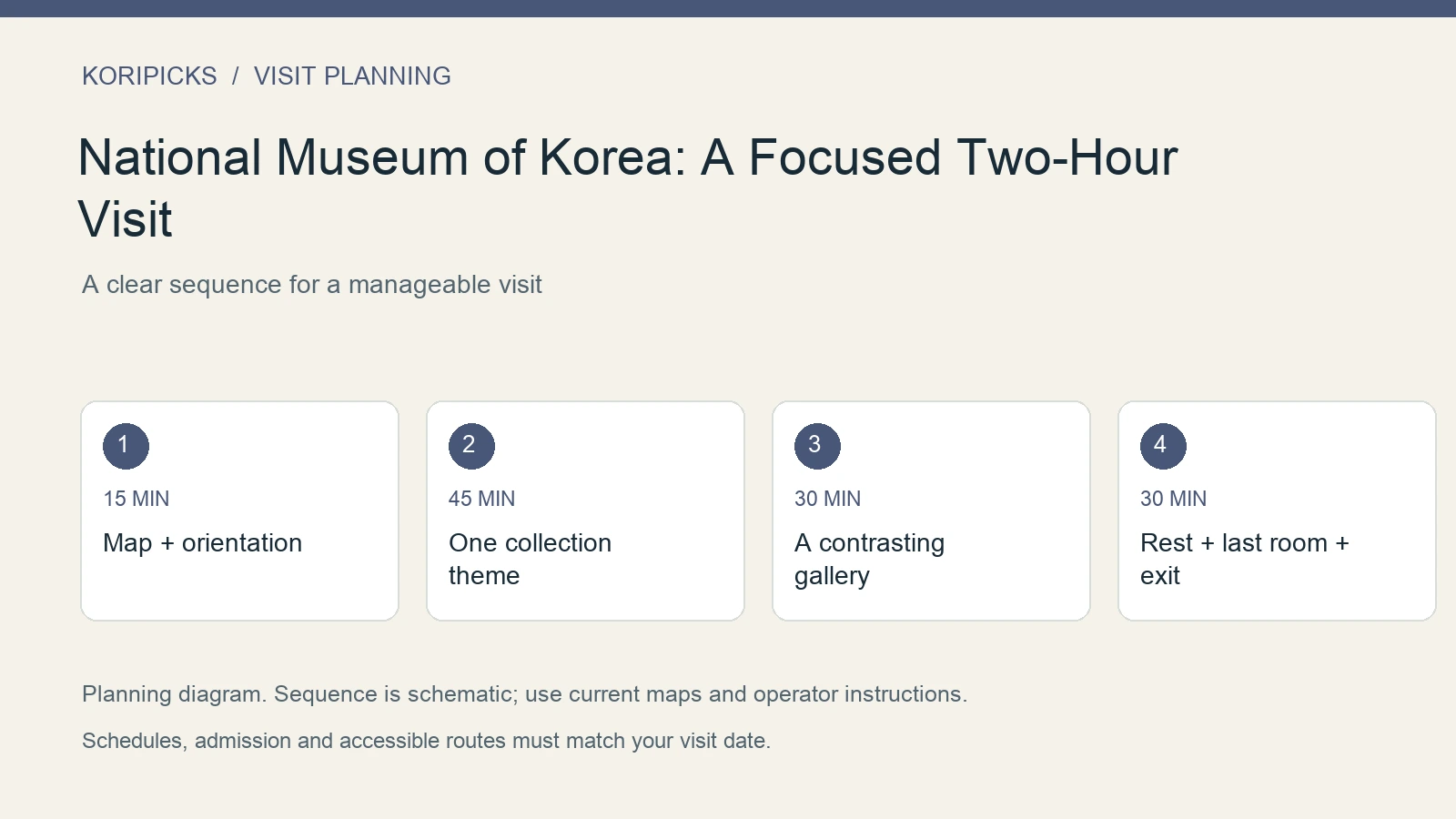
The National Museum of Korea is large enough that a first visit needs a selection strategy. Two hours can provide a rewarding introduction if you choose a few galleries and stop deliberately. It is not enough to inspect every floor, complete a special exhibition and visit the Children’s Museum without rushing.
For a first-time traveler, the permanent collection is a useful low-cost anchor near Ichon. Start with an orientation, spend the largest block of time on one theme, then add a contrasting gallery. The route below is an editorial suggestion using the museum’s published visitor information, not a recent test of every gallery or facility.
The actual two-hour collection route
For a first introduction, use this sequence: Great Hall orientation → the Gyeongcheonsa ten-story pagoda on the first-floor Path to History → the Room of Quiet Contemplation on the second floor → Celadon Gallery 303 on the third floor → return to the Great Hall. This gives you three distinct encounters: a monumental stone structure, two contemplative figures, and ceramic forms viewed at closer range.
The museum’s permanent exhibition directory locates the main collection sections by floor. Its Room of Quiet Contemplation page identifies the two pensive bodhisattva statues. The pagoda program page locates the monument on the Path to History. Use the museum map for the actual inter-floor connection.
| Time allowance | Stop | A focused way to look |
|---|---|---|
| 0–15 minutes | Great Hall, map and belongings | Identify the three stops before entering galleries |
| 15–35 minutes | Gyeongcheonsa pagoda, Path to History | Compare the whole structure with a close view of its carved levels |
| 35–65 minutes | Room of Quiet Contemplation, 2F | Spend quiet time with the two figures rather than rushing through for one photograph |
| 65–100 minutes | Celadon Gallery 303, 3F | Compare vessel profile, glaze and ornament across a few objects |
| 100–120 minutes | Rest, final look and exit | Return with time to use facilities and orient the next journey |
The allocations include movement but are editorial estimates, not a measured route. If a stop is crowded or you move more slowly, keep the pagoda and contemplation room and leave ceramics for another visit. A two-stop version is still a complete introduction.
Begin with scale at the pagoda
Look at the monument from far enough away to understand the relationship between its levels. Then approach from a permitted viewing position to inspect the carving. The museum’s collection material identifies this as a marble pagoda, which gives you a useful material comparison with the granite structures common in Korean outdoor heritage sites.
The point of this stop is not only identifying a National Treasure. It shows how architectural form, sculpture and narrative can occupy one object. Look for the change between the broader lower structure and the repeating upper levels. That gives the next, smaller objects a different sense of scale.
A timed light program is separate from ordinary object viewing. Do not wait for an evening media presentation during a daytime two-hour route. The object itself earns the stop; the program is an optional visit with its own time.
Slow down in the contemplation room
The two statues create a different viewing condition from the central hall. Keep conversation and movement restrained, and let the room’s arrangement guide the pace. Look at the repeated posture, then notice differences in crown, body proportion and drapery instead of assuming the two figures are identical.
You do not need to read every interpretive paragraph before looking. Spend the first few minutes with the objects, then read the museum’s explanation and return to the details you noticed. That sequence makes the visit more memorable than taking a photograph and leaving before the form has registered.
This room has a specific identity and should not be confused with a general Buddhist Sculpture Gallery. The distinction matters during the current renovation period.
Avoid galleries that the current renovation has closed
The museum’s renovation notice lists several closures through January 28, 2027, including Buddhist Sculpture Gallery 301 and Metal Crafts Gallery 302. It specifically says Celadon Gallery 303 and Buncheong Ware and White Porcelain Gallery 304 remain open. Other listed closures affect portions of the second-floor painting and craft sections.
That is why this route selects the contemplation room and Gallery 303 instead of vaguely recommending the whole sculpture-and-crafts floor. Follow newer notices if the schedule changes. For a closed or temporarily restricted chosen stop, substitute the nearby open ceramics gallery only when the current map and notice support access.
What to compare in Gallery 303
Choose a small group of vessels instead of reading the room as a number of display cases to finish. Compare the outline first: broad or narrow body, long or short neck, compact or spreading foot. Then look at the glaze and the way ornament relates to the shape. Finally read the labels for period and use.
This turns a ceramics stop into a structured comparison you can remember after leaving. It is also easy to shorten: seeing four objects thoughtfully is more useful than hurrying past an entire gallery because the two-hour label has become a deadline.
Confirm the correct hours for the day
The museum’s visitor information currently lists 09:30–17:30 on Monday, Tuesday, Thursday, Friday and Sunday, with extended opening until 21:00 on Wednesday and Saturday. Last admission is 30 minutes before closing. Permanent galleries are free; charged special exhibitions are exceptions.
The museum also lists holiday closures and quarterly gallery maintenance days. In September 2026, the listed Chuseok closure is September 25. Do not extrapolate ordinary hours into a holiday or assume “national museum” means the building is always open on a Monday.
Arrive at the museum, not just Ichon Station
Save 국립중앙박물관 and the address 137 Seobinggo-ro, Yongsan-gu. Ichon Station is the subway reference point, but the station-to-building portion still belongs in your travel allowance. Use the live route and current directional signs for the approach.
If you need an elevator, check the whole connection from platform to museum entrance. A station exit near the museum is not necessarily the correct accessible route. For taxis, distinguish the vehicle drop-off from the pedestrian route through the grounds.
Before entering galleries, deal with bags and wet umbrellas according to current museum instructions. The visitor information mentions storage facilities, but available locker sizes and occupancy are not guaranteed. Do not assume there will be space for multiple full-size suitcases just because lockers exist.
A special exhibition changes the calculation
Check the actual exhibition title, date range, price and admission arrangement on the museum’s official current program page. A photograph of a popular past exhibition can continue circulating long after its closing date.
If the temporary show is your main reason for visiting, treat it as the first destination and reduce the permanent collection to a short extra. Write down whether the ticket allows a selected time, whether re-entry is allowed, and whether your group has different age categories.
A free permanent museum is not the same as a free special exhibition. Keep those charges distinct in your budget, and do not buy a pass on the assumption that it includes every separately ticketed program.
Guided tours help when their schedule fits
The museum’s international visitor tour page lists languages and a gathering point, with schedules subject to change. If a tour is important, choose the visit time around the currently available language session rather than discovering it after you have entered a distant gallery.
A highlights tour can replace part of the independent route. It should not be squeezed into the middle of a full gallery checklist without additional time. Ask at the information desk about the actual session and participation arrangement; this article has not tested a reservation or guaranteed a place.
Children and mixed-mobility groups need a different plan
The Children’s Museum has its own reservation and session arrangement. General museum entry does not secure that visit. Check the current booking rules before promising it to a child, and keep the permanent collection as a fallback only if it suits their interests.
For a group with varied stamina, choose a shared meeting point and a definite reunion time rather than forcing every member through the same rooms. The museum’s published wheelchair and stroller facilities are helpful starting information, but availability and eligibility should be checked with staff.
Treat food and rest as part of the visit. A long museum morning followed by an undefined search for lunch often becomes harder than the gallery route itself. Decide whether you will use a currently operating on-site facility or return toward the station area.