
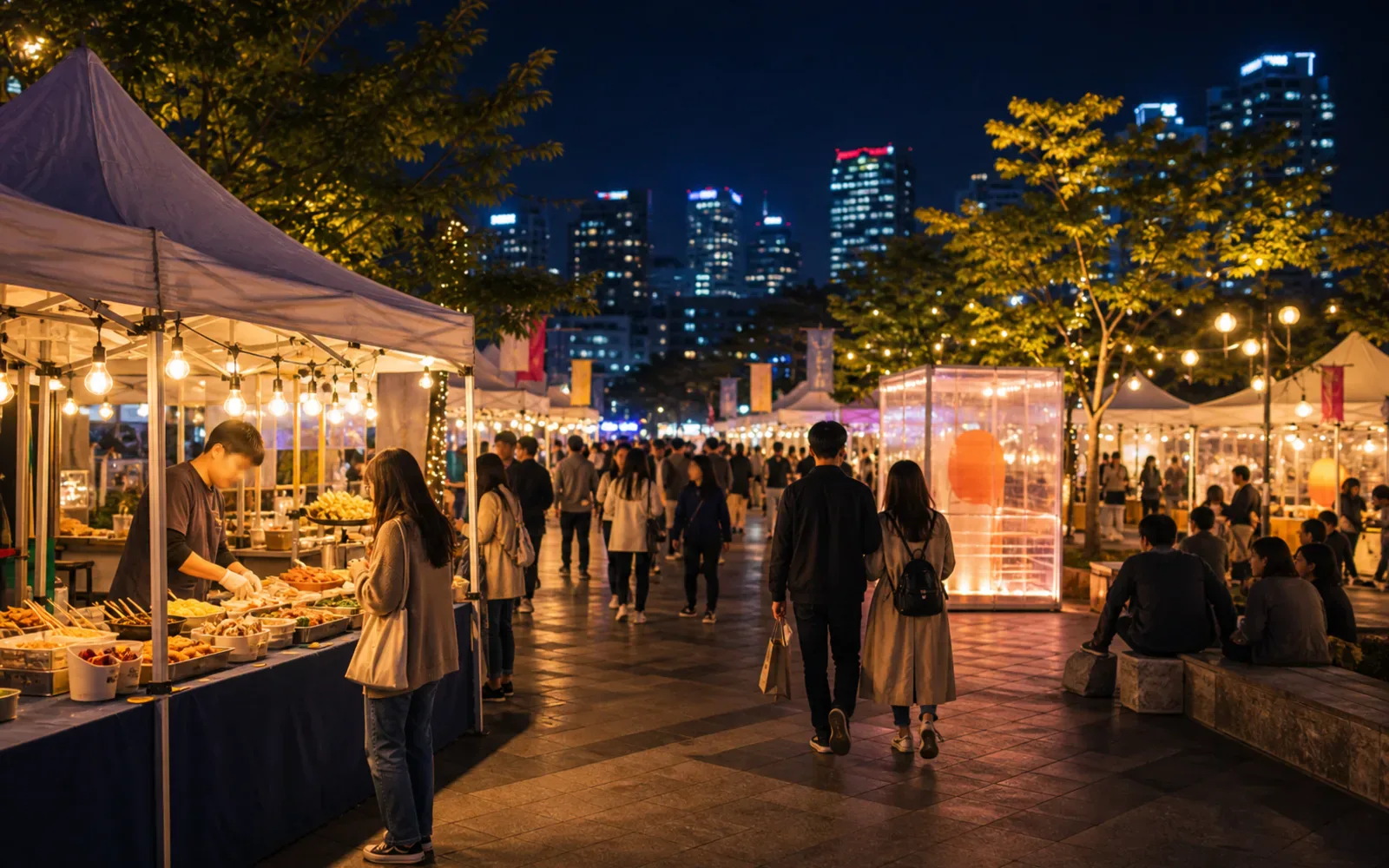
Choose Gwangjang for an ordinary market meal, or a confirmed outdoor program for a scheduled cultural outing. A permanent food street, a temporary night market and a riverside festival have different operating rules. This guide makes that choice explicit rather than treating old seasonal food-truck lists as tonight’s schedule.
Seasonal market dates checked November 23, 2026 (Korea time).
For a November evening, choose the Gwangjang food street or the separately listed Magok lights from November 27. Magok is a light display, so check whether it serves the purpose of your evening before traveling for food stalls. For a December market, Gwanghwamun has a published season beginning December 11.
Night market, outdoor festival or traditional market?
A night market is usually a limited operating program with vendors and event hours. An outdoor festival may spread performances across several sites. A traditional market is a permanent commercial district where individual shops keep their own hours. The correct planning method differs:
- For a night market, verify the exact session and food-vendor rules.
- For an outdoor festival, save the performance map and the one act you care about.
- For a traditional market, check shop and food-stall closing times rather than relying on the district’s general hours.
A real food-market stop: Gwangjang
If you want an ordinary market food evening rather than a scheduled festival, start with Gwangjang Market at 88 Changgyeonggung-ro, Jongno-gu. KTO’s current market listing distinguishes the general retail hours from the food street, displayed as 09:00–23:00. It also distinguishes Sunday retail closure from the food street’s broader operation. Individual stalls still decide their own actual service.
This is a permanent commercial market with an evening food option, not proof that Seoul’s old seasonal food-truck markets are operating tonight. The distinction lets you plan a meal without depending on an annual festival edition.
Use Jongno 5-ga on Line 1 or a route through Euljiro 4-ga on Lines 2 and 5, then select the actual market entrance in your live map. KTO’s market listing supplies the venue reference; use the current map for the appropriate station exit. The final entrance should match the food area you intend to visit rather than only the market’s central pin.
What to order and how to compare the bill
Mung-bean pancakes, small gimbap rolls and other market dishes offer different meal sizes. Choose one main item before adding snacks, and read whether the price is for one piece, one plate or a portion for sharing. A dish photographed on a social post may have a very different price unit from the sign beside the stall.
For two people, decide whether you want two individual meals or a shared main item plus one snack. Then calculate that order from the displayed menu. This prevents several small purchases from quietly becoming a larger bill than a seated restaurant meal.
KTO’s Soonheenae Bindaetteok listing provides a named pancake-business reference in the market. Use the actual branch and current menu if that stall is important to you.
A central evening that includes both walk and food
Begin at Cheonggye Plaza, walk only the central section you want, then leave at a suitable bridge and continue toward the market using the current surface route or transport connection. Alternatively, eat first and use a shorter stream walk afterward. Protect the market’s actual stall service rather than assuming the latest published food-street hour guarantees every menu item.
Allow roughly an hour for the food stop with a margin for seating and ordering. A crowded market requires more patience than purchasing a snack at an ordinary counter. If the group needs a quiet seated dinner or has difficult dietary requirements, choose a restaurant first and make the market a short additional visit.
Keep a modest cash backup, but ask whether the business accepts your actual card before ordering. The tourism listing’s card-acceptance information describes the market generally; it is not a transaction test at each individual stall.
Two winter markets with different locations and dates
| Stop | Published window | Before leaving |
|---|---|---|
| Gwanghwamun Market | December 11, 2026–January 10, 2027, Gwanghwamun Square and Sejongno Park area | Check the official market listing for operating details and recheck any scheduled activity. |
| Romantic Hangang Christmas Market | December 24–27, 2026, Ttukseom Hangang Park | Check the city’s event listing and organizer’s program for hours, access and weather changes before making a separate riverside trip. |
| Gwangjang food street | Permanent market, with business hours varying by stall | Use it as the food-first option when a seasonal program is closed. |
For one central evening, pair Gwanghwamun Market with the nearby lanterns after December 11. Ttukseom is a separate trip. The September–October outdoor-library and Jamsugyo festival examples have concluded and do not appear in these options.
Why old night-market lists fail
A page can remain online long after its food-truck lineup, river location or weekly schedule has ended. Search results also mix annual events, one-off markets and ordinary traditional markets. A historic city announcement proves that an event existed, not that it runs tonight.
Use four layers of verification:
- City calendar: confirms that the event is part of the current season.
- Organizer page: provides the venue, hours and program.
- Reservation or ticket page: shows whether advance entry is required.
- Same-day notice: controls weather cancellation, crowd limits and schedule changes.
How to read an event notice
Start with the date and venue, then look for a final-entry time, not only an end time. Free entry can still require advance reservation. Outdoor programs may close queues early when capacity is reached. If the notice gives several subway stations, match the station to the specific stage or entrance.
For a Korean-only notice, translate the sections for cancellation, reservation, age limits and prohibited items separately. A translated event title is less important than understanding whether bags, outside food, pets or re-entry are allowed.
Weather is an operating rule, not a comfort detail
Heat, heavy rain, wind and river conditions can cancel or shorten an outdoor program. Check the organizer’s same-day channel after midday. A citywide weather forecast cannot tell you whether a stage, bridge or food zone has closed.
Keep one indoor backup in the same district. Around central Seoul, that may be a museum or covered shopping area. Near the Hangang, choose the station and indoor option before arriving at a wide riverside park.
Plan the return trip before the last performance
Outdoor programs often end when thousands of visitors are leaving the same entrance. Save the ordinary last-train window, but do not treat it as your target departure. Temporary road closures can move bus stops, and a riverside venue may take longer to exit than the map suggests.
Choose a meeting point outside the densest gate, keep enough transport-card balance for a route change and note one station on the opposite side of the venue. If taxis are central to the plan, expect pickup restrictions around a closed road. The safest fallback is an earlier subway departure, not a last-minute ride request from the event entrance.
For temporary brand events, use the pop-up verification guide; for a weekly search, follow the weekend events workflow.
Official event sources
- Seoul Metropolitan Government: 2026 major events schedule
- Visit Seoul: current events calendar
- Seoul Culture Portal: event listings
- VISITKOREA: national festival calendar