
Seoul Museum of History explains how a capital became a modern metropolis; neighboring Gyeonghuigung supplies a surviving place in which to think about that transformation. The pairing is strongest when the museum gives you a question to carry outside. A model of the city, a changing street pattern or a household object can make the palace district more legible than arriving only to photograph its gate.
This is a focused collection visit with a palace second act. It goes beyond choosing a free indoor stop: select two historical chapters, use the city model to locate their geography, and examine the difference between surviving evidence and restoration in the palace grounds.
Two institutions, two sets of opening decisions
The museum is at 55 Saemunan-ro. Its visitor information lists free admission, ordinary hours of 09:00–18:00 and last entry at 17:30, with Monday and January 1 closures. It separately lists Friday late opening until 22:00. Lockers are available on the first floor; the page also identifies wheelchair and stroller provision and audio guidance in Korean, English, Japanese and Chinese.
For autumn 2026, the city’s Culture Night announcement extends selected museum spaces to 21:00 on Tuesday, Wednesday, Friday, Saturday and Sunday from September 15 through November 30. Because the museum’s ordinary Friday page and this temporary city schedule describe different closing references, verify a planned late visit against the museum’s notice for that date. A daytime pairing avoids relying on the evening pilot.
Gyeonghuigung’s own branch page lists 09:00–18:00, free admission, and Monday and New Year’s Day closures. A late-opening museum does not keep the palace grounds open afterward. Choose the palace before its closing time, or make an evening museum visit a separate experience.
| Order | Best use | Important trade-off |
|---|---|---|
| Museum, then palace | You want historical context before looking at buildings | Leave enough daylight and palace opening time |
| Palace, then museum | You arrive later or want to inspect the outdoor setting first | Bring questions from the grounds into the galleries |
| Museum only | Weather or mobility makes the outdoor section unsuitable | Use the city model and selected chapters as the complete visit |
Choose two chapters instead of reading every panel
The permanent collection divides the city’s story into the Joseon capital, the Korean Empire, Japanese colonial rule, the Republic of Korea’s growth and the city’s present and future. These chapter labels are a useful framework, not a demand to give every room equal time.
Start with The Joseon Capital if the old city’s arrangement interests you. Notice the relationship among the royal palace, ritual places, government offices, walls and commercial streets. Find one map and one ordinary object that show different scales of the same city: the governing plan and the life lived inside it.
Then choose a contrasting chapter. The Capital of the Korean Empire raises questions about modernization and sovereignty; Seoul under Japanese Control examines a period of colonial transformation. The museum’s rapid-growth chapter changes the scale again through the development of the modern capital. Select according to the question you brought, rather than treating the sequence as an exam.
For example, compare movement in two periods: where people entered the city, how goods moved and what changed when transport and roads expanded. Or compare domestic life: which displayed objects show living arrangements, work or consumption? These are ways of looking, not claims that one artifact represents every household.
Use the city model to connect history with your own journey
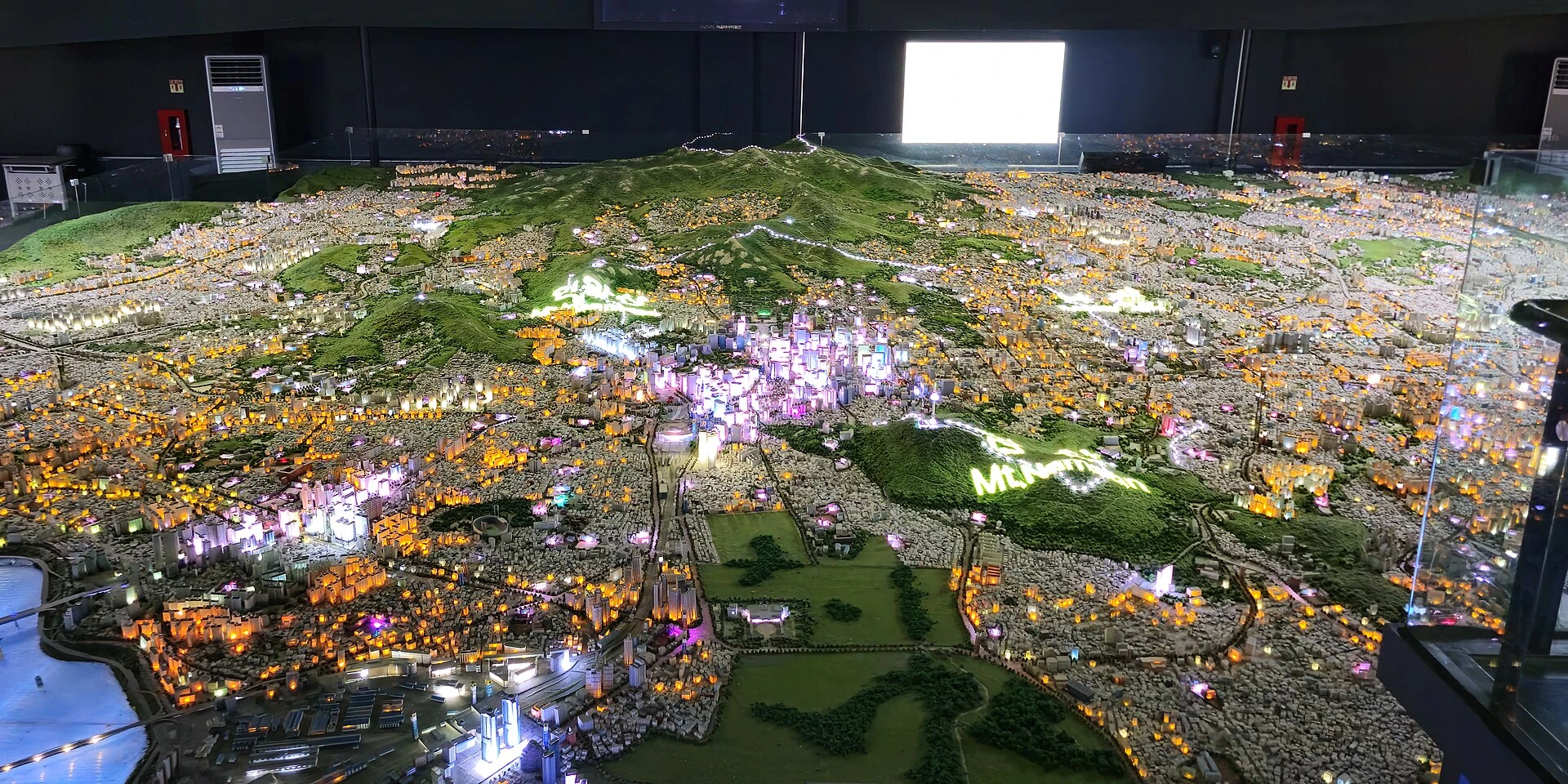
The City Model Image Hall is presented as an educational space for understanding Seoul’s natural and urban environment. Use it to locate the broad relationships you have just read about: mountains and developed land, the river and built districts, old central Seoul and later expansion.
First identify the museum district and the part of the city in which you are staying. Then choose a feature from the historical galleries and look for its relationship with today’s geography. The useful comparison is between patterns, not a hunt to locate every café from your itinerary.
If a presentation or group program is using the space, follow the available viewing arrangement. A model hall can serve several functions; an online photograph of an empty room does not reserve an unobstructed viewpoint. Afterward, make one concise note about how the city’s scale differs from the impression given by a subway diagram.
Carry one observation into Gyeonghuigung
Gyeonghuigung was a secondary palace of the Joseon dynasty. The branch’s history explains that the city excavated the site from 1987 and restored buildings before opening the grounds to citizens in 2002. The palace you visit therefore needs to be read as a historic site shaped by loss, recovery and reconstruction.
Begin at Heunghwamun, the main gate identified by the official page. Its own relocation history is instructive: the original gate position was occupied, so the restoration placed the gate in its current location. That makes it a useful antidote to assuming every present-day alignment is untouched from the royal period.
Continue toward the courtyard and Sungjeongjeon, the hall associated with royal meetings and official ceremonies. Compare the scale of the threshold, open court and raised building. From a permitted public position, consider how approaching a hall changes your sense of authority and distance. You can study the arrangement without needing access to every interior.
Where the route permits, look for Jajeongjeon and the interpretation of its working role, then choose whether you have enough energy for the remaining grounds. A small palace visit is not incomplete simply because it has fewer buildings than Gyeongbokgung. Its value here is how closely it connects with the museum’s account of a changing capital.
Read an object label and a restored building differently
A museum object may have a date, material, owner or excavated context. A restored palace building also involves decisions about reconstruction and location. Ask what the evidence establishes in each case. Is a photograph showing an earlier state? Does the text distinguish an original fragment from a later reconstruction? Which part of the narrative comes from the object, and which comes from interpretation?
These questions make the paired visit distinctive without requiring specialist knowledge. They also prevent the common mistake of describing everything that looks traditional as an intact royal-era survival. Use the institutions’ wording when recording what you saw, and keep uncertainty where a label does not resolve it.
Make food, access and the ending concrete
Store only belongings that the museum’s actual lockers accept, and keep medication, essential documents and the means to retrieve the locker with you. The availability of a wheelchair facility does not by itself establish a continuous step-free connection through the palace; confirm that outdoor route separately if it matters.
After the museum and grounds, return toward the station or meal area that serves your onward journey. Adding another distant museum usually weakens this focused day. For weather-driven alternatives, the rainy-day museum guide compares different indoor anchors. For an entirely different palace experience with ordinary evening opening, use the Deoksugung guide on another visit.