
A first Suwon trip does not need a complete circuit of Hwaseong Fortress. Choose a short wall section and the palace district, then decide whether your remaining energy justifies a longer walk. The fortress perimeter is approximately 5.7 kilometers, and a full loop adds slopes, stops and travel back to the station that a simple distance figure hides.
This plan focuses on the northern fortress landmarks and the Haenggung area. Allow several hours on site with a meal, plus the Seoul–Suwon journey. All time allowances are editorial estimates, not measured route tests or train timetables.
Start at Haenggung, then walk the northern landmarks
For a first visit without a car, begin at Hwaseong Haenggung rather than at a distant wall tower. The Suwon Cultural Foundation’s directions page identifies city buses 11, 13 and 13-4 from the stop near Suwon Station Exit 4 to the Hwaseong Haenggung stop. Use that as the local connection to look up for your departure time, with the current bus display deciding the exact stop and vehicle.
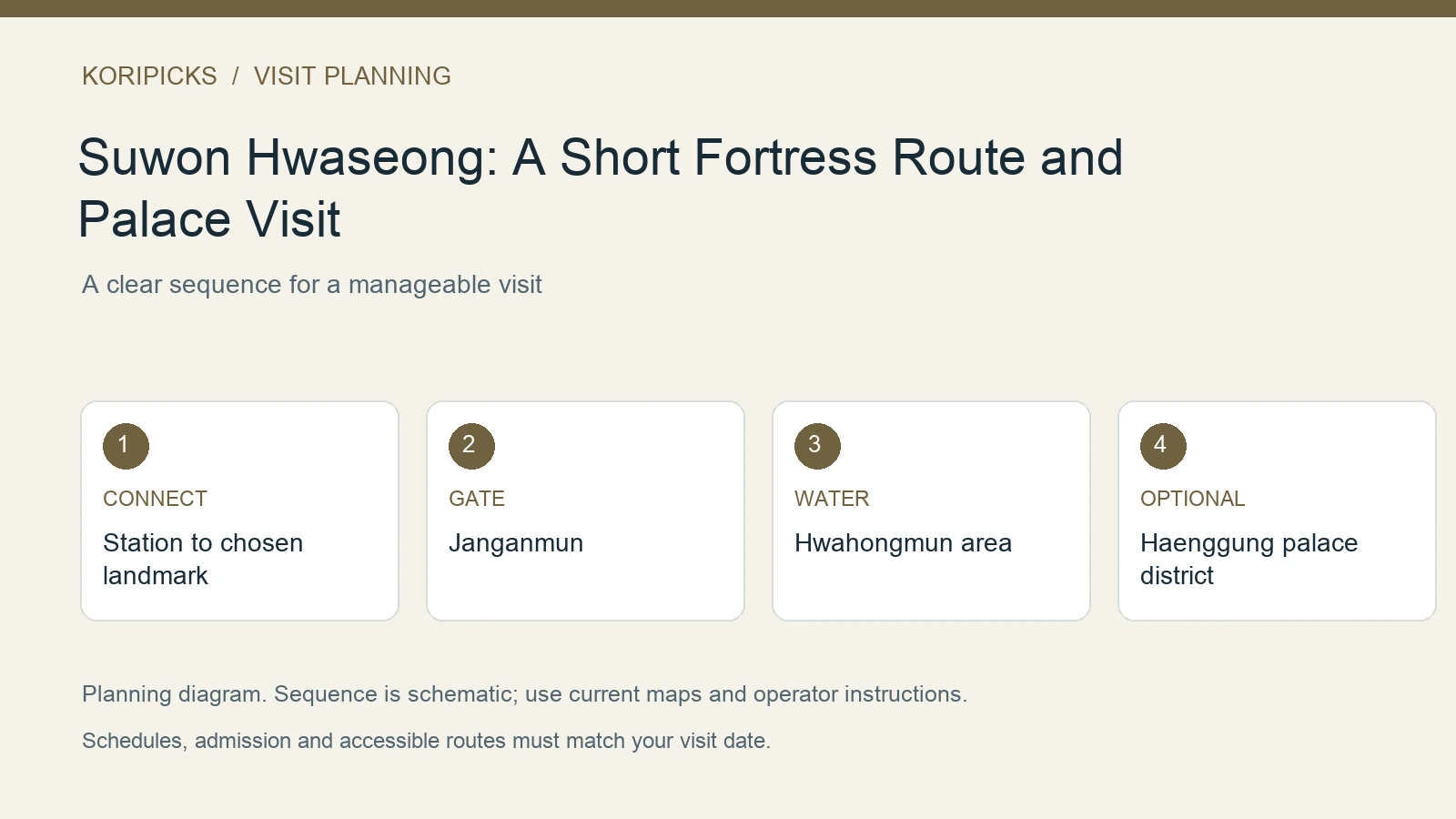
The complete sequence is Suwon Station → bus to Hwaseong Haenggung → palace → lunch in the palace district → Hwahongmun → Banghwasuryujeong surroundings → Janganmun → local transport back to Suwon Station. It avoids starting with an uphill perimeter circuit and gives you a seated break before the longer outdoor portion.
Save the Korean names 수원역, 화성행궁, 화홍문, 방화수류정 and 장안문. The palace district is your first destination; the water gate and northern gate are the afternoon landmarks. A taxi can replace the station bus connection when that is worthwhile for your group, but use the same destination names and keep its fare separate from admission.
A four-hour on-site plan
| On-site allowance | Part | What to prioritize |
|---|---|---|
| First 60–75 minutes | Hwaseong Haenggung | Main courtyards and the palace’s ceremonial axis |
| Next 45–60 minutes | Lunch and a seated break nearby | Eat before the outdoor wall section |
| Next 45–60 minutes | Hwahongmun and Banghwasuryujeong area | Water, wall and landscape rather than every tower |
| Final 30–45 minutes | Janganmun and departure connection | See one substantial gate, then return toward the station |
This is an editorial schedule, not a measured walking time or an official guided circuit. Allow the rail journey and the station-to-palace connection in addition. If you leave Seoul late, reduce the outdoor portion instead of pushing palace entry toward last admission.
The purpose of the schedule is to show where the time goes. A day trip has a meal, a local transfer and a return, not only landmark names. Leave some unassigned margin between the water-gate area and Janganmun so that a rest or a slower walker does not force the entire group to hurry.
What to observe at each landmark
At Haenggung, follow the sequence from the main entrance through the permitted courtyards. Notice how gates and halls organize an approach to authority. Look at a courtyard before crossing it, then turn to see the view back toward the gate you entered. That simple comparison makes the spatial order clearer than photographing the front of every hall separately.
At Hwahongmun, the key relationship is between water and fortification. Take a wider view that lets you understand the defensive line across the channel, then a closer view of the permitted architectural details. If a path or platform is restricted, stay on the signed public route; the broader relationship remains visible without entering it.
Around Banghwasuryujeong, compare the pavilion setting with the more direct defensive role of the gate. Use the landscape as part of the composition rather than isolating the roof against the sky. This is also a suitable point to decide whether your group still wants to continue to Janganmun.
At Janganmun, compare the gateway, adjacent wall and street approach. One substantial gate is enough to understand the scale of the fortress entrance. A first visit does not need all four major gates to become meaningful.
Two ways to shorten the afternoon
If the group is tired after lunch, keep Hwahongmun and omit the final gate. Arrange the return from a permitted roadside location or a current bus stop serving your station route. Do not walk to an unneeded tower merely because it is still listed in the plan.
If rain is persistent, make Haenggung and a currently open indoor museum the main visit, with only a brief exterior landmark view. The palace itself still includes exposed courtyards, so this is a reduction in walking rather than a claim of a fully covered day.
For someone unable to manage slopes or stairs, stay with ground-level approaches and ask the operator about the specific accessible path before adding a wall-top stretch. The easiest version is not defined by the shortest distance on a map; it is the version with suitable surfaces and a manageable return.
A cost calculation that includes the return
The operator’s current price page separates free fortress access from Haenggung admission, displayed at KRW 2,000 for an ordinary adult. Your actual total is palace admission + rail fares + local transport + lunch + optional experiences. The tourist trolley and archery are separate purchases; neither is needed for this route.
Before leaving the lunch area, check the return connection to Suwon Station and the train or subway you intend to use for Seoul. That makes the northern walk a planned final act rather than a route that ends with an uncertain journey across the city.
Free fortress access does not cover everything
The current KTO fortress listing describes free access to Hwaseong Fortress. The Cultural Foundation’s price page also distinguishes that from the paid temporary palace, museum tickets and experiences.
For Hwaseong Haenggung, the operator currently displays ordinary adult admission at KRW 2,000 and daytime opening 09:00–18:00, with last admission 17:30. Treat an evening-opening schedule as a separate dated item: the English page also contains an older 2024 night-opening block, which must not be copied as a confirmed 2026 program.
The practical budget therefore has separate entries for transport, palace admission, a meal and any optional experience. The fortress being free does not make a trolley ride or palace ticket free.
Why a short wall section can be enough
Hwaseong is useful to read as an engineered boundary: gates control movement, wall sections adapt to terrain, and water crossings require their own defensive solution. Seeing those elements in relation gives you more understanding than a series of tower photographs disconnected from the landscape.
Start with one gate, then look at how the adjacent wall approaches it. At the water-gate area, notice how the defensive line responds to the channel. If a safe path lets you compare inside and outside views, use that contrast; do not enter a closed area for it.
The operator’s palace introduction helps place Haenggung in the broader royal itinerary. It is a different type of space from the fortress wall, so reserve some attention for its courtyards and circulation rather than treating it as one more gate.
Trolley and archery are optional reservations
The Cultural Foundation lists a tourist trolley and traditional archery as separate paid experiences. Use their current session information if one is important. Do not count a seat as available because the price page mentions the service.
A trolley can change the walking plan but still requires the correct boarding location and an operating session. Rain, snow, maintenance or capacity may affect availability. An archery session likewise adds a fixed location and time; it should not be attached casually to an already crowded afternoon.
If the optional experience is unavailable, return to the wall-and-palace plan. That fallback is stronger than spending the rest of the day waiting around a ticket counter for an uncertain opening.
Food, weather and departure
Choose a restaurant in the district where your route ends. A food-famous city does not justify crossing it several times between sightseeing and lunch. Check the portion size, current opening hours and actual branch before committing.
In persistent rain, prioritize any confirmed indoor museum and reduce the wall route. A palace courtyard remains an outdoor space even when there are buildings around it. Do not use the word “indoor” for a plan that mainly involves walking exposed grounds.
Save the local leg back to the station before your final café stop. Then confirm the rail service and any reservation you need for Seoul. Our day-trip comparison and visitor payment guide help keep the transport and payment pieces separate from the historic walking route.