
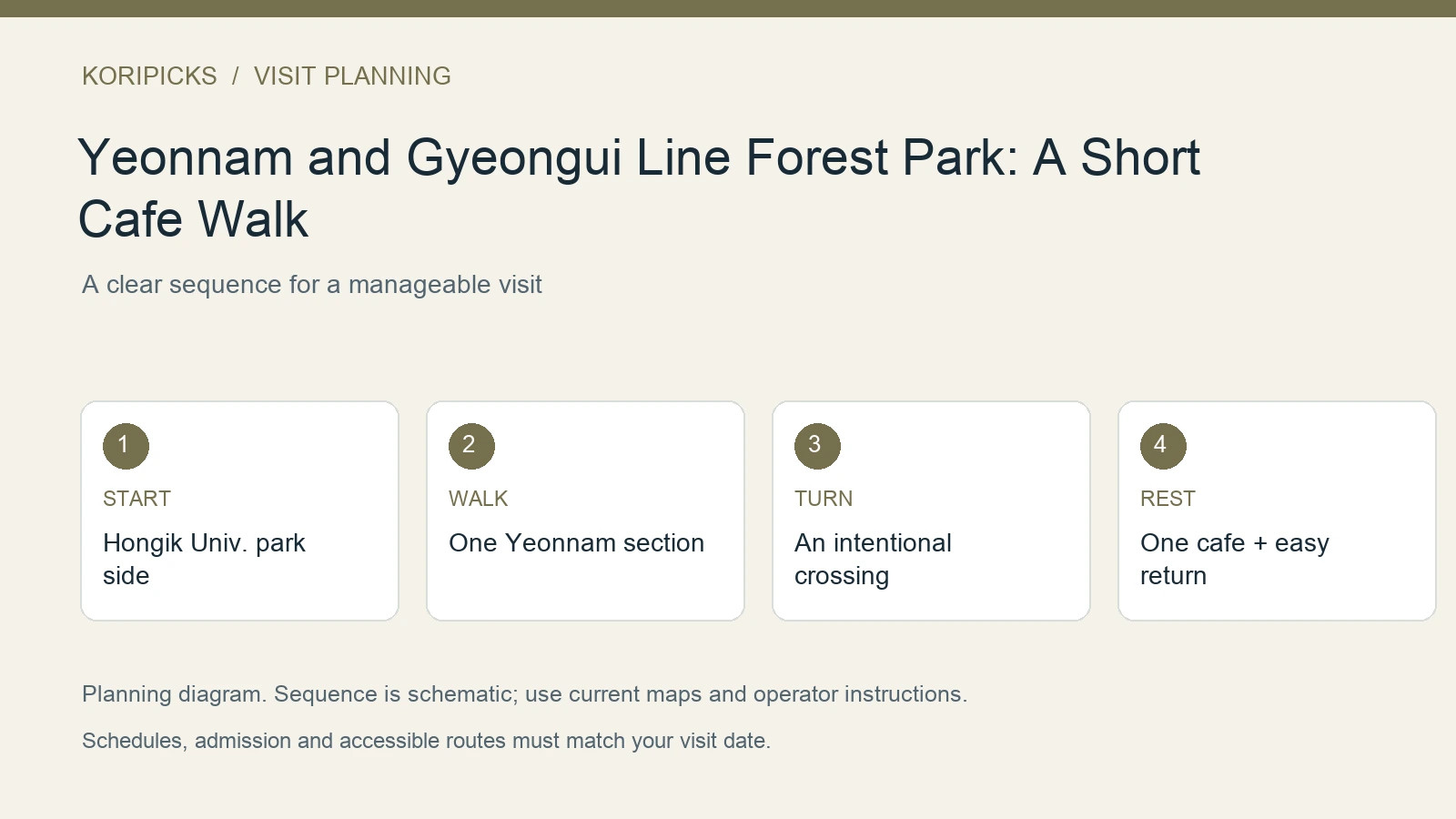
Yeonnam’s section of Gyeongui Line Forest Park is a useful Hongdae-area pause when you want an easy walk and one café rather than another attraction queue. Start on the park side of Hongik University Station, follow a short section of the greenway, and turn toward a selected café or the station before the walk becomes longer than you intended.
Allow roughly an hour for the walk, or around two with a seated café break. Those are editorial allowances, not measured route times. The objective is a compact neighborhood outing, not walking the entire multi-section Gyeongui Line park.
The café in this walk: Yeonnam Bangagan
Use Yeonnam Bangagan as the fixed seated stop. Its own location page gives 34 Donggyo-ro 29-gil, Mapo-gu, and identifies Hongik University Station Exit 3 as the approach. The operator lists weekday hours of 12:00–21:00, weekend hours of 12:00–22:00, and Monday closure. That means a morning coffee plan here should not start before noon, and a Monday version needs a different café.
This is more useful than a generic instruction to find a café somewhere in Yeonnam. Save the Korean name 연남방앗간 and the full address. The street number matters because the neighborhood contains many converted houses and cafés with similar-looking entrances.
The café provides the commercial anchor; the park provides the free walking section. A small outing can therefore have only two spending lines after transport: your selected drink and optional food. Read the current menu when ordering. An attractive house interior is a reason to look at the space, not evidence that every drink or pastry meets your dietary needs.
A complete noon-to-afternoon sequence
A practical order is Hongik University Station park side → a short Yeonnam greenway section → turn toward Donggyo-ro 29-gil → Yeonnam Bangagan → return to Hongik University Station. Begin around noon if the café is central to the plan. Walk first when the weather is pleasant; take the café break first when you need shelter, a seat or lunch-time rest.
| Planning block | Suggested use | The decision that keeps it simple |
|---|---|---|
| First 10–15 minutes | Leave the station and orient yourself along the park | Stay on the park side rather than crossing into the nightlife district |
| Next 25–40 minutes | A short greenway walk with one turning point | Turn back before the distance becomes a second outing |
| Next 45–60 minutes | Café break at Yeonnam Bangagan | Treat the selected seat and menu as the actual experience |
| Final 10–20 minutes | Walk back toward the station or nearby accommodation | Finish with the route home rather than another queue |
These are editorial time allocations, not measured walking times or an official tour. They deliberately leave room for crossings, photographs and finding the correct building. You can shorten every block except an existing appointment without losing the identity of the outing.
Where to turn during the park section
Use a visible crossing on the live map as your turnaround point and save it before moving farther. The greenway’s long shape can make continuing feel effortless until you realize you must walk the same distance back. For this version, you are sampling the Yeonnam section, not completing the entire multi-district park.
Walk slowly enough to observe how the former railway corridor meets the surrounding streets. Look for a composition that shows the linear path, the planted edge and the café-lined neighborhood together. That tells more of the place’s story than cropping every photograph to a decorative shop doorway.
Return along the public greenway when that makes the café connection clear. A side-street shortcut is worth using only when you can see how it rejoins the chosen route. If it leads into a private passage or a lane that feels residential and narrow, use the main public street instead.
Café-first, park-first and rain versions
Park first: Walk the chosen section, then go to the café when you are ready for a seat. This is the natural version for pleasant weather and a group that enjoys strolling.
Café first: Meet at the actual café address after it opens, order, then use a shorter park walk as the second part. This works when people arrive from different hotels and need a definite meeting place.
Persistent rain: Keep the café visit and omit most of the walk. You do not need to prove that you followed an outdoor circuit when conditions make it unpleasant. Confirm the café is operating before making the journey; the greenway does not provide continuous covered shelter.
These versions share a real destination but differ in the amount of walking. They are not three cafés presented as a ranking. The article does not claim an on-site tasting or an inspection of current seating availability.
What to keep out of this short plan
Do not add Book Street, a second distant café and a full Hongdae shopping circuit while retaining the same two-hour label. Each is another destination with another walking segment. If you specifically want a second café, reduce the park section and identify that café before arrival.
Finish by checking the train direction and the final accommodation walk. The pleasant part of a neighborhood outing is having enough energy left afterward. One actual café and a defined greenway section make a more useful plan than a list of popular names with no order or ending.
The whole park and the Yeonnam section are different plans
The Seoul Metropolitan Government’s Yeonnam-focused park page identifies Hongik University Station Exit 3 as a convenient approach and describes the former railway’s transformation into a greenway. The city’s broader park directory gives the overall multi-district park length as 6.3 kilometers.
Those descriptions refer to different scales. A short Yeonnam walk is not a complete end-to-end park route, and a photograph of one section does not describe the surfaces or facilities of every other section.
Read the railway trace, not only the café signs
Look for how the linear space differs from an ordinary square park. Its shape follows former transport infrastructure, which makes the walking sequence long and narrow rather than organized around a single center. Crossings and neighboring streets interrupt and reconnect the experience.
Notice the contrast between planted edges, public seating and commercial frontages. The greenway provides a common route, while shops pull you sideways into the neighborhood. That relationship is useful to observe even if you buy nothing.
These are architectural and urban observation prompts. They do not imply a recent on-site test or promise that a particular installation or water feature is operating today. Follow the current public path and respect maintenance barriers around lawns or planting.
Side streets are an optional extension
A short detour can be enjoyable if you have a specific shop or restaurant in mind. Keep the exact pin and the return crossing visible. Wandering through every lane because it looks interesting can separate you from the greenway and the station you intended to use.
Be considerate around homes, deliveries and narrow entrances. Do not stand across a business doorway for a portrait or treat residential steps as seating. If a lane becomes congested, return to the public greenway rather than searching for another crowded photo corner.
For a longer afternoon, choose one additional district objective. A park, several café queues, shopping and a cross-city attraction are different time commitments; do not hide them inside a “quick Hongdae walk.”
Rain, heat and late arrivals
In rain, use the selected café as the anchor and shorten the park section. The linear greenway is not a covered route, and trees do not supply reliable shelter in persistent rain. Check that the café is open before leaving the station.
In heat, favor a shorter walk with water and a break rather than stretching the route to reach an imagined photo location. Public lawns or benches can be occupied or temporarily restricted. Have a seated commercial alternative only if you are willing to make the required purchase.
Late in the evening, keep the return route simple and avoid assuming every side-street business remains open because Hongdae has nightlife. Your selected café may close far earlier than bars or music venues in the broader area.
Do not confuse Yeonnam with Book Street
The city’s Gyeongui Line Book Street article describes a related but differently located cultural section near Wausan-ro. Its existence does not mean every bookstore or program is beside the Yeonnam lawn where you begin.
If Book Street is your actual goal, save that destination and calculate the separate connection. For this short plan, stay with the Yeonnam section and let another park segment be a future visit.
Our Seoul base comparison explains why Hongdae can suit some itineraries, while the low-cost day plans help keep café and shopping extras visible. A complete outing here can be modest: one greenway section, one chosen rest, and a return you understand.