
Useful etiquette is a response to the place you are in. A shoe rack at a raised dining area, a marked priority seat or a resident’s front gate tells you more than a long list of supposed rules for all Koreans. Start with the posted instruction, make room for other people and ask when the boundary is unclear.
This guide draws on official visitor and venue guidance reviewed on October 17, 2026. Its examples distinguish courtesy from a specific site’s access rule; they do not turn every traditional custom into a requirement for every casual interaction.
On a train: make boarding and seating easier
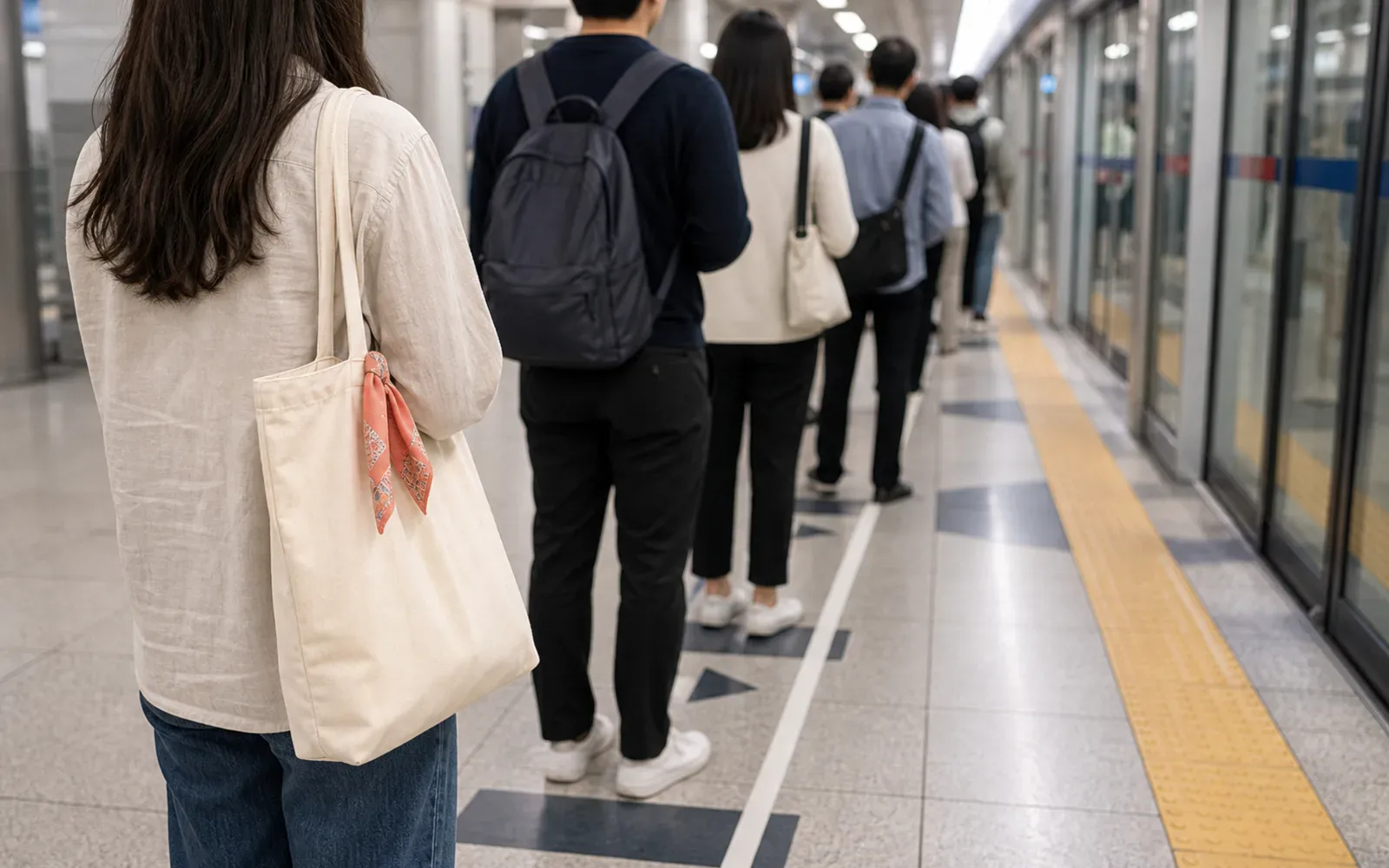
Wait to the side of the door so people can leave before you board. Once inside, move away from the doorway when space permits. If your backpack or suitcase blocks another person, adjust it before being asked. Put a phone conversation on hold when the carriage is quiet, and use headphones for audio.
Pay attention to the seat markings rather than deciding from appearances who deserves to sit. Pregnancy and other needs are not always visible. Give people space to use priority areas and respond promptly if someone needs the seat or access route. An empty reserved area is not automatically a good place to leave a suitcase.
At escalators, read the signs and keep luggage under control. Do not create a rigid “always stand on this side” rule from what one group happens to be doing. At a lift, leave space for people using wheelchairs, mobility aids or strollers to enter and exit. The goal is safe movement, not racing a local passenger through the station.
At an entrance: decide where shoes stop
Visit Seoul’s official etiquette guide describes shoe removal in settings such as residences and traditional interiors. For a visitor, the actionable signal is the threshold: a shoe rack, raised floor, slippers, posted instruction or host’s direction.
| Setting | What to do | What to avoid assuming |
|---|---|---|
| A host’s home | Pause at the entrance and follow the host’s shoe and slipper arrangement. | That outdoor shoes are acceptable because the visit is brief. |
| Restaurant with a raised floor and shoe storage | Check where to remove shoes before stepping onto the dining surface. | That the rule necessarily applies to a separate chair-seating section. |
| Ordinary café or shop | Use the normal entrance unless signs or staff say otherwise. | That every indoor business is a shoe-removal space. |
| Temple or heritage building | Read the instruction for the particular interior you are entering. | That permission to enter the grounds includes every room or platform. |
If uncertain, stop before the threshold and ask 신발을 벗어야 하나요? — “Should I take my shoes off?” Keep the entrance clear while you sort out footwear. Do not leave shoes across the path or carry dirty soles over a clean floor.
At a restaurant: identify the service pattern
Look for a host, queue, kiosk or counter before taking a table. A restaurant with self-service water and a tray-return area works differently from table service. KTO’s Korean food guide explains that self-service arrangements and ordering machines are part of the current dining landscape.
If you see utensils in a drawer or a water station, inspect the setup without reaching across another diner. If you cannot tell, ask staff where to find them. Use 주문은 어디에서 하나요? — “Where do I order?” This resolves a practical issue more effectively than assuming a quiet employee has ignored you.
When invited to a meal with a host or an older group member, wait for the host’s cue before starting and observe how shared dishes are served. With friends buying separate meals in a casual food court, the same formal sequence may not apply. Ask for a serving utensil when needed rather than treating a shared platter as an individual plate.
Rest chopsticks and spoon on the table or their rest rather than standing them upright in rice. Avoid touching food that others will share with your fingers unless the dish is intended to be assembled by hand. For allergies or dietary restrictions, explain the requirement before ordering; courtesy does not require eating something unsuitable.
Payment and handovers: be clear without performing a ceremony
When presenting a document, gift or item to a host, using both hands or supporting the receiving hand is a useful respectful gesture. At a busy shop, follow the payment tray and terminal instructions. You do not need to invent a formal handover that blocks the queue.
Visit Seoul notes that tipping is not customary. Pay the displayed bill and ask about an unclear charge rather than automatically adding a percentage. A particular hotel’s or business’s stated policy is a separate matter. If a server declines an offered tip, do not insist as a test of politeness.
When returning an incorrect order or asking about a bill, show the receipt and the specific item. A calm question is usually easier to resolve than describing a whole meal through an automatic translation. If you made the mistake, a short apology and a clear next request are enough.
Photos: separate public access from permission to photograph
A museum ticket gives access under the museum’s rules; it does not establish that every exhibition permits photography, flash or filming. Check the sign at the particular gallery. The National Museum of Korea visitor information is a starting point, and the gallery’s current instruction controls the specific space.
Ask a person before making them the subject of a close photograph. If a vendor declines, buy or leave without treating a purchase as permission. Keep tripods and group photo stops out of entrances and pedestrian flow. A clear view of an attractive doorway does not make it a public photo set.
Residential streets have more specific limits
Bukchon is a useful example because it combines a visitor destination with homes. Seoul’s official special-management-area notice concerns designated areas and tourist access restrictions. Read the current local sign and area map rather than applying an old neighborhood-wide assumption.
Keep voices low, do not look through residential windows and do not enter a courtyard because its door happens to be open. If a narrow lane is busy, move the group to a place where residents can pass before checking the next map point. A closed or restricted street means choosing another route, not waiting for the resident to stop watching.
For a visit built around the actual access rules, use the Bukchon visiting-hours and route guide. Neighborhood restrictions are site rules as well as a question of considerate behavior.
Four phrases that solve the immediate problem
- 실례합니다. — Excuse me. Use it before asking for space or a brief question.
- 여기 들어가도 되나요? — May I go in here? Ask before crossing an uncertain boundary.
- 사진 찍어도 되나요? — May I take a photograph? Point to the subject or area so the question is clear.
- 죄송합니다. — I’m sorry. Then make the small practical correction: lower your voice, move your bag or step back.
You do not have to memorize every expression. A saved short question, a gesture toward the relevant sign and willingness to follow the answer are usually more useful than trying to demonstrate a complete set of cultural rules.