
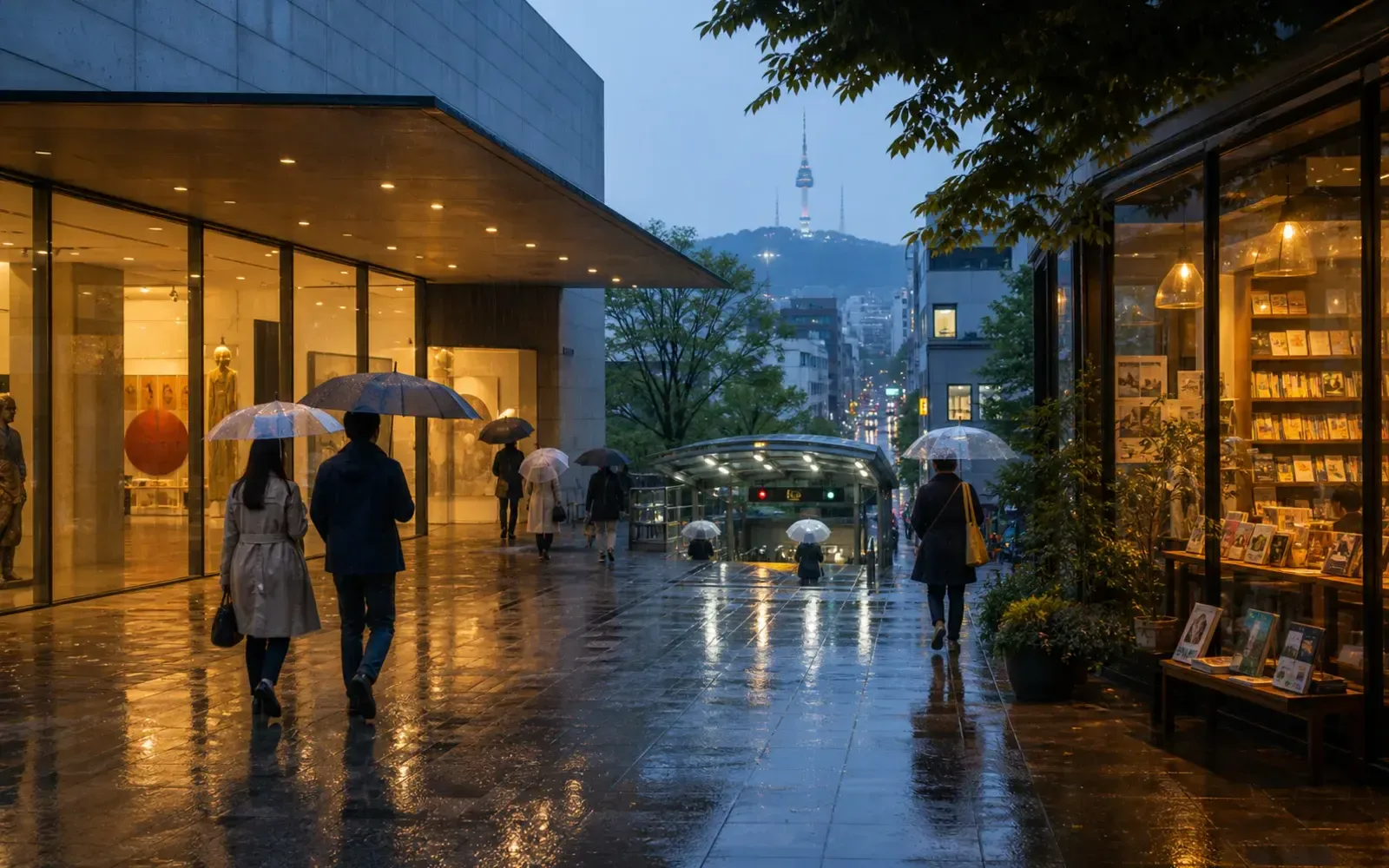
Weather-plan verification: July 27, 2026. A rainy Seoul day works best when you choose one indoor anchor and keep the transfers short. This plan uses museums with published hours and subway-accessible districts, then shows how to build a flexible route around them.
Do not plan four “indoor” attractions scattered across the city. Station exits, uncovered walks and wet luggage create more friction than the rain itself. Pick one of the three routes below, confirm same-day opening information, and leave one optional stop.
Three rainy-day schedules with an indoor first act
Use one museum as the main appointment and put the flexible meal or short outdoor connection afterward. This order protects the reason for traveling when rain becomes heavier. The schedules below are editorial visit allocations, not measured transfer times.
| Version | Indoor block | Meal and optional second block | A sensible ending |
|---|---|---|---|
| Yongsan collection day | Two to three hours at the National Museum of Korea | A selected meal, then a brief grounds walk only if conditions suit | Return toward Ichon |
| Central city-history day | About 90 minutes at Seoul Museum of History | Lunch nearby; a short Gwanghwamun-side walk if rain eases | A useful central station |
| City Hall contemporary-art day | One current SeMA Seosomun exhibition | A meal in Jeongdong or the chosen station area | City Hall route back |
The outdoor block is optional. You can omit it and still complete the museum day. Do not keep the original walking checklist when weather makes the transfer unpleasant or unsafe.
Choose the current galleries, not only the building
The National Museum of Korea’s renovation notice lists closures affecting portions of the painting and craft sections through January 28, 2027, including Galleries 301 and 302. It identifies Celadon Gallery 303 and Buncheong Ware and White Porcelain Gallery 304 among the galleries remaining open.
That matters when a rainy-day article recommends history plus art without specifying the rooms. Use the first-floor historical material and a currently available art or ceramics area, rather than expecting the entire craft floor to operate unchanged. The Room of Quiet Contemplation has its own identity and should not be confused with a general Buddhist sculpture room.
For SeMA, the exhibition itself determines whether the visit interests you. An open building between installations can offer less than a current exhibition day. Read the exact show and branch before using it as your only indoor anchor.
Keep the wet station-to-venue connection honest
A museum near a subway station is not necessarily connected by a fully covered route. Save the correct surface exit and entrance, and allow time for umbrellas, crossings and bag storage. If you need a lift, select the station’s accessible route rather than the shortest stair exit.
For a group with suitcases, an additional hotel or staffed-storage stop can be worth the time. Confirm the actual bag arrangement before relying on a museum locker. A cloakroom or a small compartment should not be presented as guaranteed storage for several large cases.
If the exposed connection is long and the weather severe, compare a legitimate road transfer with another indoor venue closer to your current district. The objective is a comfortable, worthwhile collection visit, not completing the venue originally chosen before the forecast changed.
Make lunch a real destination
Choose a restaurant or museum food facility with current opening information. A café can provide a drink and a seat, but may not provide the substantial meal your group expects. Check the actual menu and dietary needs before using it as the middle of a long indoor day.
Keep the meal near the chosen museum or return station. Moving across Seoul for a second indoor stop can reintroduce the very exposed walking and transfer problems that the rain plan was meant to reduce.
End with something remembered rather than everything covered
Select two galleries or one exhibition and finish while you still have attention for the labels and objects. Use the last block to note a room or work you would revisit, collect belongings and save the journey back.
A successful rainy day can be one museum, one meal and an easy return. It does not need several distant attractions merely to justify spending the day indoors.
Route A: National Museum of Korea and Yongsan
The National Museum of Korea is at 137 Seobinggo-ro, Yongsan-gu, near Ichon Station. Its permanent exhibitions are free. The museum’s 2026 visitor page lists regular hours of 9:30 a.m.–5:30 p.m. on Monday, Tuesday, Thursday, Friday and Sunday, with Wednesday and Saturday opening until 9 p.m. It closes on January 1, Lunar New Year’s Day and Chuseok. Special exhibitions may require a separate ticket.
This is the strongest full-day rain option because the collection is large enough to justify the trip. Decide on two galleries before arriving—Korean history plus art, for example—rather than trying to cover every floor. The museum announces temporary hour changes, so the official visitor page is the final authority. Temporary notices can override the regular schedule; the previous July 27–August 17 summer notice is no longer a plan for a September visit.
Route B: Seoul Museum of History and central Seoul
The Seoul Museum of History is at 55 Saemunan-ro, Jongno-gu. Admission is free. The English visitor page lists 9 a.m.–6 p.m. hours, with Friday extended to 10 p.m., and closure on Mondays and January 1. Lockers are available. This location works well when your hotel is around Myeong-dong, City Hall, Gwanghwamun or Jongno because the transfer is shorter than a cross-city museum day.
Use the permanent exhibition to understand the city’s growth before walking outside. If the rain eases, Gyeonghuigung and the Gwanghwamun area are nearby; if it intensifies, stay indoors or move to a second venue only after checking the route from the exact station exit.
Route C: SeMA Seosomun and City Hall
Seoul Museum of Art’s Seosomun Main Branch is at 61 Deoksugung-gil, Jung-gu. The museum lists free general admission except for selected special exhibitions. Published hours are Tuesday–Thursday 10 a.m.–8 p.m. and Friday 10 a.m.–9 p.m.; weekend closing time varies by season. It closes on Mondays. Because exhibition turnovers can close galleries even when the building schedule looks normal, check the current exhibition list on the visit date.
The branch is near City Hall and Deoksugung. In light rain, the stone-wall road is a manageable addition; in heavy rain, treat the museum itself as the destination. A café is not a substitute for a backup plan—popular indoor spaces fill quickly during downpours.
What to carry
- A compact umbrella plus a waterproof sleeve for your phone and passport.
- Shoes that tolerate wet station floors; smooth tile becomes slippery.
- A small bag for the wet umbrella. Many entrances provide sleeves or stands, but availability is not guaranteed.
- A screenshot of the museum name and address in Korean for a taxi or navigation check.
- A portable battery. Indoor rerouting increases map and translation use.
How to read a Seoul rain forecast
Look beyond the daily rain icon. Hourly precipitation and severe-weather alerts determine whether a short outdoor connection is sensible. During monsoon conditions, avoid stream paths and low-lying routes even if a navigation app suggests them. The Korea Meteorological Administration’s English site publishes current forecasts and warnings. Follow official safety alerts received on your phone.
Reservation and closure checklist
- Open the venue’s official page on the morning of the visit.
- Confirm the date is not a Monday closure, holiday closure or installation period.
- Check whether a desired special exhibition uses timed tickets.
- Route from the station exit, not only from the station marker.
- Save a second venue in the same district, not on the opposite side of Seoul.
For a museum-only comparison, see our free Seoul museums guide. If bags make the day difficult, the official-station luggage guide lists current locker and staffed-storage options.
Quarterly gallery closures at the National Museum of Korea
The museum visitor page also lists permanent and special gallery closures on the first Monday of March, June, September and December, with any announced exception stated separately. Check the selected date as well as holiday closures before making the museum your only indoor anchor.
Official sources
- National Museum of Korea: hours, admission and access
- Seoul city: cultural facilities and museum links
- Seoul Museum of Art: Seosomun visit information
- Korea Meteorological Administration
Scope note: These are planning options, not claims of an on-site visit. Hours and exhibition access were checked against the linked official pages on July 27, 2026 and can change.