
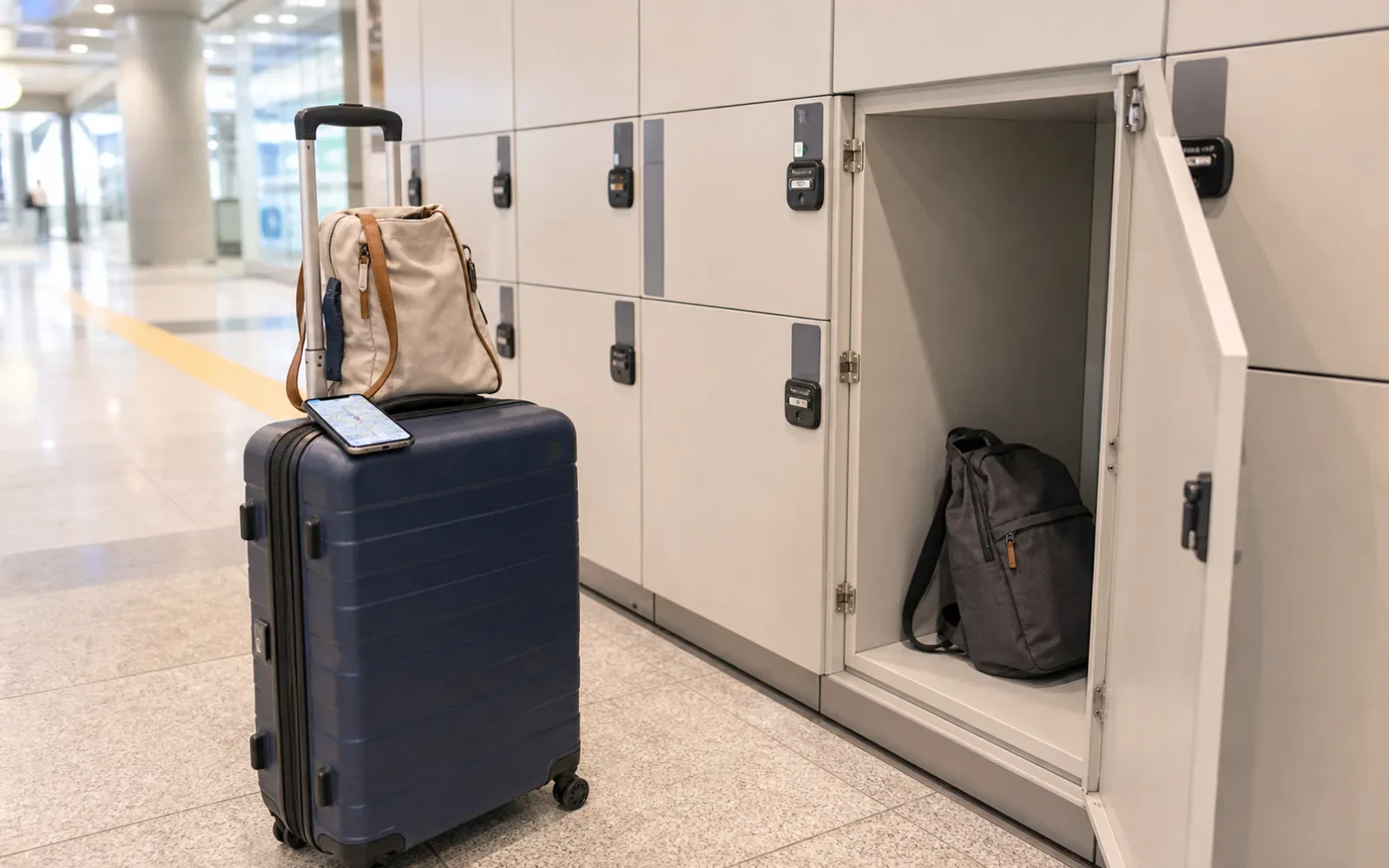
Locations and rates checked September 12, 2026. Seoul’s official T-Luggage counters and T-Locker system are useful when a hotel will not hold bags. The staffed service has published four-hour prices and selected station locations; ordinary lockers are cheaper but depend on size and vacancy.
A checkout day built around the storage station
Choose storage after deciding the airport or onward rail route. A counter near your next departure is often more practical than a slightly cheaper locker that requires a return across Seoul. The station, floor and collection method should be known before you leave the bags.
For a checkout followed by central sightseeing, first ask the hotel whether it will hold luggage under its current policy. If that arrangement fits the later journey, it can remove another transaction and station navigation. If it does not fit, choose a station facility on the actual route you will use afterward.
| Day pattern | Useful storage strategy | The final check |
|---|---|---|
| Hotel checkout, sightseeing nearby, return past the hotel | Confirm hotel holding first | Does the pickup time and hotel route still fit departure? |
| Central visit before an airport rail journey | A current facility at a useful departure station | Exact floor, pickup window and onward platform |
| Short stop with a small bag | A suitable available locker | Bag dimensions, transaction method and retrieval |
| Delivery instead of returning for bags | Separately confirmed delivery service | Destination, acceptance deadline and receiving instructions |
The table describes planning strategies, not guaranteed space or an individual operator’s liability promise.
Read the locker dimensions as three dimensions
Width, depth and height matter together. A suitcase’s airline cabin label is not a locker measurement, and wheels or an extended handle can change the fit. Compare the complete bag with the actual compartment rather than forcing it through the door.
The city’s storage page publishes locker size categories and rate information. Use the selected locker screen and current operating instructions for the actual transaction. The existence of a large category does not establish vacancy at the station you need.
If the bag does not fit, choose another suitable compartment or a staffed facility. Do not leave part of the bag outside a locker or assume the door closing partly establishes a completed secure storage transaction.
Keep the collection method independent of a dead phone
Save the receipt, locker number, service contact and any legitimate retrieval instructions. Keep access codes private. If the process depends on an app, account or confirmation, know how you will retrieve the relevant record when the phone connection is poor.
Retain enough battery for pickup and the onward route. A power bank can be more useful on a checkout day than another sightseeing purchase. Do not put the only charger, essential medication or travel documents inside the bag you cannot access during the visit.
The extra hour begins before you realize it
An attraction queue, a long lunch or a delayed train can extend storage beyond the initial block. Use the published base and extra-hour categories to estimate the additional cost, then compare with the actual screen or counter before agreeing.
Set a collection reminder with a useful travel buffer. An alarm at the counter’s closing time is too late if you are still across the district. The reminder should tell you when to leave the last activity, not merely when the operating window ends.
Do not confuse a station label with the counter location
Large stations contain different lines, floors, shopping areas and entrances. A facility at Seoul Station or Hongik University still needs a precise approach. Save the current floor and nearby exit given by the operator and allow time to reach the onward platform after collection.
A short-looking airport connection can become awkward if the locker is on another part of the complex or the selected route uses stairs. Inspect the complete pickup-to-platform leg before using it as the final departure plan.
Finish the transaction before beginning sightseeing
Confirm the bag is accepted or the locker is secured, keep the actual receipt and check the pickup condition. Then begin the sightseeing route. An unfinished payment screen or an unconfirmed delivery request should not be treated as completed storage.
The useful outcome is a day with lighter bags and a predictable collection, not only the lowest displayed four-hour rate. Storage should make the itinerary simpler from drop-off through the final journey.
T-Luggage staffed-storage prices
| Size | Weekday, first 4 hours | Weekend, first 4 hours | Additional hour |
|---|---|---|---|
| Small | KRW 3,000 | KRW 4,000 | KRW 1,000 |
| Medium | KRW 4,000 | KRW 6,000 | KRW 1,000 |
| Large | KRW 6,000 | KRW 9,000 | KRW 1,000 |
| Extra large | KRW 9,000 | KRW 13,000 | KRW 1,000 |
Size is determined by the service, not by the airline’s cabin-bag label. Oversize items and prohibited contents are subject to operating rules.
T-Locker prices and hours
The city page lists locker service hours of 5 a.m.–midnight. Base four-hour rates are: small KRW 2,200 weekday / 3,100 weekend, then KRW 500 per additional hour; medium KRW 3,300 / 4,600, then KRW 800 per hour; large KRW 4,400 / 6,100, then KRW 1,000 per hour. Vacancy is not guaranteed, especially at major stations and checkout times.
Choose staffed storage or locker
| Need | Better starting point | Reason |
|---|---|---|
| Large suitcase or unclear fit | T-Luggage | Staff can assign size and explain pickup |
| Small bag for a few hours | T-Locker | Lower published base price |
| Very early pickup | Locker, after confirming access | Staffed counter hours may differ |
| Valuable or prohibited item | Neither until rules are checked | Storage liability and exclusions apply |
Do not store these without checking rules
Passports, large amounts of cash, medicine needed during the day, fragile electronics, perishables and dangerous goods should not be treated like ordinary luggage. Keep essential travel documents with you. Photograph the locker number or receipt without exposing an access code.
Pickup planning
- Choose storage on the path to your next train, airport route or hotel.
- Add time for station navigation; Seoul Station is a large complex.
- Save the exact floor, exit and retrieval method.
- Set an alarm before the counter closes or the hourly charge grows.
- Keep a backup payment method and the service contact.
A locker across Seoul from the airport route is false economy. Compare your final transfer in the airport transport guide. For the subway card used to reach the station, see the T-money instructions.
Estimate a storage bill before handing over the bag
Using the city table above, a large bag held for six weekday hours at the staffed service has a base four-hour charge of KRW 6,000 plus two additional hours at KRW 1,000: KRW 8,000 if those rates and that classification apply. The comparable weekend calculation is KRW 9,000 plus KRW 2,000, or KRW 11,000. These are arithmetic examples, not quotes for a particular bag.
For a large locker, the table’s six-hour weekday calculation is KRW 4,400 plus two hours at KRW 1,000, or KRW 6,400. A lower paper price is useful only if the bag fits, a compartment is available and retrieval remains possible at your departure time. Confirm the screen’s actual size and charge before payment.
Storage and delivery are different transactions
Leaving a bag at a station for later pickup is storage. Sending it to another station or an airport is delivery, with separate prices, acceptance deadlines and destination conditions. Do not assume a storage receipt means your bag will be moved automatically.
If delivery is essential, confirm the receiving location, pickup window and identification requirements before handing over the bag. Keep medication, passport, payment cards and your flight documents with you. A sightseeing plan should never depend on an unconfirmed delivery reaching the airport at the last possible moment.
The retrieval checklist
Save the station, floor, counter or locker number, receipt and support contact in one note. Keep access codes private. Test that you can retrieve the relevant app or receipt offline, and leave enough phone battery for any required digital process.
Route the final meal and sightseeing stop toward the storage station. Then reserve a time buffer for a queue, an elevator or a payment problem. A cheaper counter that forces you to cross Seoul twice can be worse value than storage on your actual airport route.
Official staffed T-Luggage locations
Seoul Metropolitan Government lists these station points:
- Seoul Station: basement level 1, near Exit 1.
- Hongik University Station: basement level 1, near Exits 3 and 4.
- Jamsil Station: basement level 1, near Exits 3 and 4.
- Myeong-dong Station: basement level 1, near Exits 9 and 10.
- Gimpo Airport Station: basement level 1 near the information center.
- Jongno 3-ga Station: basement level 1 near Exit 6.
Station construction or service changes can move a counter. Follow current signs and the official T-Luggage page on the day.
Official source
Verification note: The location and price tables above follow the city’s published English guidance; counter and locker operation must be checked separately. Recheck operating status and availability on the storage date.