
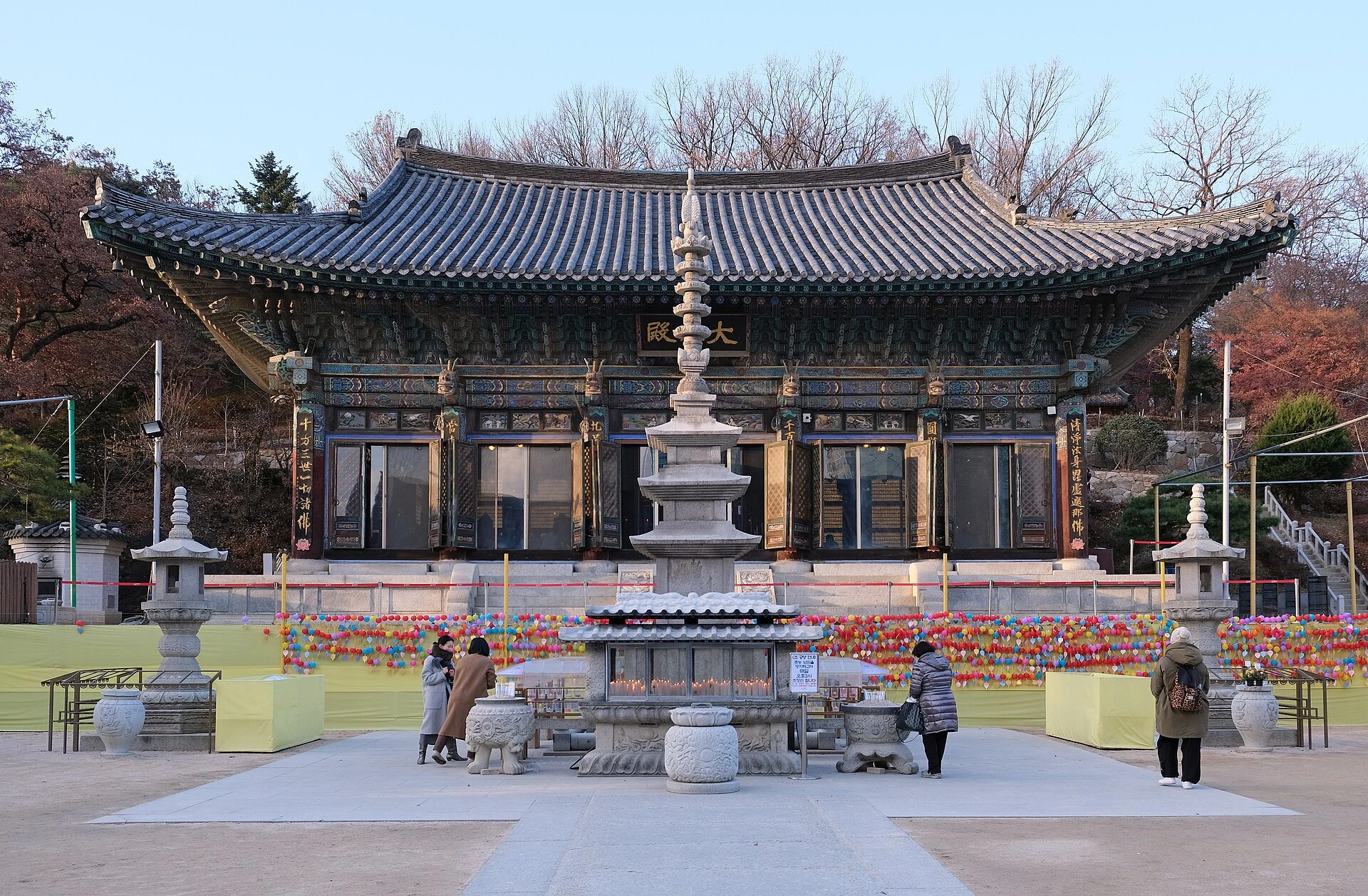
Bongeunsa and Starfield Library sit in the same Gangnam outing, but they ask different things of a visitor. The temple is a place of religious practice, with access shaped by worship. The library is an open cultural space inside a commercial complex, with books, events, moving shoppers and photographs. Enjoying both requires noticing that change of purpose when you cross from one to the other.
Choose the temple first if its grounds and religious setting interest you. Choose the library first if a particular talk or your meal arrangement fixes the timing. A mall’s long opening hours should not make the temple a hurried decorative stop at the end.
Keep the two opening windows separate
Korea Tourism Organization’s Bongeunsa record gives the temple address as 531 Bongeunsa-ro, ordinary opening of 05:00–22:00 and free entry. Visit Seoul adds a qualification: use can vary with Buddhist services and prayer schedules. Those are grounds-level planning references, not permission to enter every hall whenever its door is open.
The Starfield operator’s library page gives 10:30–22:00 and describes a space open to everyone free of charge. The address of COEX Mall is 513 Yeongdong-daero. A free library entrance does not include paid entertainment, food, shopping or a reserved program elsewhere in the complex.
| Decision | Bongeunsa | Starfield Library |
|---|---|---|
| Primary purpose | Religious practice and a cultural visit to an active temple | Reading, meeting and cultural activity within COEX Mall |
| Ordinary entry | Free; hall use can depend on services | Free; events and available seating vary |
| Best approach | Bongeunsa Station Exit 1 for the temple side | Use the mall map and the library’s actual interior position |
| Photography decision | Check each hall and respect worshippers | Keep stairs, escalators and reading seats usable |
Start on the side that serves your first destination
The official Bongeunsa location page identifies Bongeunsa Station Exit 1 on Line 9 as an approach. For the library, Visit Seoul’s library directions list Samseong Station Exit 5 on Line 2 and Bongeunsa Station Exit 7 on Line 9. The different exit numbers are meaningful: the temple entrance and a mall approach are not the same destination.
Save the temple and the library as separate pins. When crossing between them, use the actual legal crossing and signed mall entrance rather than following a straight line on a map. Inside COEX, switch from a city map to the mall’s floor map; an underground corridor can make a familiar-looking street direction unhelpful.
If you need an elevator, identify the station lift and the connecting entrance independently. A nearby exit label does not establish a step-free route through both the temple grounds and the commercial complex. Build the connection around the person’s actual mobility requirements, not the shortest stair-based route.
At Bongeunsa, read the threshold before the interior
Pause at the entrance and orient yourself before walking toward a hall. Notice which areas are open for ordinary visitors, where a service is taking place and where people have left shoes. Follow the local instruction; do not generalize from one building that shoes come off throughout the entire outdoor site.
From a permitted public position, look at the relationship among the gate, courtyard and religious buildings. The surroundings make the contrast with contemporary Gangnam visible without needing to interrupt a ceremony or enter a restricted room. The temple’s value does not depend on gaining access to every interior.
If hall entry is allowed, keep your visit unobtrusive. Move around the edge rather than cutting between someone praying and the focal religious space. Keep phones quiet, avoid directing a companion into a worshipper’s path for a portrait, and leave a seat or cushion alone unless its use is clear.
Visitors do not have to perform a ritual they do not understand to show respect. Watching quietly and following a posted boundary is appropriate. If you want a structured practice session or a temple-stay activity, use the temple’s official program channel and read its date, language, price and reservation conditions. Ordinary free entry does not make a scheduled program a walk-in entitlement.
Look beyond the temple–skyscraper photograph
KTO’s historical account describes the temple’s earlier name, relocation and important Buddhist texts. That context makes a better starting point than treating the buildings only as a striking contrast with the surrounding high-rises. Ask what a particular hall is used for and what the interpretation says about the object or practice inside.
For a concise visit, choose one architectural relationship and one piece of interpretation. You might notice how the entrance leads toward a quieter courtyard, or compare the outward appearance of a building with the activity it accommodates. Use the labels to identify it instead of assigning a religious meaning from decorative appearance alone.
Photography should preserve that attention. Ask before making a close image of an identifiable worshipper, and obey a no-photography notice even if another visitor ignores it. A photograph from a public area can record the setting without turning a private act of prayer into the subject of your outing.
At Starfield Library, decide whether you are reading or looking
The operator describes the library through books, rest, meetings and cultural communication. It is also a busy public space within a mall. Someone seeking a quiet work session has a different need from someone coming to see the tall shelves and open interior. Decide which experience you want before looking for a seat.
For a short visual visit, take a permitted viewpoint that leaves the circulation route clear. Stay off escalator landings while adjusting a camera. Then look through a section of books or magazines rather than judging the entire library from the first photograph.
For reading, find a suitable available seat and follow the space’s current rules. Do not occupy several places with shopping bags or assume a nearby café purchase reserves a library table. If conversation, a full meal or intensive laptop work is the main need, a business designed for that use may fit better.
A talk or performance belongs to its actual event listing. Check whether attendance is open, whether a separate registration applies and which part of the library is being used. The existence of a regular events calendar does not mean a particular author talk is offered every day.
Keep shopping and dinner from absorbing the whole outing
COEX can add a meal and a weatherproof break, but its scale makes unplanned browsing expand quickly. Choose the meal area after locating the library, and keep the route back to the station in view. If a paid attraction is part of the day, give that purchase its own booking and time allowance instead of treating it as included in the library visit.
On a wet day, the mall provides a substantial indoor component while the temple approach remains outdoors. On a pleasant day, begin with the temple and use the library as the contrasting second act. For broader visitor behavior, the practical etiquette guide explains how signs, shoe boundaries and privacy work in different settings. The ordering guide helps when the meal is the day’s next unfamiliar transaction.