
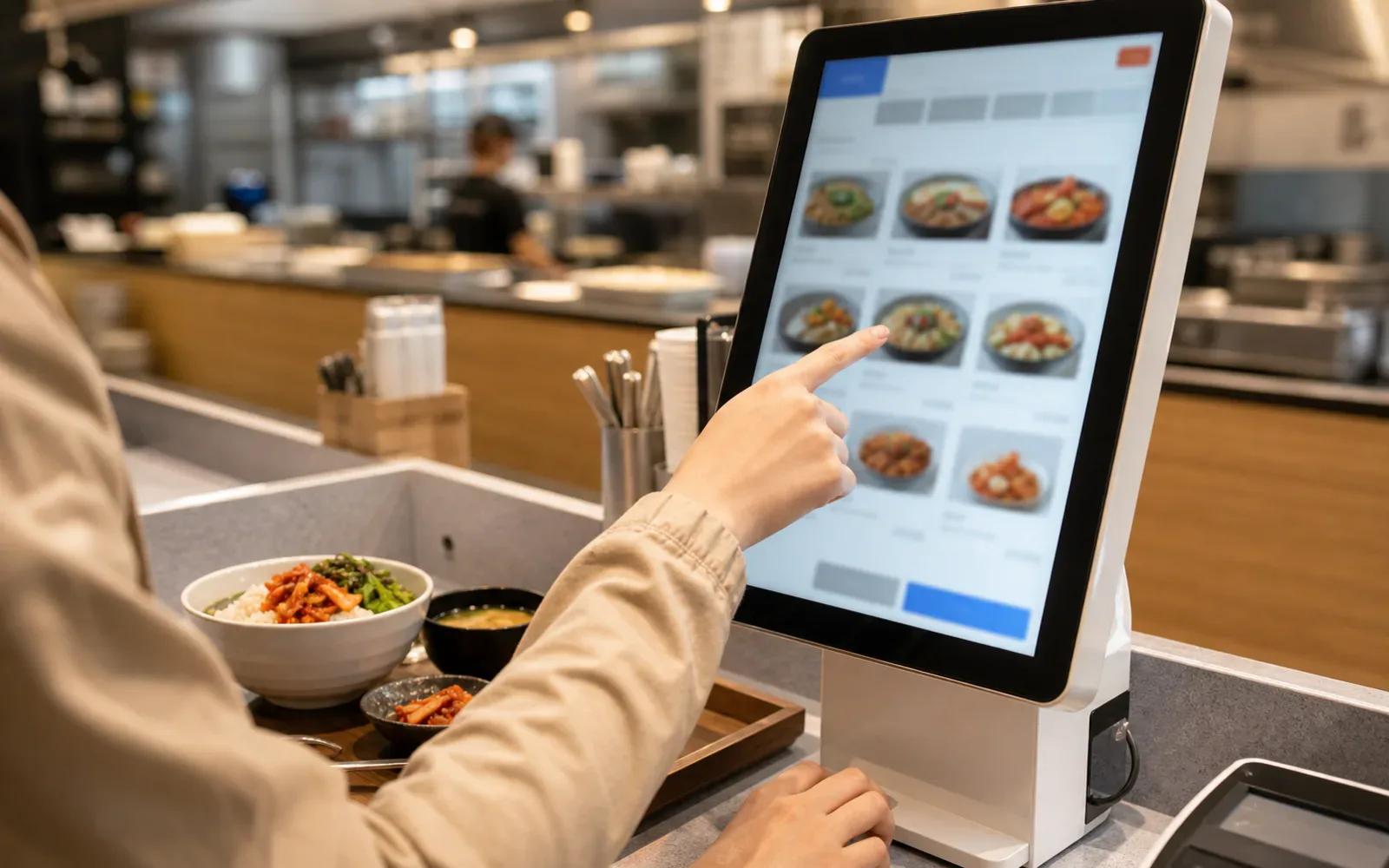
A restaurant order in Korea becomes easier once you know where it happens: with staff, at a front counter, on a kiosk, on a table tablet or through a QR page. Work through the dish, quantity, options and total in that order. Translating the entire menu is less useful than understanding the few choices that change your meal.
Find the ordering point before choosing a seat
| System | First action | Confirmation to keep |
|---|---|---|
| Staff at the table | Identify the menu line and price unit | The agreed dish, quantity and any changes |
| Front counter | Order and check whether payment comes first | The receipt or collection number |
| Kiosk | Find the language option and choose dine-in or takeaway | The completed transaction and order number |
| Table tablet | Check the table or ordering session | The submitted order, rather than an unsubmitted cart |
| QR page | Confirm with the restaurant that it is the correct ordering page | The table reference and completed ordering stage |
A QR code can lead to a menu without taking orders, or to a system where ordering and payment happen separately. Before entering payment details, confirm that the page belongs to the restaurant’s ordering process. An unfamiliar page is a reason to ask staff, not to guess the next step.
Read the words that change the order
Camera translation can mix neighboring columns and separate a price from its unit. Crop the dish name and its options together. If a photograph is numbered, use that number while confirming the size and quantity; the picture alone may represent a larger serving or a set.
| Korean term | Common meaning | What it changes |
|---|---|---|
| 매장 | Dine-in | Where the meal will be eaten |
| 포장 | Takeaway | Packaging and collection |
| 추가 | Extra or addition | An additional item or charge |
| 세트 | Set or combination | The components included in the order |
| 품절 | Sold out | Whether the item can be selected |
| 수량 | Quantity | How many items are in the cart |
| 결제 | Payment | The transaction stage and total |
| 주문 완료 | Order completed | The reference to retain |
These are reading aids; the wording and screen sequence vary. Also inspect hot or cold, spice level, meat type and portion size when those options appear. Translate the actual option beside its charge rather than assuming every upgrade is included.
Complete a kiosk or tablet order once
At a kiosk, choose dine-in or takeaway, select the base item and review the options before opening the cart. Check quantity, set upgrades and the final total. Exploring a menu can accidentally add the same item twice, so compare the cart with the meal you intend to buy before paying.
On a table tablet, make sure you use the final submit action. Items placed in a cart may not have reached the kitchen. For another round, check the new quantity and order status rather than assuming the screen remembers what you meant. Payment may still take place at the front counter after the meal.
If a card is rejected, establish whether the sale failed before repeating the transaction. Ask staff and retain the relevant receipt; a bank notification alone may not explain the merchant’s result. Foreign-card acceptance differs by terminal and payment network, so a second card and a modest cash backup can be useful.
Give staff one clear order at a time
Point to the menu line, show quantity, state any requested change and confirm the price unit. For a shared plate, ask whether the amount is for the whole dish or per person. For meat, read the portion weight and first-order minimum before agreeing to the order.
When the item is already identified, 하나 주세요 requests one. 공깃밥 하나 주세요 asks for a bowl of rice; 포장해 주세요 asks for takeaway packing, subject to the restaurant offering it. Keep a translated request short enough to read alongside the menu. One item and one change are easier to resolve than several unrelated instructions in a long paragraph.
Many tables have a call button; press once and wait. Without one, “yeogiyo” is a common way to attract attention. If a receipt shows the wrong item or quantity, point to the exact line promptly so staff can identify the problem.
Resolve dietary requirements before submitting
A removed topping does not remove a pre-made broth, sauce, batter or marinade. For an allergy, show a translated statement naming the ingredient and severity, and ask whether the kitchen can accommodate it, including cross-contact concerns. Menu translation cannot establish that a preparation is safe.
“Less spicy” may still contain chili. Vegetarian, halal-friendly and suitable for a particular allergy are also different conditions. The vegetarian food guide and Muslim-friendly food guide explain those distinctions. If the answer remains unclear, use a prepared alternative before paying.
Follow collection, self-service and payment signs
After ordering, identify whether food comes to the table or is collected by number. Keep the reference until the complete order arrives. At a food court, the pickup display and tray-return point may belong to your chosen vendor rather than the whole seating area.
Korea Tourism Organization guidance notes increasing self-service for water and side dishes in casual restaurants. Cutlery and napkins may be in a table drawer. Follow refill signs and take a small amount first: not every side is unlimited, and premium additions can cost extra.
When paying at the front counter, bring the table slip or provide the table number. KTO visitor guidance describes tipping as not customary in ordinary Korean restaurants. For a table-grill meal, consult the barbecue guide; the visitor payment guide covers card and cash planning.
Treat delivery as a separate arrangement
A restaurant kiosk working with your card does not establish that a delivery app will. Delivery can depend on a Korean phone number, supported payment, a precise Korean address and the service’s current coverage. Visitor-oriented options exist, but their fees and processes vary. Ask your accommodation whether drivers can enter or whether you must collect in the lobby.
If an ordinary order becomes too difficult to explain, a photographed single-item meal or a venue with a useful multilingual menu can simplify the next attempt. Choose that alternative because its ingredients and process are understandable, rather than assuming a simple-looking dish meets a dietary restriction.
Official visitor resources
- VISITKOREA: Korean meals and restaurant customs
- VISITKOREA: food delivery guidance for visitors
- VISITKOREA: official food and restaurant portal
Accuracy boundary: Ordering and payment systems differ by restaurant. This guide describes a verification process and does not promise that a venue can accommodate an allergy, religious restriction or foreign payment card.