
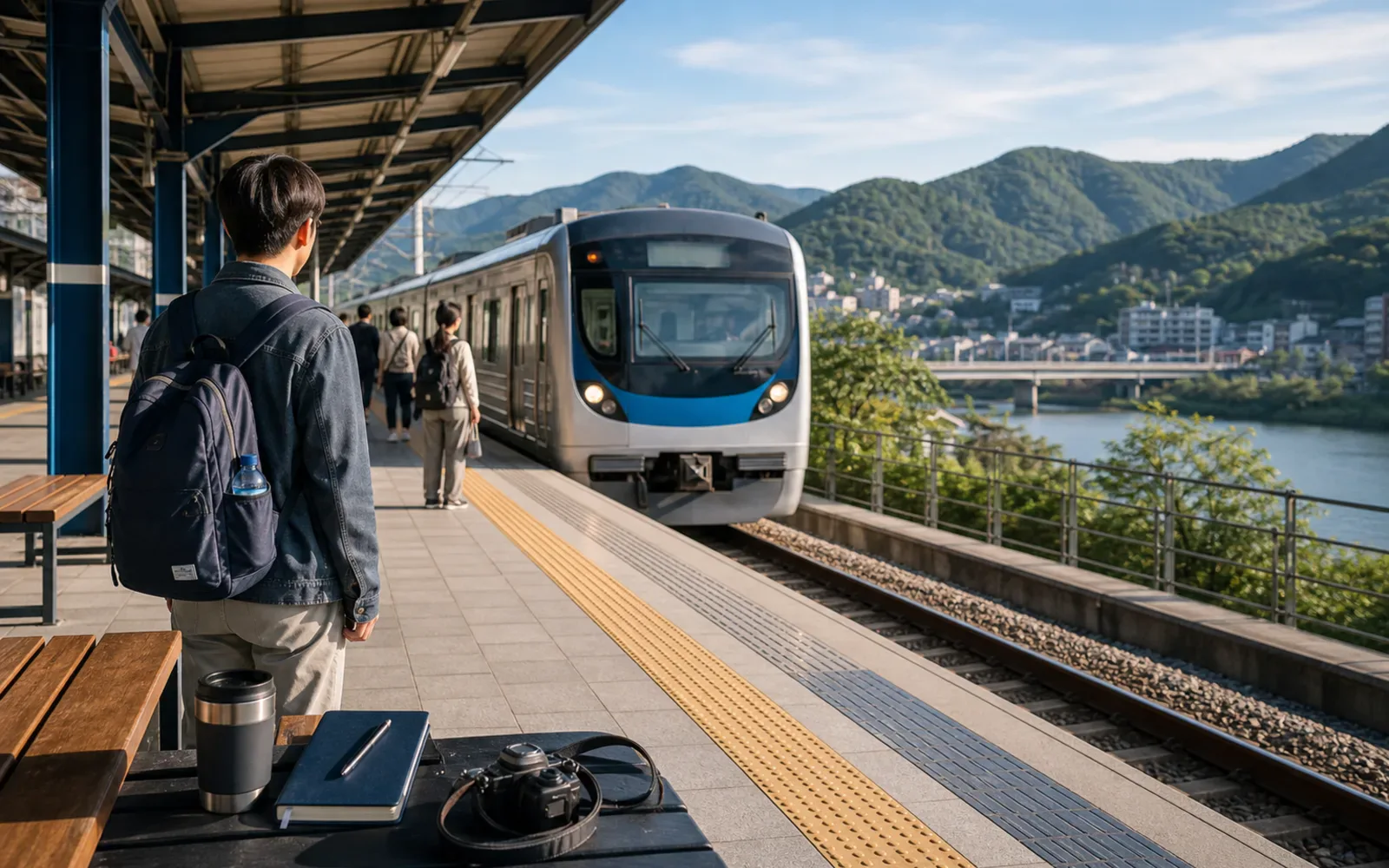
Suwon is the easiest history-focused day trip, Incheon Open Port is the simplest urban walk, and Chuncheon is the better nature choice when you are willing to plan local transport. All three can be reached without renting a car, but “near Seoul” does not mean the same door-to-door effort.
Three different rail trips, written as complete days
The journeys below are editorial route templates. Train time must come from the actual departure you choose; the on-site allocations are planning estimates, not measured trips. Their purpose is to connect the arrival station with the first attraction and the eventual return, rather than treating a destination name as a finished itinerary.
Suwon: palace district before a short fortress section
For a central-Seoul departure, look up Line 1 toward Suwon or a suitable reserved Korail service to Suwon Station. Compare the actual departure point and arrival time, not simply subway versus train in the abstract. A transport card and a reserved rail seat are different tickets.
From Suwon Station, the Cultural Foundation’s directions identify city buses 11, 13 and 13-4 from the stop near Exit 4 to the Hwaseong Haenggung area. Make that the first attraction district. Spend around an hour at the palace, eat nearby, and use the remaining outdoor block for Hwahongmun or one other selected fortress landmark before returning toward the station.
This order prevents the common mistake of arriving at the station, starting a long walk toward a wall tower, and reaching the palace near last admission. The operator’s current price page distinguishes free fortress access from Haenggung admission and separately paid experiences.
Incheon: old port, one museum and a meal
Use a rail route specifically to Incheon Station, with the Line 1 Incheon branch as the central-Seoul reference. Do not follow an airport route or a train bound south toward Suwon simply because the service belongs to the same larger metropolitan network.
On arrival, begin with Chinatown and the neighboring historic port streets. Visit the Open Port Museum before a long lunch if your arrival is late. Its official tourism listing supplies the address and admission window. End with a meal in the same district and return to Incheon Station.
Allow two to three hours on site for a selective street-and-museum visit, with more time if you choose the hill toward Jayu Park. Songdo is a separate extension, not a place automatically included because the day is labeled Incheon. The compact version has a distinct beginning and end without adding another district.
Chuncheon: choose the local destination before the rail ticket
KTO’s rail guide identifies ITX-Cheongchun between Yongsan and Chuncheon. Compare the useful departure from your hotel with the actual train and ticket you can obtain.
Your local destination then decides whether Chuncheon or Namchuncheon is more practical. A downtown meal plan, a lakeside attraction and a destination farther outside the city need different final connections. Save that connection before reserving a return, because the local leg can consume more time than expected.
For a first city-focused visit, choose one central activity, a meal and one nearby second stop. Avoid adding Nami Island, several lakeside attractions and downtown Chuncheon under the same short-day label. A rail line serving the region does not make every regional attraction adjacent to its final station.
A comparison that includes the local leg
| Question | Suwon | Incheon old port | Chuncheon |
|---|---|---|---|
| First arrival task | Connect station to palace district | Orient toward Chinatown | Connect chosen station to actual activity |
| Main geographical strategy | Palace plus one wall section | One compact commercial-and-history district | One anchor with planned local transport |
| Easy reduction | Omit a distant gate or full perimeter | Omit the hill and separate districts | Omit the second distant attraction |
| Return to protect | Local connection to Suwon Station | Correct rail branch from Incheon Station | Actual station and any reserved return seat |
Compare the whole day in five blocks: hotel to rail station, rail journey, local connection, sightseeing and meal, then the full return. That structure makes destination choice more honest than ranking three cities by the shortest train time alone.
When another city is not the better day
If the journey plus local transfers leaves only a hurried attraction visit, a focused Seoul district can be the more rewarding choice. A day trip should provide enough time to experience its anchor, not only the satisfaction of crossing a city boundary.
Choose Suwon for a royal-and-fortress day, Incheon for an old-port walk, and Chuncheon only after the nature or city activity is clearly selected. They are three different experiences, not interchangeable destinations reached by a line on a rail map.
Match the arrival station to the return ticket
A ticket to the city is not always a ticket to the most convenient station for your activity. Read the full station name on both journeys and compare the local connection in each direction. If you arrive at one station and leave from another, make that deliberate and save both locations before traveling.
For a reserved service, keep the departure date, time, carriage and seat together. For a metropolitan journey, keep the line branch and destination direction instead. These are different navigation tasks, and mixing them is a common source of confusion when an excursion includes both an ordinary subway and a booked rail leg.
A useful final check is simple: can you describe how you get from the last activity to the actual departure platform? If that part is still missing, the day is not ready merely because the outward train is booked.
Choose the destination by the fixed part of the day
| Destination | Anchor | Main planning risk | Best fit |
|---|---|---|---|
| Suwon | Hwaseong Fortress and the palace area | The fortress is long; trying to walk all of it can consume the day | History, architecture and a structured route |
| Incheon Open Port | Chinatown and nearby modern-history streets | Treating distant Songdo and the old port as one compact neighborhood | Food, urban history and a low-complexity walk |
| Chuncheon | Lake, riverside or one selected attraction | Local attractions are spread out after the train arrives | Nature and a longer full-day plan |
The door-to-door test
- Route from your accommodation, not Seoul Station by default.
- Add the time from the destination station to the first attraction.
- Check the last useful return, including transfers in Seoul.
- Choose one indoor or low-weather-risk backup.
- Remove any stop that requires crossing the destination city twice.
A day trip should still leave energy for the return. Two hours of extra movement can erase the value of adding one more famous place.
Tickets, cards and reservations
Do not assume a T-money card covers every useful service. Ordinary metropolitan rail, intercity rail, reserved trains, tourist trolleys, cable cars and attraction tickets can use different payment and reservation systems. Confirm the operator and ticket type for the exact route.
If a reserved train is central to the plan, purchase it through the official rail channel and keep the departure station clear. If using the metropolitan network, allow more time and verify the final service. The T-money visitor guide explains the stored-value boundary.
What to do if the weather changes
For Suwon, reduce the wall walk and use the museum or palace area after checking opening days. For Incheon, keep the compact museum and exhibition spaces around the Open Port district. For Chuncheon, confirm whether the chosen lake, boat or cable-car service is operating and be willing to postpone a scenery-first day.
Our Seoul rainy-day guide is the fallback when leaving the city no longer makes sense.
Official destination references
- VISITKOREA: current ways to explore Suwon Hwaseong
- VISITKOREA: Incheon Open Port history course
- VISITKOREA: Chuncheon by subway and rail
Editorial method: This comparison uses official tourism information and separates rail access from local movement. Timetables, attraction prices and operating days should be checked on the travel date.