
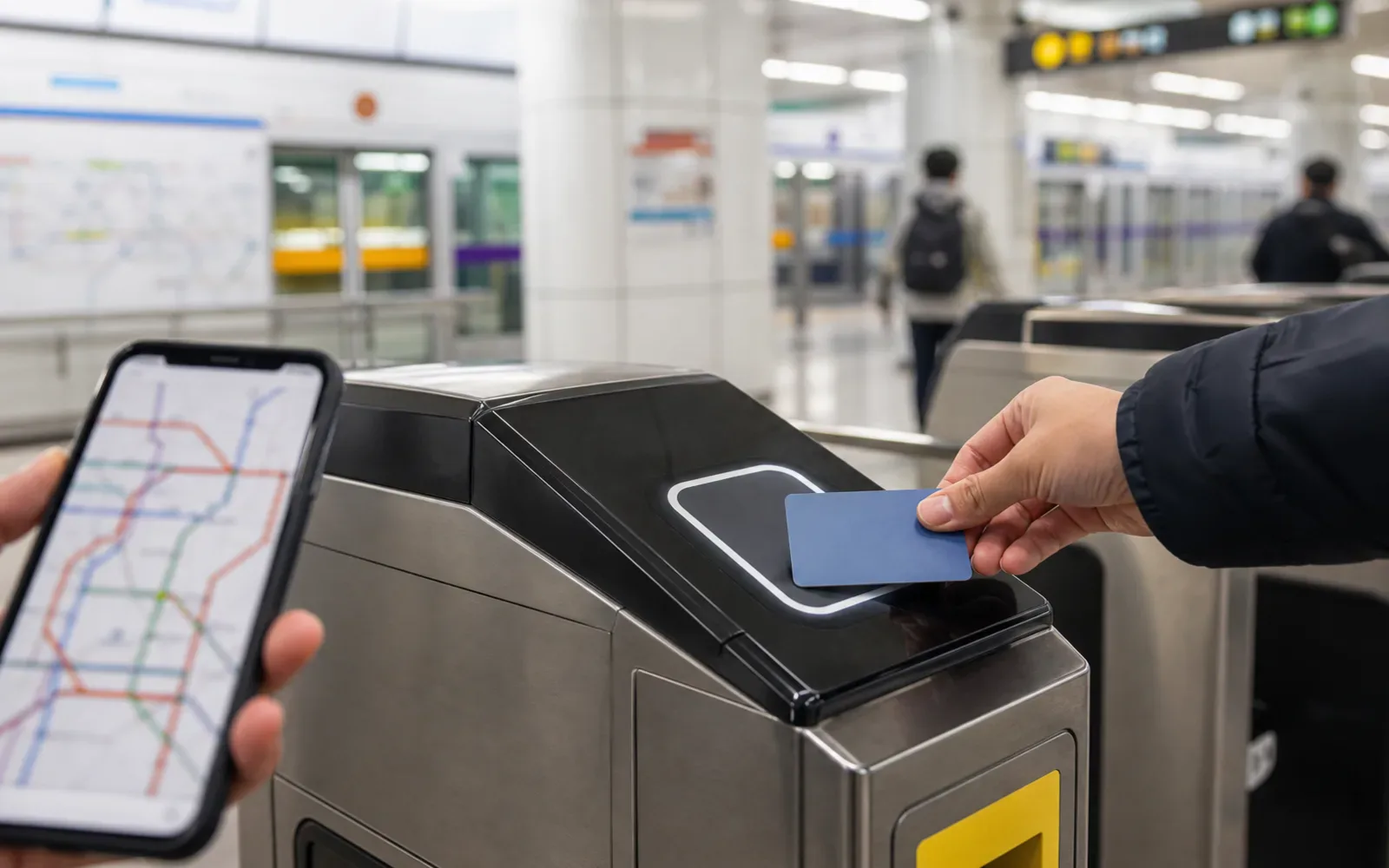
Transport guidance reviewed July 27, 2026. T-money is a rechargeable stored-value card used to pay transit fares. It is not an unlimited pass and it does not reserve intercity trains. For most short-term visitors, its advantage is simple transfer payment across ordinary subway and bus trips.
A cash top-up you can carry out at the counter
The official T-money foreign-language guide says to present the card and Korean-won cash at a top-up location. It lists loading in KRW 1,000 units, with an individual top-up range of KRW 1,000–90,000. The cost of buying the physical card remains separate from that loaded value.
At a convenience-store counter, hand over the card and say 티머니 만 원 충전해 주세요—Please add ten thousand won to this T-money card. If you choose another amount, show it on your phone as a number. Keep the card and cash together in view until the transaction is finished, then check the balance or receipt.
A KRW 10,000 top-up in that sentence is a communication example, not a universal recommendation for your trip. Someone taking only a few city rides needs a different estimate from someone including an eligible airport all-stop journey. The important point is to request loaded value explicitly, rather than accidentally asking to buy another card.
| What you want | Korean wording | What to check afterward |
|---|---|---|
| Add KRW 10,000 | 만 원 충전해 주세요 | The balance increased by the amount requested |
| See the balance | 잔액 확인해 주세요 | The displayed balance, not the physical card price |
| Ask about a refund | 잔액 환불할 수 있나요? | Whether that outlet handles your card and balance |
Loading at a station machine
Use a machine that offers transport-card recharge, choose the displayed language if available, and place the card in the marked area. Select the amount, insert the accepted cash and wait for the machine to finish before taking the card away. Keep any receipt and compare the displayed final balance with the amount you intended to add.
Do not confuse a single-journey ticket machine’s ticket-purchase function with rechargeable-card loading. One machine may provide several products, but the selected screen decides the transaction. If the machine does not accept your chosen payment method, use an eligible staffed point rather than repeatedly starting the same process.
Put the card back in a reachable pocket before approaching the gate. Searching for it immediately in front of the reader slows everyone behind you and makes it easier to tap a different contactless card by mistake.
A worked balance plan for two city days
Suppose your actual route has four city trips on the first day and three on the second. Write down the current fare estimate for each journey, including longer-distance charges and any transfer treatment shown by the operator. Add those seven estimates and a small margin, then choose the nearest practical top-up amount.
Do not multiply every vehicle boarding by a full new fare when an eligible transfer applies, and do not presume every leg receives a transfer discount. A premium service or a separate reserved rail ticket belongs on another budget line. The card’s job is paying eligible fares, not deciding which operator’s ticket is required.
At the end of the first day, use the observed remaining balance to adjust the next top-up. That is better evidence than the original estimate. If the next morning begins with a longer ride, recharge before the first gate rather than relying on the minimum that worked yesterday.
Refunds: the actual fee and the separate card cost
The same official guide states that a balance refund is paid in Korean-won cash and that a KRW 500 service fee applies. It explicitly excludes the physical card’s purchase cost from the refund. The eligibility and handling route can depend on the balance and card type, so ask the outlet before making a special journey.
For an eligible refund of a KRW 7,300 balance with the displayed KRW 500 fee, the arithmetic is KRW 6,800 returned. That is a calculation example, not a promise that every sales outlet processes every balance. A refund of stored value is also different from returning the card as a retail purchase.
The guide restricts partial-refund handling to particular T-money service locations and specified amounts. A short-term visitor will usually find a small final balance easier to manage than deliberately leaving a large amount for departure-day processing.
One traveler, one readable card
Keep each traveler’s card identifiable. A small sticker or a separate pocket helps when several similar designs are bought together. Do not stack them while tapping, and do not exchange cards halfway through a journey that relies on an entry and exit record.
For a child or teenager, ask the sales point about the current registration requirement and provide the legitimate age documentation it asks for. The operator’s guide distinguishes registered youth categories from ordinary adult use. A discounted-looking card design alone does not establish entitlement to a reduced fare.
What the card does
Load money, tap at the subway gate or bus reader, and the applicable fare is deducted. Tap when entering and leaving systems that require both. Correct exit tapping matters for distance calculation and transfer treatment. Participating convenience stores and merchants may also accept T-money, but do not rely on that function as your only payment method.
Where to buy and load
Use an official station sales point or a convenience store displaying the T-money logo. Card designs and purchase prices vary. Top-up payment methods can differ by machine and outlet; cash is the most broadly practical backup. The official foreign-language guide is the final reference for current purchase, recharge and refund rules.
Airport arrival sequence
- Confirm your arrival terminal and whether your chosen airport rail or bus accepts the payment method you plan to use.
- Buy a card only from a legitimate outlet.
- Load enough for the airport journey plus the first city ride.
- Keep the receipt until the card works.
- Do not block a gate while reorganizing luggage; step aside before tapping.
How much balance to add
There is no universal correct first top-up. Estimate the first two days, then add more rather than leaving a large unused balance. Airport transport, premium rail, intercity trains and taxis can follow different payment rules. Keep a bank card and some cash.
Transfers and tapping mistakes
| Mistake | Result | Prevention |
|---|---|---|
| Forgetting to tap out | Fare or transfer treatment may be affected | Keep the card in the same reachable pocket |
| Two people using one card | Normal individual gate use fails | Give each traveler a card |
| Insufficient balance at exit or boarding | Trip is delayed | Check balance after longer rides |
| Stacking cards in a wallet | Reader can detect the wrong card | Tap one card separately |
When a Climate Card might be better
A short-term Seoul Climate Card can be economical for repeated rides inside its coverage. It uses period-based pricing and has network limits. Compare the exact stations and travel days; an unlimited label is not useful when airport or outside-Seoul legs dominate. Our tourist card comparison lists current 2026 short-term prices and foreign-card machine changes.
Lost cards and refunds
Treat an ordinary unregistered card like cash. Recovery and refund depend on card type, registration and outlet. Do not promise yourself an airport refund without reading the official rule and leaving time before departure. Use down most of the balance naturally rather than loading a large amount on the final day.
Accessibility and gates
Use the wider accessible gate when luggage or mobility needs make a standard gate difficult. Station staff can help when the gate displays an error. Do not tailgate another passenger or force a barrier; show the card and error to the staffed window.
Save these official pages
- T-money: foreign visitor guide
- Seoul Metropolitan Government: public transportation
- Seoul: Climate Card rules
If luggage is the reason a transfer feels difficult, see the station locker and T-Luggage comparison. For card versus cash at shops, read how to pay in Korea.
Accuracy boundary: Fare schedules, card prices, recharge methods and refund counters can change. KoriPicks deliberately avoids an unverified universal card price; confirm the official guide at purchase.