
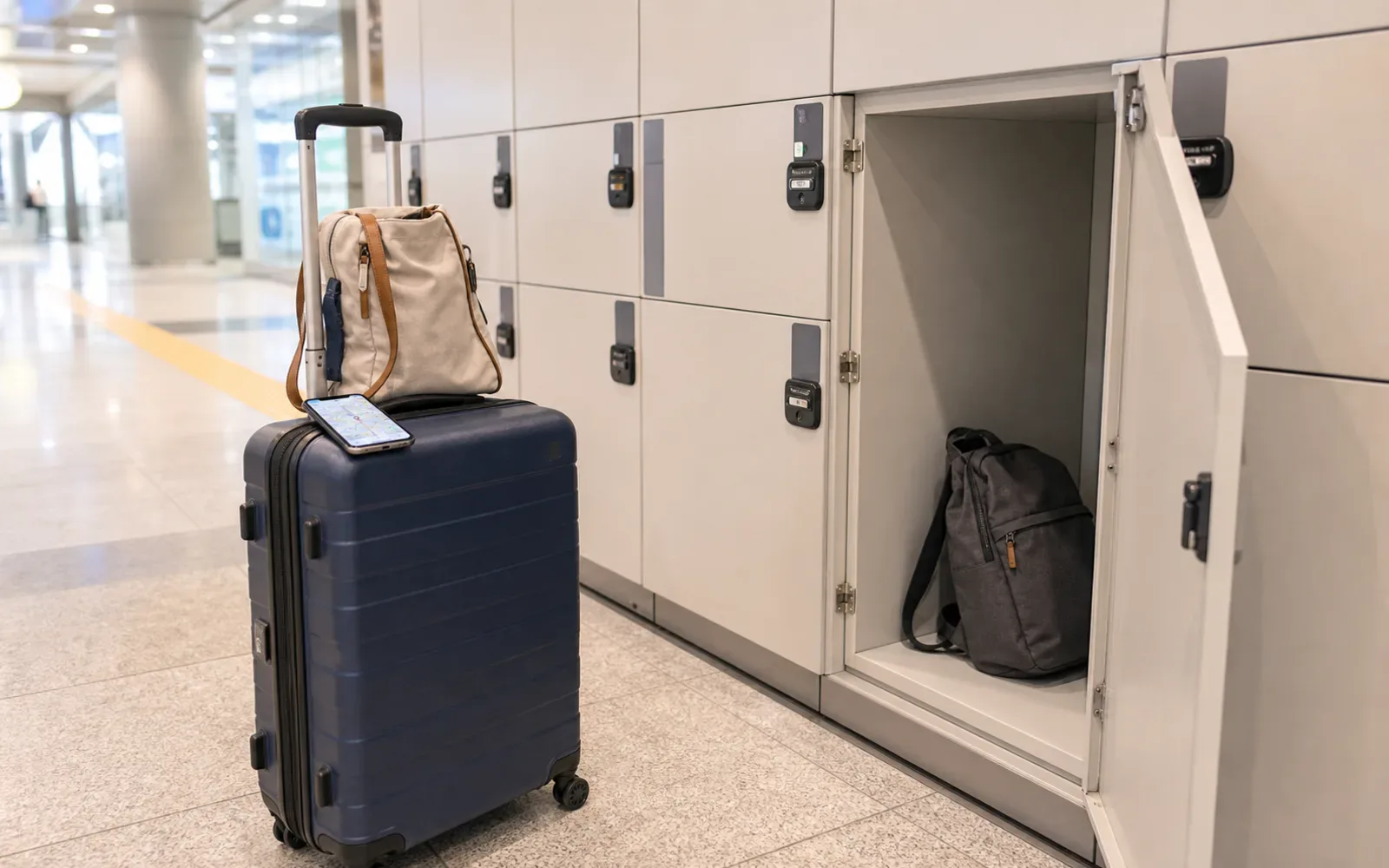
Choose luggage storage around the journey you will make after collection. Seoul’s staffed T-Luggage counters and T-Locker compartments can both help on a checkout day, but a cheaper facility is poor value if retrieving the bag sends you back across the city. First identify the departure station, then compare fit, price, access and pickup conditions.
Start with the route and the kind of storage
Ask your hotel whether it will hold bags under its current policy. If sightseeing and the onward journey naturally pass the hotel, that can remove another station transaction. Otherwise, choose a facility along the airport, rail or hotel route you will actually use.
| Need | Useful starting point | The condition to confirm |
|---|---|---|
| Large suitcase or uncertain fit | Staffed T-Luggage | Accepted size, available space and counter pickup window |
| Small bag for a short stop | T-Locker | Dimensions, vacancy, payment and retrieval |
| Early collection | A locker with suitable confirmed access | The actual service window, not just the station’s train hours |
| Sending a bag onward | A separately confirmed delivery booking | Acceptance deadline, destination and receiving arrangements |
Storage means returning to collect the bag. Delivery moves it to another location under separate prices and conditions. A storage receipt does not automatically create an airport transfer for the luggage.
Compare the published staffed-storage rates
Seoul Metropolitan Government’s storage page lists these T-Luggage base charges. The service assigns the size category; an airline cabin-bag description does not determine the counter’s classification.
| Size | Weekday, first 4 hours | Weekend, first 4 hours | Additional hour |
|---|---|---|---|
| Small | KRW 3,000 | KRW 4,000 | KRW 1,000 |
| Medium | KRW 4,000 | KRW 6,000 | KRW 1,000 |
| Large | KRW 6,000 | KRW 9,000 | KRW 1,000 |
| Extra large | KRW 9,000 | KRW 13,000 | KRW 1,000 |
For a large bag stored for six weekday hours, the published calculation is KRW 6,000 plus two additional hours at KRW 1,000, totaling KRW 8,000. The comparable weekend calculation is KRW 9,000 plus KRW 2,000, totaling KRW 11,000. These are arithmetic examples using the city table, not a quote for a particular bag; confirm the actual category and charge at the counter.
Check locker dimensions and the full charge
The city’s subway storage information lists the following T-Locker dimensions and rates. Measure width, depth and height, including wheels or other protrusions; a suitcase fitting one dimension is not enough.
| Locker | Width × depth × height | First 4 hours: weekday / weekend | Additional hour |
|---|---|---|---|
| Small | 50 × 30 × 60 cm | KRW 2,200 / 3,100 | KRW 500 |
| Medium | 50 × 45 × 60 cm | KRW 3,300 / 4,600 | KRW 800 |
| Large | 50 × 90 × 60 cm | KRW 4,400 / 6,100 | KRW 1,000 |
A large locker for six weekday hours has a table-based cost of KRW 4,400 plus KRW 2,000, or KRW 6,400. That lower price helps only if a suitable compartment is vacant and retrieval fits the onward journey. Use the selected locker’s screen and posted instructions for the actual transaction; new and older lockers can have different processes.
The city lists T-Locker operating hours of 5 a.m.–midnight and states that storage and retrieval are unavailable outside them. Check the particular facility and station access before depending on an early or late pickup. Do not assume that an overnight train timetable extends the locker window.
Locate the staffed counter inside the station
The city’s published T-Luggage locations are:
- Seoul Station: basement level 1, near Exit 1.
- Hongik University Station: basement level 1, near Exits 3 and 4.
- Jamsil Station: basement level 1, near Exits 3 and 4.
- Myeong-dong Station: basement level 1, near Exits 9 and 10.
- Gimpo Airport Station: basement level 1, near the information center.
- Jongno 3-ga Station: basement level 1, near Exit 6.
Save the current floor and approach, not just the station name. Large complexes connect several lines, shopping areas and entrances; collecting a bag and reaching the onward platform can take separate navigation. Construction or service changes can move a counter, so follow the current operator information and station signs.
Complete drop-off before leaving
Check the accepted contents and liability conditions. Keep passports, payment cards, flight documents and medication needed during the day with you. Valuable, fragile, perishable or dangerous items require particular attention to the rules rather than being treated as ordinary luggage.
Confirm that the counter has accepted the bag or that the locker is secured and the transaction complete. A partly closed door or an unfinished payment screen is not completed storage. If the bag does not fit, choose another suitable compartment or staffed facility instead of forcing it.
Save the receipt, station, floor, counter or locker number, retrieval method and support contact together. Keep access codes private. Know where the required app or confirmation is stored and whether a connection is needed. Retain enough phone battery for retrieval and the onward route, and avoid storing your only needed charger with the bag.
Set the reminder for leaving the last activity
A reminder at closing time is too late if you are still across the district. Work backward from collection, allowing for a queue, an elevator, a payment problem and the trip to the final platform. A delayed meal or attraction can also add hours to the storage charge.
Route the last sightseeing stop or meal toward the bag. Compare the onward leg in the airport transport guide; the T-money guide covers the transit card used for the station journey.
Confirm delivery as its own booking
If the plan depends on sending luggage elsewhere, establish the receiving location, acceptance deadline, pickup window and identification requirements before handing it over. Keep the delivery confirmation and contact details separate from any storage receipt.
Do not build the airport journey around an unconfirmed delivery arriving at the last possible moment. Storage should produce a lighter sightseeing day with a predictable collection or handover, rather than another unresolved connection before departure.
Official source
Verification note: The location and price tables above follow the city’s published English guidance; counter and locker operation must be checked separately. Recheck operating status and availability on the storage date.