
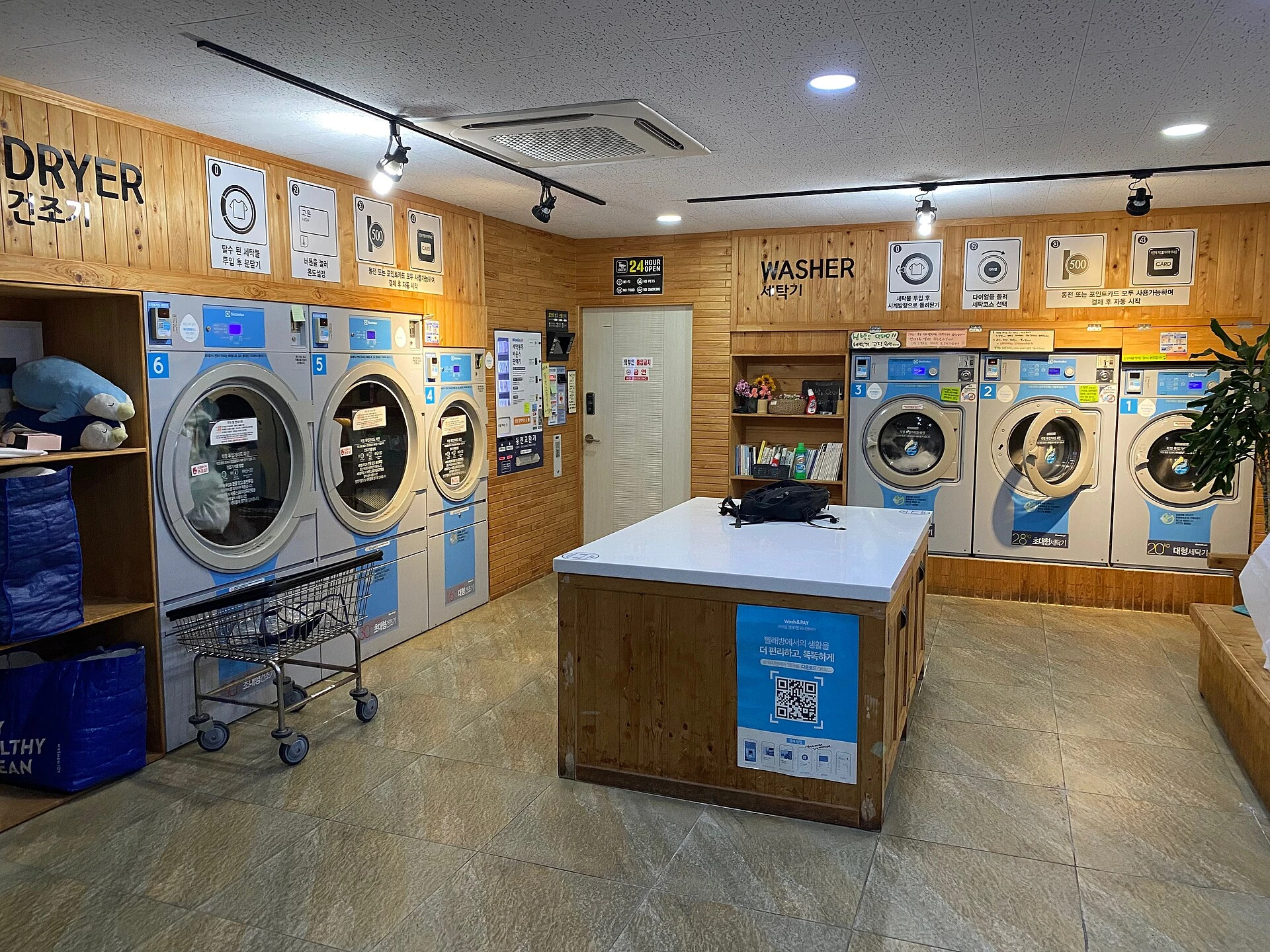
A useful laundry stop starts before the clothes reach a machine. Check what can be washed together, what must not go into a dryer, and whether the location is a self-service laundromat or a business that takes garments away for cleaning. Those are different services even when the storefront uses the same brand.
This guide uses Cleantopia’s published Korean service information as a concrete operator example, reviewed October 17, 2026. It does not claim that every laundry in Korea has the same machines, payment method, prices, detergents or hours.
Choose the right kind of laundry
Cleantopia’s self-service information identifies its coin-wash formats and describes machines intended for customers to use themselves. A staffed cleaning counter may instead accept items for later processing and collection. A locker-based drop-off system is another service again.
For a traveler leaving the next morning, the distinction matters more than the sign outside. Ask whether you can complete the wash and dry yourself during the available hours, whether a staff-assisted service is actually operating, and when a handed-over item will be ready. “Laundry service” does not establish same-day return.
The operator’s multi-shop FAQ says coin facilities are generally operated 24 hours but some locations differ. Check the actual branch rather than building an overnight plan around a chain-wide assumption. Staffed counter hours can also be shorter than machine-access hours.
Sort by the garment label first
Read the care labels on the items you intend to wash. A mixed travel bag can contain ordinary cotton clothes, a wool layer, technical waterproof fabric and a garment requiring professional care. The availability of a large hot wash does not make all of those items suitable for it.
- Separate items with incompatible wash temperatures or care instructions.
- Check for color transfer risk, especially with new or strongly colored garments.
- Remove tissues, coins, cards, earphones and other objects from pockets.
- Close or secure items according to their care instructions and inspect fragile fasteners.
- Identify everything that cannot be tumble-dried before it is mixed into the load.
Do not guess a specialist fabric’s treatment from a generic travel article. Follow the garment maker’s instructions or use an appropriate professional service. A ruined essential jacket is more expensive than postponing an unsuitable machine load.
Read the machine’s unit of sale
Before paying, establish which machine you are buying a cycle on, its usable capacity and what the displayed price covers. A washer price and a dryer price are separate parts of the total. An additional drying period may be charged separately again.
Check whether detergent and softener are automatically supplied. Cleantopia’s self-service page says those products are automatically included in its described service. That is a reason not to add your own detergent by reflex at that machine, not a universal statement about all Korean laundromats.
If you need an unscented product, have a detergent sensitivity or cannot use the supplied softener on a garment, ask the operator before starting. A self-service control panel may not offer the adjustment you need. Choosing another suitable service is better than assuming you can disable an automatic dosing system.
No fixed nationwide wash price is given here. Read the branch’s current machine and payment display, and include drying and any necessary extras in the comparison. A low-looking wash price alone does not describe the final cost.
Korean labels to read before selecting a machine
| Korean | Meaning | Check before pressing |
|---|---|---|
| 세탁 / 건조 | Wash / dry | That you are paying for the right machine and stage |
| 세제 / 섬유유연제 | Detergent / fabric softener | Whether these are automatically supplied |
| 표준 | Standard | Whether the program suits the garment labels |
| 고온 / 중온 / 저온 | High / medium / low temperature | The permitted temperature, especially for drying |
| 추가 / 시작 / 일시정지 | Add / start / pause | Whether “add” means extra paid time and whether pausing is permitted |
| 남은 시간 | Time remaining | The machine’s current display, rather than a general duration estimate |
Match the machine number on a central payment screen to the number on your loaded washer before paying. On the drying step, read the unit of time and temperature again; a wash purchase does not establish that drying has been paid for. These translations help read the controls, but they do not establish that a particular brand offers every setting or supplies a particular detergent.
Pay only after the load and program are ready
Inspect the drum and obvious contact surfaces before loading. Use another machine or contact the operator if there is a problem. Do not put clothing into a machine that is already assigned to another customer or try to interrupt a running cycle.
Match the garment instructions with the offered program and avoid overfilling the drum. A machine’s advertised capacity is not an invitation to pack every item tightly into the available space. Read the load guidance on the actual machine.
Follow the payment instructions for that location. Some facilities use coins, some use card or a central payment kiosk, and some offer an app. A branch displaying one method does not establish that your foreign card or phone account can use every payment option. Have an accepted backup before your wet clothes depend on the next paid step.
Confirm the machine number and selected cycle before final payment. If payment appears unsuccessful, check the machine and transaction status before paying repeatedly. Use the posted operator contact for a jammed coin mechanism or an unexplained charge; do not open panels or attempt repairs.
Use the wash period as a real appointment
Set a reminder for the displayed completion time and remain close enough to return promptly. The operator describes an approximate wash-and-dry duration for its service, but queues, selected programs and the load can change the outing. An approximate hour is not a guaranteed collection deadline.
Keep the payment record or machine reference until the cycle is complete. If you step out, do not leave a passport, wallet or unlocked phone on a folding table. A laundromat is a shared customer space, not a supervised storage room for valuables.
Plan the laundry stop before the final evening when practical. Clothes that cannot use a dryer need a suitable drying arrangement at the accommodation, and even a dryer-compatible load can require more time than expected.
Drying is a separate care decision
Sort the finished wash again before transferring it. Remove items whose labels prohibit tumble drying or require a different treatment. One convenient dryer setting is not a safe default for every garment that survived the wash.
Select the temperature and cycle permitted by both the clothing labels and the machine’s instructions. Do not try to compensate for an overloaded drum by choosing more heat. If the load is still damp, reassess the quantity and permitted drying method rather than adding repeated high-temperature cycles automatically.
Use an appropriate clean container for the finished clothes. A bag that carried dirty, damp laundry should not make clean items wet or dirty again. Check the drum carefully for small socks and other items before leaving it for the next customer.
If you need someone else to handle the clothes
Cleantopia’s staff-assisted coin-laundry service is a separate paid option available during the owner’s working hours, according to the operator. Confirm availability, the included tasks, the collection time and any item restrictions before handing over the bag.
Keep a record of the items accepted and any special instruction. A staff member agreeing to a machine-laundry service does not automatically establish professional dry-cleaning treatment for every fabric. Explain the actual care requirement and let the provider confirm whether it can meet it.
Before the final dryer payment, check how the finished load will get back to the accommodation. Clean clothes need a suitable bag, and items remaining damp need an allowed drying space. Do not plan to hang wet items from electrical equipment, room sprinklers or other unsuitable fixtures. Ask the accommodation what facilities it provides rather than turning a small room into an improvised laundry installation.
Leave the shared space ready for the next person
Return on time, clear the drum, use the folding area considerately and dispose of packaging in the appropriate place. Do not remove another person’s load without following the venue’s own policy or asking its operator. Avoid placing outdoor bags or shoes on a clean folding surface.
For translation or payment preparation, keep the visitor payment guide available. If you are planning the errand around wet-weather travel, the rain planning guide helps distinguish an ordinary indoor errand from conditions when nonessential travel should be postponed.