
Korea’s rainy season is a planning context, not a daily weather forecast. A July visit can include dry intervals, and a day outside the usual Changma period can still bring dangerous rain. Separate three questions: what the climate is usually like, what is forecast for your destination, and whether a warning or closure changes what you should do today.
This guide was checked on October 17, 2026. Its seasonal figures describe published climate normals; they do not predict dates for the next summer or confirm conditions on a future travel day.
Changma timing differs by region
The Korea Meteorological Administration’s rainy-season statistics publish different normal start and end dates for central Korea, southern Korea and Jeju. These averages help with packing and flexible bookings. They are not a schedule that rainfall must follow.
| Region | Average start | Average end | How to use this |
|---|---|---|---|
| Central region, including Seoul | June 25 | July 26 | Build flexibility into outdoor Seoul and central-region plans. |
| Southern region | June 23 | July 24 | Check the actual southern destination; do not use Seoul’s forecast. |
| Jeju | June 19 | July 20 | Account for an earlier typical period and local wind/coastal conditions. |
The KMA page identifies the 1991–2020 thirty-year average in its statistics. Its English climate overview also explains the summer monsoon and the potential for heavy rain and flash floods. Do not read these dates as saying August is reliably dry or that a Jeju ferry will operate because the seasonal average has ended.
Check three things before leaving your accommodation
- The destination forecast: open KMA Weather Nuri and select the actual city or district. A Seoul forecast is not enough for a day trip to a mountain or another province.
- The time of the rain: compare the forecast interval with the walking, transfer and return portions of your route. A low chance during museum hours is unhelpful if heavy rain is expected on the journey home.
- Warnings and access: inspect KMA’s current severe-weather status and the operator’s closure notice. Recheck before a long outdoor segment.
Keep emergency alerts enabled and read accommodation or venue instructions. If you cannot understand a Korean alert, translate it or ask staff for help with the location and requested action. A forecast screenshot saved yesterday should not override a current warning.
Use a different plan for ordinary rain and a warning
| Situation | A reasonable response | A weak assumption |
|---|---|---|
| Light rain, normal access | Shorten exposed walking and retain a nearby indoor stop. | Every attraction must be canceled. |
| Persistent rain or strong wind | Choose one indoor destination with a manageable door-to-door route. | An umbrella makes a long exposed route comfortable. |
| Heavy-rain warning, rising water or access restriction | Follow official safety instructions and postpone nonessential travel. | A prepaid ticket makes the trip safe enough to attempt. |
KMA’s heavy-rain safety guidance advises limiting outings when warnings are expected and avoiding dangerous areas such as rivers, valleys and landslide-prone places. A closed stream entrance or barrier is a route boundary. Do not step around it for a photograph or use a flooded passage as a shortcut.
Two real indoor alternatives in Seoul
City Hall area: Seosomun Main Branch of SeMA
If a central-Seoul outdoor plan becomes unpleasant in ordinary rain, consider the Seoul Museum of Art’s Seosomun Main Branch at 61 Deoksugung-gil. General admission is free except for special exhibitions. Check the day’s exhibition and branch hours; the published last admission is one hour before closing.
This is a practical alternative to a long palace-area walk only if the branch is open and your route there remains suitable. It is not a fully sheltered connection from every station or palace gate. Check your actual exit, final outdoor approach and any closure before replacing the original plan.
Yongsan: National Museum of Korea
The National Museum of Korea offers an indoor permanent collection with free general admission; special exhibitions can be charged separately. Choose one collection section instead of trying to cross the entire museum. This produces a defined indoor visit rather than an exhausted attempt to fill the whole day.
The museum is a destination in its own right, not a quick indoor detour from every Seoul neighborhood. If you are already far away, compare the full journey with an indoor option closer to your accommodation. Neither a museum ticket nor an underground station makes travel appropriate during an evacuation instruction or dangerous flooding.
Pack for water management, not just rain coverage
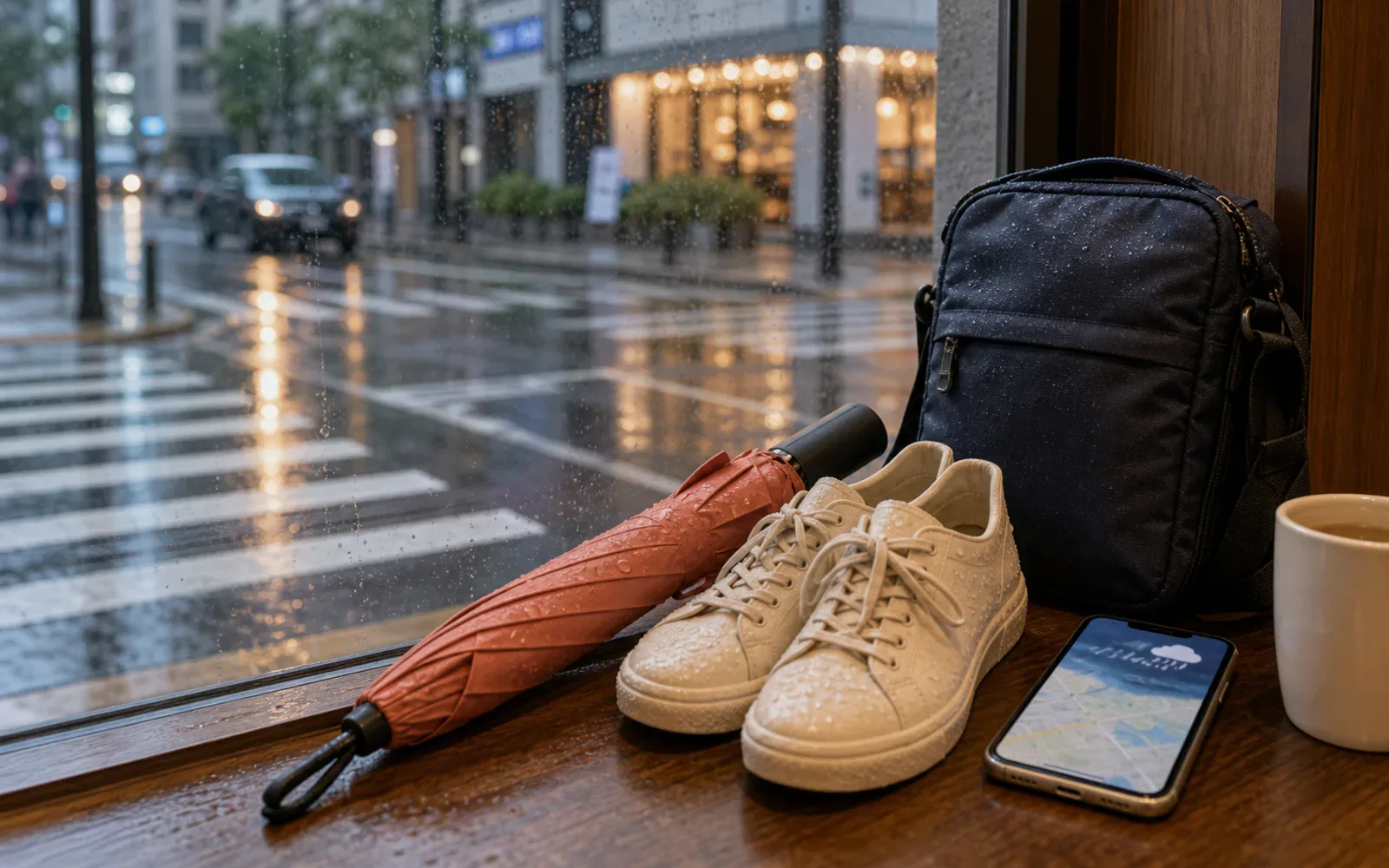
Bring a compact umbrella when the wind permits its use, a lightweight outer layer appropriate to the temperature, and a bag that protects essential documents and electronics. Carry a small waterproof pouch or inner bag for a passport and spare socks. Keep the phone accessible enough to read transport and weather updates without exposing it for long periods.
Choose shoes for grip and drying time, and consider how you will handle wet footwear at the end of the day. Waterproof shoes can keep rain out but may also be uncomfortable in humid heat; open footwear has different slipping and protection trade-offs. There is no single shoe that fits every walking route and traveler.
When entering a museum, café or shop, close the umbrella outside the pedestrian flow and use the provided stand or cover if available. Keep dripping equipment away from seating, displays and slippery entrance tiles. A thin spare layer can help when wet clothes meet indoor air-conditioning.
Build a booking plan that can survive a change
Put the least flexible outdoor booking on a day with room around it rather than between two long transfers. Read the rain, cancellation and rescheduling terms before purchase. An event might operate in light rain but stop for a warning, while a garden or trail might close independently of your ticket seller’s cancellation deadline.
For an ordinary rainy day, select one primary district and one indoor fallback. Save the two venue locations, hours and transport directions. For a warning, the fallback can simply be staying in a safe place and following official instructions. Planning well does not require finding a sightseeing replacement for every weather condition.
For the indoor destinations above, see the National Museum two-hour plan and Seoul art-museum comparison. Recheck their official notices for the actual visit date.