
Seoul Botanic Park contains both open parkland and a ticketed botanic garden with a greenhouse. That distinction decides the cost, Monday plan and rainy-day usefulness of a visit. The outdoor park being open does not mean the greenhouse is open, and a park photograph does not prove that your route to the indoor entrance stays dry.
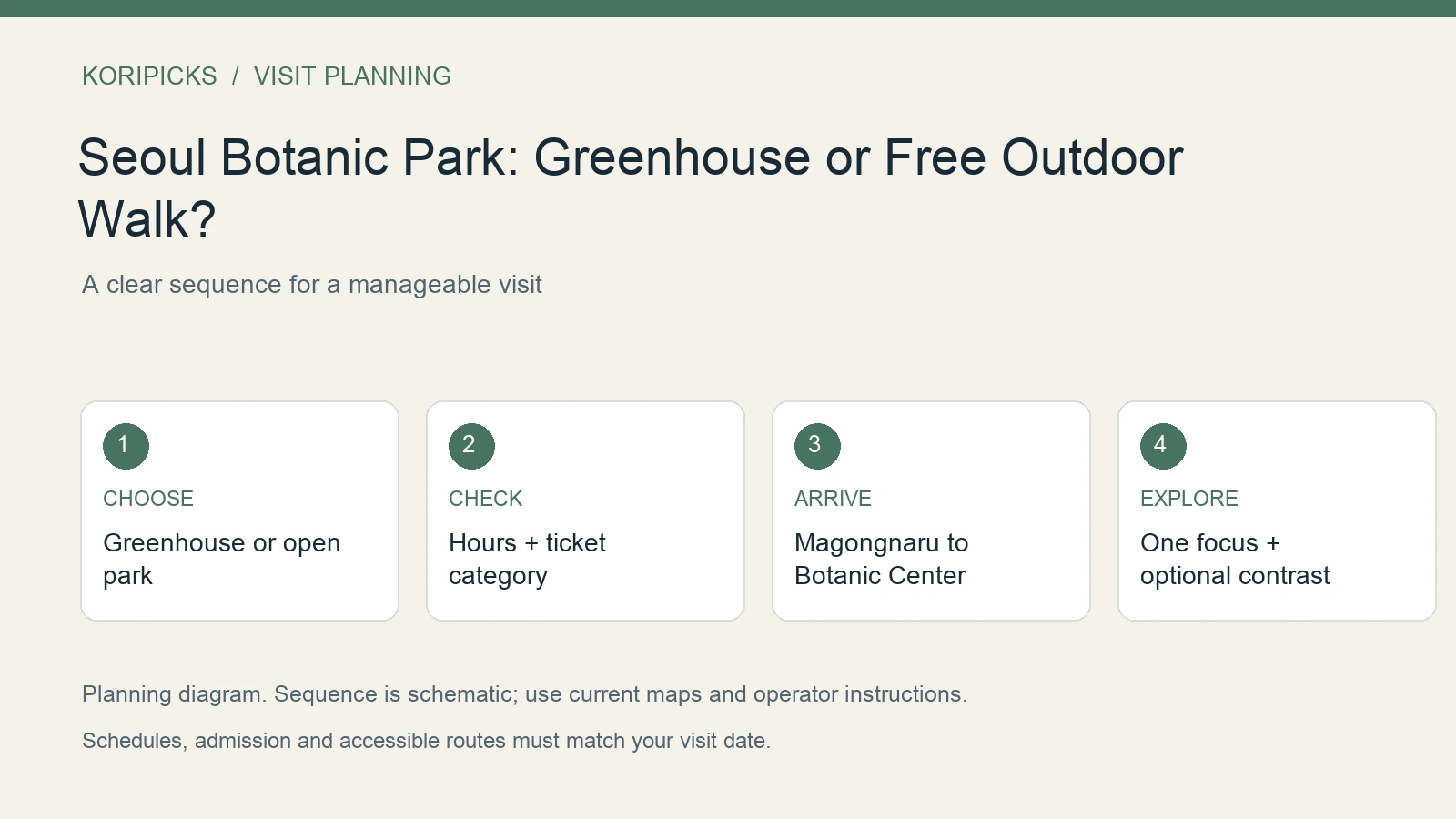
For a first visit, choose either a greenhouse-led outing or an outdoor lakeside walk. Add the other part only if you have time and the weather suits it. A two- to three-hour allowance works as an editorial starting point, not as a measured or official visit duration.
A greenhouse-and-lake route with an actual sequence
Use Magongnaru Station → Forest Field approach → Botanic Center and greenhouse → a short Lake Garden section → return to Magongnaru. The indoor collection is the anchor and the outdoor landscape is the optional second act. This is a different visit from a completely free parkland walk, which omits the ticketed greenhouse.
At the station-side park entrance, open the operator’s map and locate the Botanic Center before walking deeper into the grounds. A connection to the park is not the same as arriving at the greenhouse ticket area. The official English leaflet identifies the greenhouse, display gardens, lake and wetland as distinct parts.
| Suggested block | Focus | What to omit when shortening |
|---|---|---|
| First 15–25 minutes | Station approach, ticket and map | An unplanned long outdoor detour |
| Next 45–60 minutes | Tropical and Mediterranean greenhouse sections | Reading every plant label |
| Next 20–30 minutes | One display or learning area that is currently accessible | A program needing a separate booking |
| Next 20–40 minutes | Lake Garden contrast, if weather suits | Wetland extension and a full grounds circuit |
| Final margin | Rest and return to the station | A second long outdoor section |
These are editorial visit blocks, not measured walking times. If the day is wet, spend more of the available time indoors and omit the lake. If your goal is a free walk, begin with the open park areas instead and do not imply that the greenhouse is included.
Compare the two environments instead of treating plants as scenery
In the tropical section, observe the scale of leaves, the density of planting and the relationship between taller growth and the plants beneath it. In the Mediterranean section, compare the more open appearance, leaf forms and the way planting is arranged around a different climatic idea.
Look at the plants before reading a long list of names. Choose a few forms to compare, then use the labels to connect what you saw with origin and climate. That makes the greenhouse useful even for someone who cannot identify a species at first glance.
The elevated skywalk, if currently accessible, provides another perspective on the tropical planting. It is an optional viewpoint, not a reason to assume every route is suitable for the same mobility needs. Use the actual visitor signs and staff advice for the appropriate path.
What the lake adds after the greenhouse
The outdoor section changes the scale from enclosed plant displays to a larger landscape. Choose a short waterside segment with a clear return. Notice the transition between maintained paths, planted edges and open water rather than using the lake only as a backdrop.
The wetlands are another extension, not a compulsory continuation. If your group is tired after the greenhouse, a brief lake view and a seated rest can be the right ending. The long map should not decide how far everyone must walk.
An arrival-day version needs a flight margin
Magongnaru’s Airport Railroad connection can make the park attractive on an arrival or departure day, but the station-to-garden walk, storage and airline timing must still fit. A nearby rail line does not establish that suitcases can be stored where you need them or that the flight journey remains short.
If your visit depends on bag storage, resolve that arrangement before buying admission. Keep the airport terminal and complete return connection separate from the park route. On a short flight day, choose only the greenhouse or only a brief open-park walk rather than trying to complete both.
Leave with one comparison you can remember
The best outcome is not a count of every species or every park zone. It is understanding how the two greenhouse environments differ and how the outdoor landscape changes the viewing experience. One focused route with a real return gives you that without needing the whole site to operate as a checklist.
Use the right part of the site
| Part | What it offers | Planning consequence |
|---|---|---|
| Open park areas | Outdoor walking and landscape | Weather and walking distance remain important |
| Ticketed botanic garden | Display gardens and greenhouse access | Check admission and closing day |
| Greenhouse | Tropical and Mediterranean plant environments | Warm indoor conditions; separate visitor rules |
| Plant library or program | A particular indoor cultural activity | Its hours or booking may differ |
The operator’s English visitor leaflet distinguishes the free park areas from the botanic garden and lists Monday closures for the garden. It displays ordinary adult garden admission at KRW 5,000. Discount eligibility should be checked separately; a smaller number in a leaflet is not automatically your fare.
Read seasonal hours with care
The leaflet lists ordinary garden hours of 09:30–18:00, with last admission at 17:00, and shorter winter hours of 09:30–17:00, with last admission at 16:00. Its English month label for ordinary hours is inconsistent with its winter block, so use the current operator website to resolve the seasonal boundary for your date.
That inconsistency is worth noticing rather than silently copying. If you are visiting near November, confirm the actual closing time before traveling. A paid garden admission late in the afternoon can leave too little time for both greenhouse and outdoor displays.
Likewise, a Monday walk can still use open parkland, but it should not be sold to your group as a greenhouse day. Choose a different date if indoor plant viewing is essential.
Magongnaru is the arrival reference point
Save 서울식물원 and 식물문화센터 for the park and Botanic Center. The listed address is 161 Magokdong-ro, Gangseo-gu. The visitor leaflet identifies Magongnaru Station, on Line 9 and the Airport Railroad, with Exits 3 and 4 connected to the park side.
Use the live map to compare the complete journey and the final walk to the greenhouse. The park connection and the greenhouse doorway are different milestones. Do not call the whole visit a covered route merely because the subway serves the area.
With luggage, decide whether this is genuinely compatible with an airport transfer. A nearby Airport Railroad station does not guarantee suitcase storage at the greenhouse, a short walk, or enough time before a flight. Confirm storage and allow the complete station-to-terminal journey before treating the park as a stopover.
A greenhouse-led route
Begin at the Botanic Center, confirm the ticket and current entry rules, and deal with umbrellas or bags before entering the display. Follow one climatic section carefully, then compare it with the other rather than rushing through both as backdrops for portraits.
Notice how leaf size, plant density and growth form change between environments. The value of the greenhouse is not only the number of plants; it is seeing what similar urban climates and different moisture conditions allow plants to do.
The leaflet describes an elevated skywalk in the tropical section. Check current access if it matters to your visit. It is an optional viewing layer rather than proof that every part of the greenhouse has identical mobility conditions.
An outdoor route that remains modest
For a free walking visit, select one park section and a clear return path to Magongnaru. The lake and wetlands can be appealing, but adding every section lengthens the route and can leave you far from the station when the weather changes.
Read the park map on arrival and mark the nearest permitted exit to your next destination. If you have already spent time in the greenhouse, treat the outdoor walk as a short contrast rather than a second full tour.
With children, agree on the return point before they become tired. An open path stretching farther ahead is not a reason to continue if toilets, food and the station are behind you.
Warm indoor conditions and camera rules
The greenhouse recreates warmer climates, so heavy outdoor clothing can feel uncomfortable inside. Carry layers you can manage rather than relying on a large coat you have nowhere to place.
The operator’s leaflet states that food and drink other than water are not permitted inside and that tripods are not allowed. It also prohibits damaging plants and entering planted areas. Follow current staff instructions if details have changed.
Photograph from the visitor path without leaning into a planting bed or blocking a narrow section. For close views, use the phone or camera’s framing rather than stepping behind a barrier. Mist, glass reflections and dense foliage can be part of the experience; they are not obstacles that justify interfering with the plants.
Food and an indoor break
The leaflet identifies cafés and food facilities in the Botanic Center, but current operating times and menus should be checked on the day. A listed café is not a guarantee of available seating for a large group or a particular dietary option.
Choose whether lunch comes before or after the greenhouse so it does not interrupt a timed program. For allergies or other restrictions, ask about the actual meal and ingredients rather than treating a plant-focused attraction as vegetarian food assurance.
The vegetarian ingredient guide can help prepare those questions. The rainy-day itineraries offer more central indoor alternatives if a long western-Seoul transfer does not fit your day.
The best reason to choose this outing
Choose Seoul Botanic Park when you want close plant observation plus a manageable outdoor contrast. Choose another museum when you need a fully indoor historical or art visit with less exposed walking.
Before departing, save the selected garden hours, admission category, Botanic Center pin and return station route. These are more useful than a list of every park facility. A visit centered on one part of the site is easier to enjoy and easier to shorten when conditions change.