
Ingredient guidance checked July 27, 2026. A Korean dish can look meat-free and still contain anchovy stock, beef broth, fish sauce, shrimp paste or a meat garnish. The safest approach is to ask about the base broth and seasoning before choosing from appearance alone.
A named temple-food option in central Seoul
KTO’s Balwoo Gongyang information identifies a temple-food course restaurant on the fifth floor of the Templestay Information Center, 56 Ujeongguk-ro, Jongno-gu. The guide describes course meals without meat or seafood and identifies vegan cuisine in its service information.
That makes it a concrete central-Seoul option to investigate for a plant-based meal, not a certification issued by this publication. Use the operator contact and website listed by KTO for the current course, price and reservation. Older tourism pages contain different menu amounts and potentially confusing hours, so they should not be copied as a current transaction quote.
Choose a course restaurant when you want a planned meal with its own time block. It is a different experience from modifying a quick bibimbap order. State egg, dairy, honey and any other ingredient requirement to the current operator, and separate a dietary preference from a medical allergy.
Compare three practical meal strategies
| Strategy | Why it can work | What remains to establish |
|---|---|---|
| Current plant-based or temple-food venue | The menu begins closer to the desired diet | Actual ingredients, service day and reservation |
| Modified ordinary dish | Flexible for a casual meal | Broth, seasoning, garnish and preparation, not only visible meat |
| Clearly understood packaged food | Useful when a late arrival limits choices | The current ingredient and allergen labels |
None is universally suitable. A simple ordinary dish can be convenient for one traveler while an uncertain broth makes it unsuitable for another. A course venue can provide a more considered meal but requires the current booking and menu to fit the day.
A dish-by-dish conversation
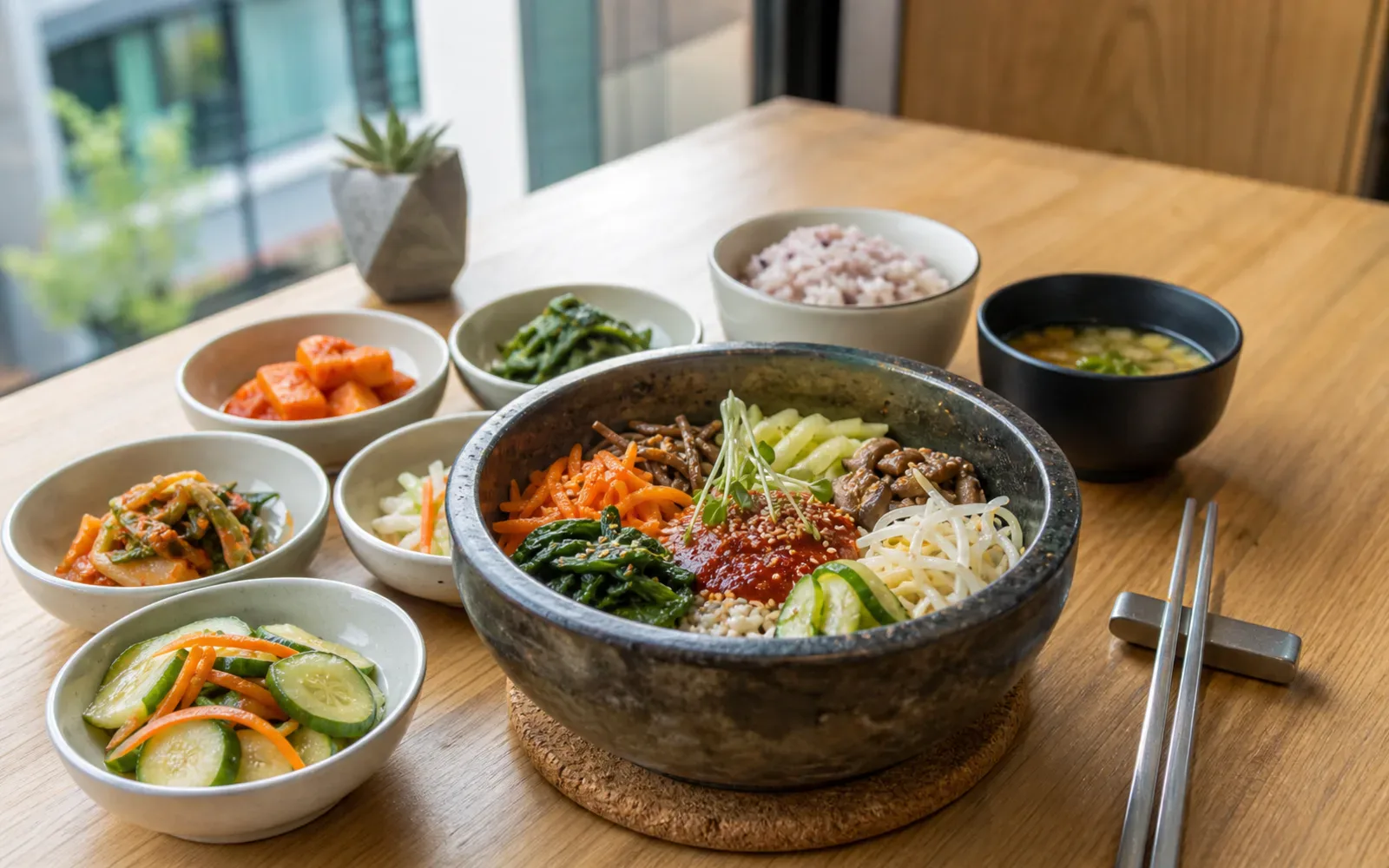
For bibimbap, separate the rice and vegetables from meat garnish, egg and sauce. For gimbap, inspect the actual filling rather than relying on a vegetable name. Fish cake, ham or egg can be included in a roll that looks plant-heavy from the outside.
For a soup or tofu dish, ask about the base liquid before choosing a garnish. Removing a visible piece of meat does not replace the stock. For a pancake, ask about egg, seafood and the actual batter and cooking surface when those matter to your diet.
Show one clear statement at a time. 고기와 해산물을 먹지 않아요 means you do not eat meat or seafood; it does not automatically communicate avoidance of eggs or dairy. Add the particular ingredients you avoid rather than expecting a single label to express the whole requirement.
Do not treat a side dish as a complete meal plan
A restaurant can provide vegetable sides while serving a meat-centered main menu. Ask what complete meal is available under your stated requirements. If the answer is uncertain, use the prepared alternative rather than assembling a dinner from a few sides whose seasoning you cannot explain.
At a buffet, inspect each item’s label and the actual serving arrangement. A vegetarian-looking tray may sit beside ingredients or utensils that do not meet your requirement. For a serious allergy, the kitchen’s ability to explain preparation is a different question from the dish’s dietary category.
Prepare the next meal while today’s answer is clear
Save the branch, menu item, requested change and response. That record is more useful than only a plate photograph because it preserves what made the meal fit your requirement. Do not apply one branch’s answer to another without checking.
For the next day, choose one planned meal near the main activity and one understandable fallback. This reduces the need to search while hungry and makes the dietary plan part of the itinerary rather than an unresolved problem after sightseeing.
Start by defining your diet
“Vegetarian” is interpreted differently across restaurants. State whether you avoid meat only, meat and seafood, eggs, dairy, fish sauce, and shared cooking equipment. A vegan traveler needs a longer question than “no meat.” Keep it on your phone in Korean and show it before the order is placed.
Dishes that can work—with questions
| Dish | Why it may work | What to verify |
|---|---|---|
| Bibimbap | Rice and vegetables are visible | Meat garnish, egg, sauce and shared preparation |
| Gimbap | Vegetable versions exist | Ham, fish cake, egg and shared knife |
| Kongguksu | Soybean-based cold noodles | Broth recipe, toppings and seasonal availability |
| Vegetable jeon | Vegetable pancake | Egg, seafood pieces and shared griddle |
| Muk dishes | Acorn or mung-bean jelly base | Fish-based seasoning or garnish |
| Tofu dishes | Tofu is the visible main ingredient | Meat/seafood broth and kimchi ingredients |
Korea Tourism Organization’s vegetarian guide identifies temple food and several of these dishes as useful starting points, while warning that broths and kimchi can contain animal ingredients. The guide was updated in October 2023, so use it for ingredient logic and verify the current restaurant directly.
Temple food is a strong starting category
Korean temple cuisine generally avoids meat and fish and also has its own restrictions on pungent vegetables. A temple-food restaurant is often easier for plant-based travelers than modifying a meat-centered kitchen. It still does not automatically prove vegan preparation, allergen isolation or a specific certification. Ask if dairy, egg or honey matters to you.
Korean questions to save
- 고기와 해산물을 먹지 않아요. I do not eat meat or seafood.
- 멸치 육수가 들어가나요? Does it contain anchovy broth?
- 액젓이나 새우젓이 들어가나요? Does it contain fish sauce or salted shrimp?
- 계란도 빼 주세요. Please leave out the egg too.
- 같은 조리도구를 사용하나요? Do you use the same cooking utensils?
Translation helps communication but does not turn an uncertain answer into a guarantee. For severe allergies, use a professionally translated allergy card and choose a kitchen that can explain its process.
Convenience-store planning
Packaged foods can rescue a late arrival, but front-label vegetables do not reveal broth or seasoning. Use the ingredient list and allergen box. Korean labeling can still be difficult to interpret, and recipes change. Plain rice, fruit, nuts or clearly labeled products are safer fallbacks than guessing from a prepared meal name.
A practical day structure
Choose one researched meal near the day’s anchor and keep the other meal simple. Save the restaurant’s current menu and opening day, plus a second option in the same district. Do not travel an hour for a listing whose last review is old and whose official page has disappeared.
Red flags in third-party lists
- “Vegetarian-friendly” with no explanation of broth or fish sauce.
- A restaurant address copied without a current official page.
- A vegan claim based only on one customizable menu item.
- No update date despite frequent Seoul restaurant turnover.
For table-grill cross-contact, read the Korean barbecue first-timer guide. Travelers who also require halal handling should use the separate KTO category guide; vegetarian and halal are different standards.
A modified bibimbap order, step by step
Imagine a menu showing a vegetable bibimbap photograph with an egg on top. First ask whether beef, fish products or animal broth are included in the rice, sauce or vegetables. Next state whether you want the egg removed. Finally ask whether the kitchen can prepare that order using the equipment you require. The photograph answers only the visible-topping question.
If staff say the vegetables are already mixed with a seasoning you avoid, removing the garnish will not solve it. Choose a different dish or your planned backup. This is a hypothetical ordering example, not a tested recipe or a claim about a named restaurant.
Separate preference from allergy
A dietary preference and a serious allergy require different conversations. A restaurant may be able to omit meat for a vegetarian order while still using shared utensils, stock or a griddle. Someone who cannot tolerate an ingredient needs an explicit answer about preparation, not only the menu name.
For packaged food, read the complete current ingredients and allergen information. A product that worked on an earlier trip can change its formula. Plain-looking bread can contain dairy or egg, and a vegetable rice roll can include fish cake or meat seasoning. If the translation is uncertain, do not turn the uncertainty into a confident vegan label.
A meal record that makes tomorrow easier
Save the exact branch, dish name, options requested and the answer you received. Keep a photograph of the menu rather than only the plate. That helps you order again or explain the requirement elsewhere without assuming every branch serves the same recipe.
Choose the next day’s main meal near its activity, then retain a clearly understood fallback. The useful outcome is a repeatable ordering process and a meal you can verify, not collecting a long list of restaurants marked friendly without ingredient evidence.
Official source
Accuracy note: KoriPicks does not label individual restaurants vegan without current evidence. Ingredient formulas and kitchen practices can change; ask on the day.