
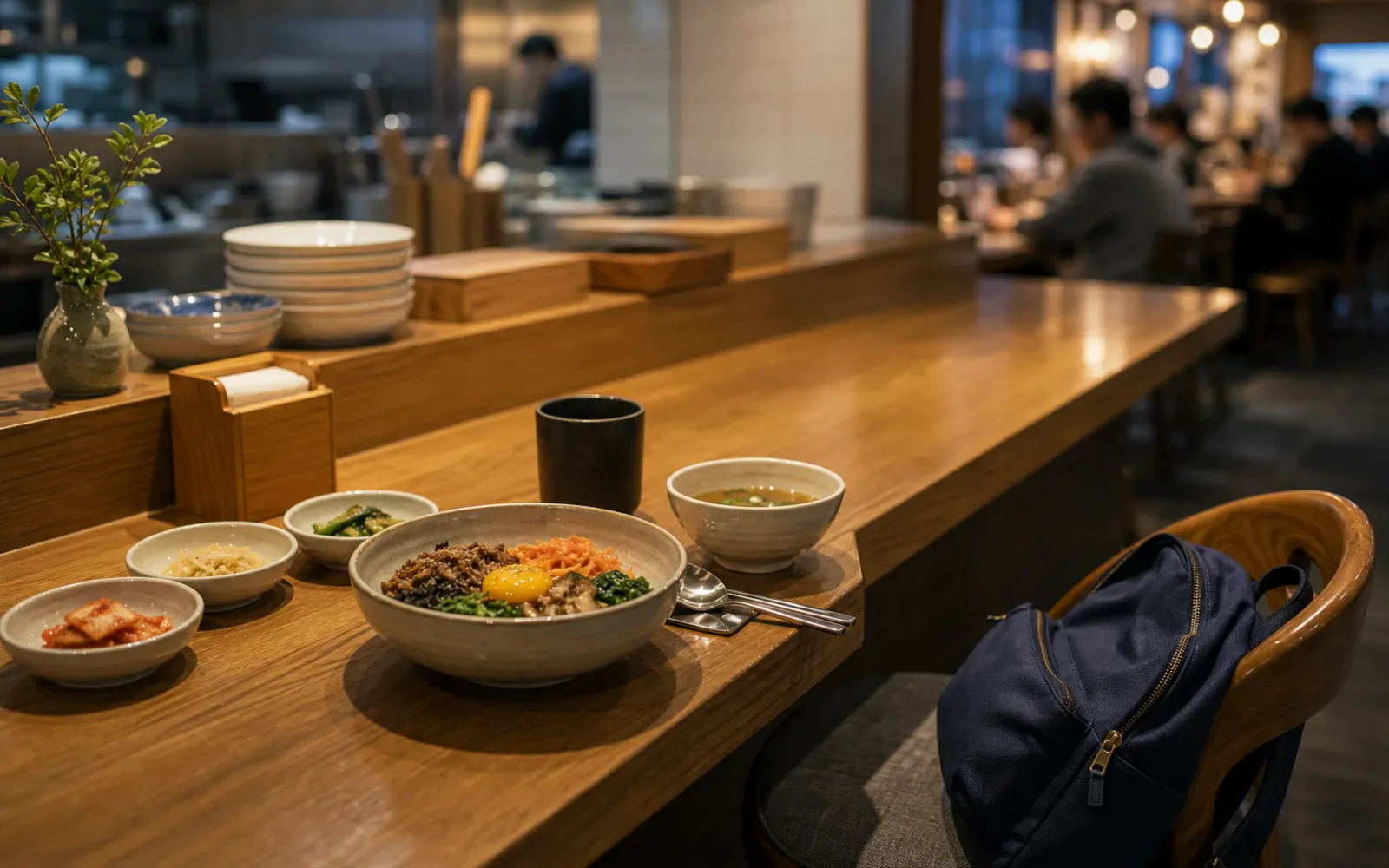
Eating alone in Seoul is easiest when the restaurant’s format already fits one person. Look for counter seating, single bowls, set meals, food courts and reservation pages that accept one guest. Barbecue and shared hot-pot restaurants can also work, but minimum-order rules matter more than whether an empty chair is visible.
This is a decision guide, not a list of venues the editor claims to have tested. Restaurant hours, menus and solo policies change quickly, so verify the individual business before making a special trip.
Three solo meals with different ordering demands
A single bowl, a set meal and a shared grill require different checks. The easiest first solo meal is usually the format that already provides one person’s order, not the restaurant with the largest number of empty tables.
For a rice or noodle bowl, confirm the size, topping options and whether the listed price includes the complete bowl. For a set meal, look at the components and ask whether one person can order one set. For barbecue or a shared pot, ask both whether one diner is accepted and how many portions must be ordered first.
| Format | First question | Second question |
|---|---|---|
| Single bowl | Which size and options do I want? | Is the shown total the complete order? |
| Individual set | Can one person order this set? | Which sides or drinks cost extra? |
| Table barbecue | Can I eat alone here? | What is the minimum initial portion order? |
| Shared pot or platter | Is a one-person portion available? | What quantity and total apply if not? |
This is a practical menu-reading comparison, not a tested list of solo-friendly branches. A reservation system accepting one guest and a walk-in table policy can also differ.
A short staff conversation before sitting
Start with 혼자 식사할 수 있나요?—Can I eat alone? Then point to the intended dish and ask whether a one-person order is available. If the menu shows a minimum, ask the actual portion count before agreeing to the table.
Keep the questions separate. A staff member saying one person can sit may still expect the shared dish’s minimum quantity. A menu saying two portions are required may not explain peak-time seating. Resolve both conditions rather than accepting an answer to only one.
If the amount is too large or expensive for the meal you want, choose the prepared single-bowl alternative. That is a better use of the evening than ordering beyond your appetite solely to justify staying at a restaurant.
Kiosk and food-hall versions
At a kiosk, choose dine-in or takeaway first, then the base item, options and quantity. Read the cart before payment. Keep the order number and notice where the pickup screen is positioned so you do not wait at an unrelated counter.
At a food hall, vendors can share seating while maintaining separate orders and collection points. Buy from the selected vendor, find a suitable seat and return the tray according to the actual signs. A spare seat does not tell you which vendor accepts your payment method or whether you can leave belongings unattended while collecting food.
For a solo visitor carrying bags, complete the order without spreading luggage across a narrow aisle. Store the essential payment method and phone where they can be reached without reorganizing the entire bag at the machine.
A reservation is useful only when its conditions fit
If you want a particular restaurant, inspect the current reservation record for party size, branch, deposit and cancellation. A place available for two guests is not automatically bookable for one, and a global listing may offer a different function from a domestic waitlist.
Use the legitimate official or authorized global channel. If it does not accept your party size or contact method, ask the restaurant or choose the alternative. This guide does not claim to have completed a current booking or tested a particular foreign card.
Keep the backup in the same district
Choose a second meal option close to the first before entering a queue. It should be an ordinary format you genuinely want, with a current branch and opening arrangement. Another uncertain reservation across Seoul is a new outing, not a quick dinner fallback.
When the first venue is crowded, decide whether the expected wait still fits the evening. Protect the return journey and your appetite rather than treating persistence as the route to a better meal.
The successful solo plan is simple: one suitable format, a clear initial order, an understandable payment process and a nearby alternative. You do not need an invented restaurant ranking to make those decisions well.
Start with the menu format
| Format | Usually easiest for one | Check before sitting down |
|---|---|---|
| Rice or noodle bowl | One item forms a complete order | Whether sides or toppings are self-service |
| Soup or stew set | Often priced per person | Spice level and whether rice is included |
| Gimbap or bunsik shop | Fast, visible menu and flexible portions | Kiosk language and dish size |
| Department-store food hall | Shared seating with separate vendors | Pickup screen, tray return and closing time |
| Table barbecue or hot pot | Possible at some restaurants | Minimum portions, grill charge and peak-hour policy |
Do not read “two portions” as “two people” without checking
Some restaurants accept one diner but require a minimum of two meat portions or a minimum pot size. That can be reasonable if you want the meal, but it changes the price and quantity. Ask before ordering rather than discovering the minimum after the grill is lit.
A menu may show a price per 100 or 150 grams, per serving, or for the whole dish. Photographing only the number can remove the unit. Use the Korean text beside the price and confirm whether rice, stew or side dishes are included.
Counter seats and visible turnover are useful signals
A long counter, individual induction burners, tray pickup or single-seat dividers usually indicate that solo diners are part of the normal operation. A restaurant filled with large grills and group tables may still welcome one guest outside the rush, but the format gives you less certainty.
At busy lunch and dinner times, staff may prioritize tables that match the restaurant’s serving style. If a particular place matters, use its official reservation channel or message it. Otherwise, keep a second option within the same block instead of turning one meal into a long wait.
Four ordering systems you will encounter
- Staff order: point to the menu item and show the quantity clearly.
- Table tablet: review the cart before paying; defaults can include toppings or sets.
- Front kiosk: note the order number and watch the pickup display.
- QR order: confirm that the code opens the restaurant’s real domain before entering payment information.
If the system has no useful English, translate the item name and the option labels separately. “Less spicy” is not the same as “no chili,” and removing a visible topping does not guarantee that an allergen is absent from broth, sauce or marinade.
Reservations without a Korean phone number
The Korea Tourism Organization’s 2026 dining guidance points international visitors to multilingual reservation services such as CATCHTABLE Global for participating restaurants. Availability is restaurant-specific. An English listing does not guarantee that every wait-list function or deposit rule works without a Korean number.
Check cancellation time, deposit refund, seating duration and whether the booking is for the exact branch. For an ordinary neighborhood meal, a reservation may add more friction than choosing a restaurant designed for walk-ins.
How to handle water, side dishes and the bill
Korea Tourism Organization guidance notes that water and side dishes are increasingly self-service in casual restaurants. Look for a counter marked for water, cutlery or banchan before repeatedly calling staff. Some tables store spoons, chopsticks and napkins in a drawer.
Payment is commonly made at the counter even when ordering happened at the table. Carry a second card and a small cash reserve; foreign cards can fail for issuer or terminal reasons unrelated to the restaurant. The official visitor guide also notes that tipping is not customary in ordinary Korean restaurants.
Dietary restrictions need a separate plan
For an allergy, religious restriction or strict vegetarian requirement, the name of the main dish is not enough. Broths, kimchi, seasoning pastes and shared cooking surfaces can contain ingredients that are not visible. Show a translated restriction before ordering and ask whether the kitchen can actually accommodate it.
Our vegetarian Korean food guide and Muslim-friendly food guide explain why menu labels and certification categories should not be guessed.
A low-stress solo meal checklist
- Choose a single-item meal format for the first try.
- Confirm minimum order and portion unit.
- Save the Korean restaurant name and branch.
- Keep one nearby alternative.
- Check payment location and tray-return signs before leaving.
Read a minimum-order message before choosing the table
If a menu says 2인분부터 주문 가능, it means ordering is possible from two portions. That alone does not establish whether one person may occupy the table. Ask 혼자 식사할 수 있나요?—Can I eat alone?—then ask the minimum initial order. Seating policy and portion minimum are separate questions.
For a hypothetical grill menu, multiply the price per portion by the required minimum, then add rice, drink or other items you actually want. Do not compare that total with the headline price of a single portion. If the quantity or cost no longer suits one diner, choose a single-bowl format instead.
Choose the fallback before the queue
Save two current options in the same district: your intended restaurant and an ordinary single-item alternative. Confirm their exact branches and opening times. A second destination that requires another subway ride is a new outing, not a simple meal backup.
When a kiosk or tablet has no useful translation, begin with dine-in, the dish, quantity and the cart total. Keep the order number after payment. If a dietary condition cannot be explained, use the prepared alternative rather than assuming an uncomplicated-looking soup is suitable.
Official food and reservation resources
- VISITKOREA: Korean food and restaurant customs
- VISITKOREA: restaurant search
- VISITKOREA: 2026 multilingual dining reservation guidance
Editorial method: KoriPicks compared official visitor guidance and common restaurant formats. It does not invent visits, service experiences or universal solo-dining policies.