
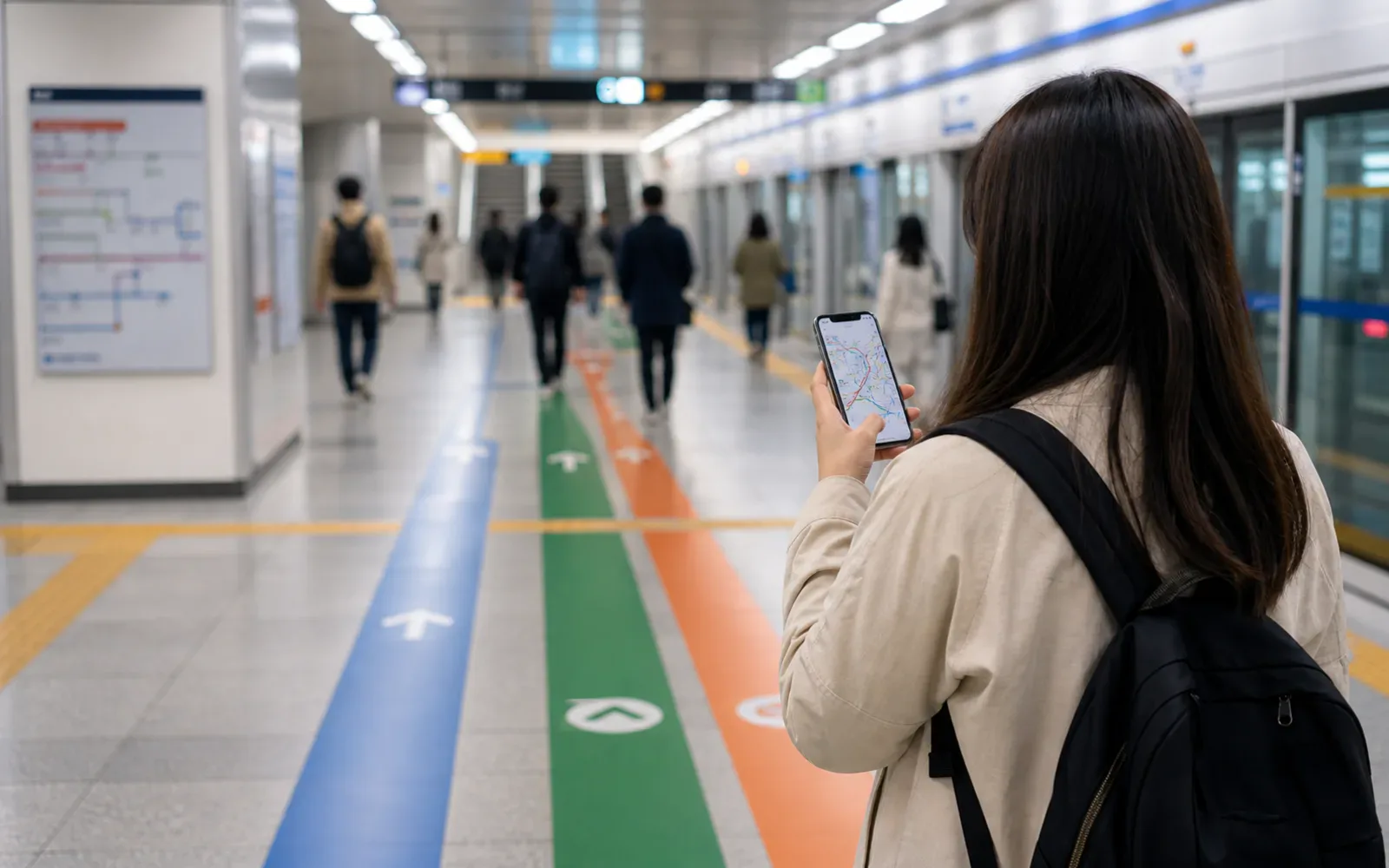
Most first-time Seoul subway problems happen before or after the train ride: the wrong station exit, a missed card tap, an unrealistic transfer, or a last train checked too late. The network is usable in English, but a route can still feel difficult when the station itself is large.
Use this as a failure-prevention list. Fares, service changes and transfer rules can change, so the current Seoul transport page and the official subway app remain the final references.
Three journeys that expose different mistakes
An airport arrival, a cross-city sightseeing ride and a late evening return require different checks. Use the purpose of the journey to decide which detail matters most rather than applying the same generic subway advice to every trip.
| Journey | Detail to resolve first | Why |
|---|---|---|
| Airport arrival with bags | All-stop versus reserved express and the hotel connection | An airport station is not the accommodation door |
| A palace or museum visit | Actual destination exit and entrance | A station-center pin can finish far from the needed doorway |
| An evening event | Last complete connection and return surface walk | The last train on one line may miss the onward transfer |
| A city outside Seoul | Correct line branch or reserved rail product | The metropolitan line color does not settle the whole ticket |
The useful habit is to name the actual final destination, not only the line. A ride to Jamsil, a walk to one lake entrance and a return from a concert venue can all involve different exits at the same station.
Airport all-stop and express are different products
The all-stop Airport Railroad serves intermediate stations, while the express is a reserved direct service between the airport and Seoul Station. Use the correct platform and ticket for the chosen service. A normal rechargeable-card trip should not be assumed to reserve an express seat.
For a Hongdae accommodation, the all-stop connection can make Hongik University the useful arrival. For a central accommodation reached via Seoul Station, compare the onward lift, subway or road transfer as part of the same journey.
Put the terminal, service and final hotel route in one offline note. Keeping only airport to Seoul Station leaves the hardest luggage connection unresolved.
A palace journey ends at a gate
For Gyeongbokgung, save the intended public entrance separately from the station. The authority’s current directions identify several subway approaches, including Gyeongbokgung Exit 5. Choose the appropriate one for your route and accessibility needs instead of following whichever exit the crowd uses.
At a museum, use the same approach: station → actual venue doorway. If a preferred exit uses stairs, select the lift route and allow its extra surface distance. The correct accessible journey can be longer on the map and still be the easier trip.
Branches and terminus displays matter on a day trip
For an Incheon journey on Line 1, read the destination and branch rather than boarding any southbound service. For Suwon, use the service and local connection that reach the actual palace or fortress district. A rail station is a gateway to the visit, not the attraction itself.
A reserved train additionally requires the departure station, date, time, carriage and seat. Do not carry a metropolitan tapping habit into a product that needs a separate reservation or ticket.
Check the return before the event begins
Save the last practical route that completes every connection to your accommodation. Then retain a margin for leaving the venue, reaching the station and walking between platforms. Do not aim for the final theoretical departure while ignoring the event exit crowd.
If you plan a road fallback, save the accommodation address and a permitted pickup location. A stadium plaza, river footpath or palace gate is not automatically a vehicle pickup point. Keep enough phone battery for the actual journey after the photographs and ticket screens are finished.
Resolve a gate error without changing the trip record blindly
Step aside, keep the intended card separate from other contactless cards, and show the displayed error to staff. Repeatedly tapping different cards can make it harder to understand which entry record applies.
The goal is not moving through the barrier at any cost. It is keeping a valid, understandable trip with the correct ticket or card, destination direction and final exit.
Mistake 1: routing to a station instead of an exit
A station name is only the first half of the address. Large stations can have exits on opposite sides of a major road, underground shopping area or hill. An extra ten minutes underground is common when the map pin is attached to the station center instead of the correct exit.
Before boarding, save the exit number and the final street-level turn. If you need an elevator, check the accessible route separately; the closest exit on the map may use stairs. Hotel instructions, venue pages and station maps often provide a more useful exit than a general navigation result.
Mistake 2: assuming every train on the platform goes to the same place
Check the line number, direction and final destination shown on the platform display. Some services branch, terminate early or use express patterns. A line color alone is not enough. When the platform sign names several downstream stations, confirm that your destination is on that branch before boarding.
At transfer stations, follow the numbered line signs rather than the crowd. A short transfer on an app can still involve long corridors. If someone in your group walks slowly or carries luggage, compare a one-transfer route with a slightly longer direct ride.
Mistake 3: treating a single-journey ticket like a transport card
Seoul’s official guide states that a single-journey subway ticket is for the subway only; it does not work as a bus card. The ticket also includes a refundable deposit handled at a deposit-refund machine after the trip. A rechargeable transport card is usually simpler when the day includes buses or multiple rides.
Do not copy a fare from an old article and load the exact minimum. Seoul’s official fare page labels its effective date, and longer trips can add distance charges. Keep a small balance margin and check the live fare information before a budget-sensitive journey.
Mistake 4: forgetting the exit tap and transfer window
The integrated fare system depends on tapping as you enter and leave each transport mode. Seoul’s transport guidance also sets a time window for discounted transfers and explains that the same route does not always qualify. If a reader or gate displays an error, step aside and ask station staff rather than repeatedly tapping different cards.
Keep one physical card away from other contactless cards when tapping. A crowded wallet can trigger the wrong card or an incomplete read. Each traveler should normally use their own card for subway gates.
Mistake 5: putting all Seoul stations into one mental network
The metropolitan system has multiple operators, through-services and stations with similar English names. The experience is mostly integrated, but airport rail, high-speed rail, intercity trains and ordinary subway services do not share identical tickets or boarding rules.
| Trip | What to verify | Common wrong assumption |
|---|---|---|
| Subway plus city bus | Transport-card tap and transfer timing | A single-journey subway ticket covers the bus |
| Airport to central Seoul | All-stop versus express service and the final transfer | Every airport train uses the same ticket |
| Seoul to another city | Rail operator, reserved seat and departure station | A subway card reserves an intercity train |
| Late-night return | Last useful departure and connection | The station closing time equals the last train time |
Mistake 6: waiting until the platform to check the last train
The relevant time is the last train that completes your whole route, including the transfer. A later train may reach the interchange after the connecting line has finished. Event nights and maintenance can also change normal patterns.
Check the official app before dinner or the event starts. Save a bus or taxi fallback and enough battery to show the destination. If the route crosses the city, leave a buffer instead of targeting the final theoretical connection.
Mistake 7: standing in the wrong place with luggage
Do not stop immediately inside a gate, at the top of an escalator or in front of a carriage door to reorganize bags. Move to the side before opening a map. On the platform, let passengers exit first and use lifts where heavy luggage makes stairs unsafe.
For airport days, compare the station’s elevator path with a bus or direct rail option. The Seoul luggage-storage guide covers staffed storage and lockers, and the T-money guide explains the difference between stored value and an unlimited pass.
A two-minute check before entering the gate
- Confirm the station name, line number and direction.
- Save the destination exit and accessible route if needed.
- Check whether the card has a reasonable balance.
- Look at the transfer walking time, not only the train time.
- For late travel, confirm the last complete connection.
Official transport references
- Seoul Metropolitan Government: public transportation for visitors
- Seoul Metropolitan Government: current subway fares and transfer rules
- Seoul Metropolitan Government: official foreign-language subway app
Accuracy boundary: This guide explains the decisions that prevent common errors. Live fares, operating notices, first and last trains, elevator access and service disruptions must be checked for the actual travel date.