
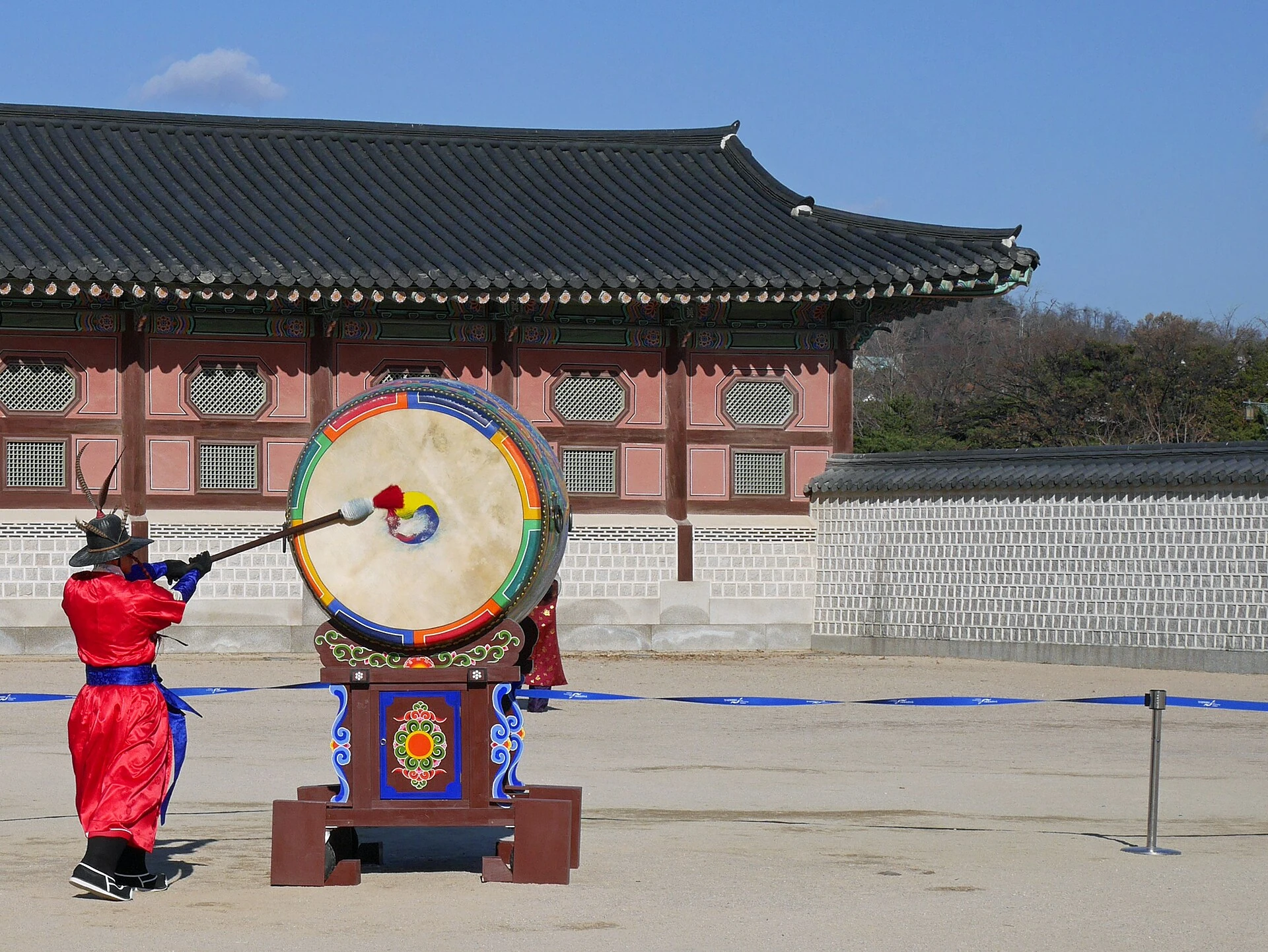
A guard changing ceremony is not the same experience as touring Gyeongbokgung’s halls. It is a scheduled reconstruction of royal-guard practice, with a moving formation, music and a defined sequence. Decide which ceremony you want, arrive at its actual public viewing area, and leave the palace ticket as a separate choice.
The common planning mistake is to save a palace gate, see several military-looking times online and assume they all describe the full guard change. The operator distinguishes a 20-minute changing ceremony, a shorter guard-duty performance, a training session and a seasonal patrol. Each creates a different visit.
Three regular displays, three different appointments
The Korea Heritage Agency’s current program page lists the following regular schedule. A dated cancellation or special-event notice can change it. KTO’s official visitor information lists the ceremony Wednesday–Monday, with Tuesday closure; holiday exceptions still need the actual notice for your date.
| Program | Published time | Operator duration | What to expect |
|---|---|---|---|
| Changing of the Royal Palace Guard | 10:00 and 14:00 | 20 minutes | The main shift-changing ceremonial sequence |
| Guard Duty Performance | 11:00 and 13:00 | 10 minutes | A shorter guard-duty display, not a repeat of the complete change |
| Guard Training Session | 09:35 and 13:35 | 15 minutes | Public training; use the marked area in that day’s instructions |
Some older descriptions use 09:30 and 13:30 for training. The current operator page specifies 09:35 and 13:35. Do not combine an older time with a different program name and assume you have found an extra full ceremony.
The forecourt and the ticketed palace are different spaces
KTO’s palace-program information identifies the Gyeongbokgung guard change with the Heungnyemun Gate area at 161 Sajik-ro and lists it as free. The guards’ movements and the public viewing arrangement occur around the front-gate/forecourt setting. Follow the designated spectator boundary rather than trying to enter a formation route for a closer photograph.
Watching the ordinary public ceremony does not require you to buy a palace tour simply because a seller bundles the two. Conversely, seeing the guards does not establish admission to the paid palace area or a separately reserved interior. If you continue inside afterward, use the normal admission process and the rules that apply to your visitor category.
Save Gwanghwamun as the front-gate orientation point and identify Heungnyemun in the actual site layout. A generic pin in the middle of the palace can lead you toward a different section. The palace operator’s directions page gives Gyeongbokgung Station Exit 5 on Line 3 and Gwanghwamun Station Exit 2 on Line 5 as approaches; check elevators separately if required.
Choose a viewing position that lets you follow the sequence
Arrive before the published start with time to orient yourself. Stand behind the marked public line and retain a view of the formation’s entrance and the central ceremonial space. A position very close to one guard can produce a striking portrait while making the overall handover harder to understand.
For a first viewing, prioritize the sequence over a perfect photograph. Watch where the incoming group arrives, how the guard leaders communicate and how music and movement divide the action. KTO describes the ceremony as a historical reconstruction based on records, rather than a present-day military security operation.
Do not invent a meaning for every color or gesture from appearance alone. Read the official introduction beforehand or use the interpretation provided on site. Recognizing who is entering, who is leaving and how authority is transferred is enough to make the ceremony legible without specialist knowledge.
When taking pictures, make a few frames and lower the camera for part of the event. Keep tripods, umbrellas and raised phones from blocking the people behind you, and leave the movement corridor open. A crowd standing nearby does not grant permission to cross a rope or follow directly behind performers.
If seeing over a standing audience is a concern, contact the ceremony office at +82-2-3210-1645 before the visit and ask about the arrangement for the specific display. Explain whether you need a wheelchair viewing position or another practical accommodation. Free public viewing does not establish a reserved seat, a particular sightline or permission to move into the performers’ space. On arrival, ask staff before settling at the edge of a movement route. A position that looks clear before the ceremony can become an entrance or exit when the formation begins.
Weather and special programs can change the plan
The palace authority’s published schedule notice warns that rain, extreme heat or heavy snow can cancel ceremonial events and that operating circumstances can change the time or place. Check the current operator notice for the selected display. The presence of guards does not establish that the full 20-minute changing ceremony is proceeding.
Check the current operator notice before making the journey, especially in severe weather. If the desired ceremony is canceled, choose whether the palace visit itself still interests you. There is no reason to wait outside for another scheduled time without confirming that the same cancellation does not apply.
A festival can also replace regular programming. A search result for a named royal-guard special event may describe a single past date, a demonstration with different capacity or a temporary suspension of the usual change. Read the year and the actual event period before using that notice to organize an ordinary visit.
The patrol is seasonal and its route can move
The operator lists a 15:00–16:00 guard patrol during March–May and September–November on weekends and public holidays. It describes an inside-palace route on Saturdays and a Gwanghwamun-to-Insadong route on Sundays, with the possibility of moving the latter inside because of road conditions, demonstrations or rallies.
That is a separate program from the 10:00/14:00 change. Do not wait along a street in Insadong merely because an old photograph shows a procession there. Use the notice for the selected day to establish the actual route and the permitted public viewing position.
If the procession moves inside, palace access conditions also become relevant. A free event does not automatically remove every boundary at the larger venue. Ask staff which area is open to spectators rather than trying to follow the guards through an entrance you have not been authorized to use.
Two complete ways to use the ceremony
Ceremony-led morning: arrive at the front-gate area for the confirmed 10:00 change, watch it, then decide whether to enter the palace or continue to a central-Seoul meal and public-space walk. Make the palace optional only if you are content to leave after the ceremony.
Palace-led day: give the grounds a proper visiting block and use one confirmed ceremony as a timed anchor. Avoid crossing the palace repeatedly to collect every display. One fully watched change is more coherent than seeing fragments of several events while worrying about another reservation.
For the longer interior route, the daytime Gyeongbokgung guide explains buildings, tickets and seasonal closing. For an independent walk afterward, the short Cheonggyecheon guide supplies an actual beginning and ending. Keep that additional walk proportionate to the attention and time you have left.