
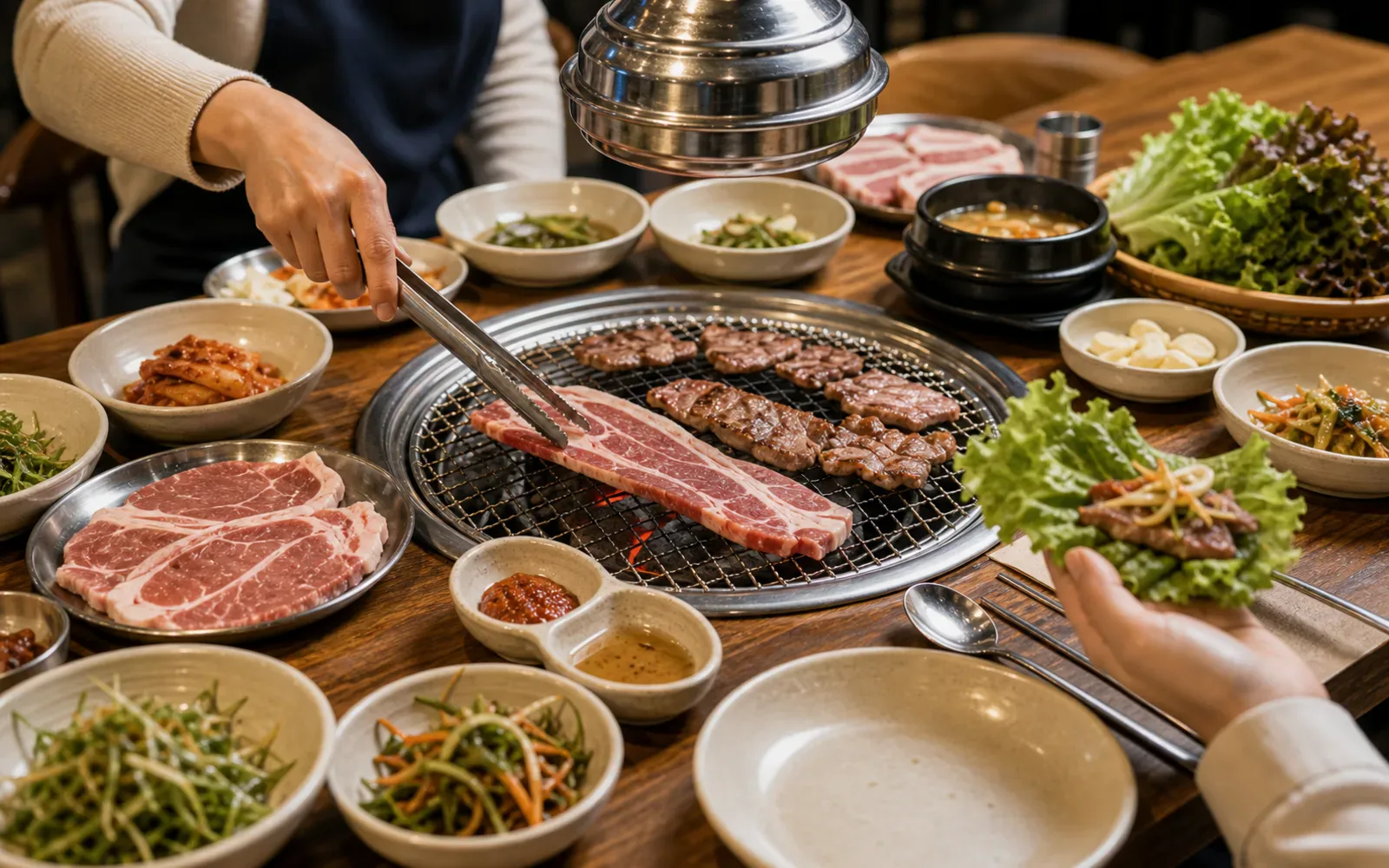
Visitor guide reviewed July 27, 2026. Korean barbecue is a table format, not one dish. You choose meat, the restaurant brings shared side dishes, and the food cooks on a grill at the table. The difficult part for a first visit is usually portion rules, doneness responsibility and dietary questions—not chopstick technique.
Read the bill from portions, not from people
A barbecue menu can display one portion with a weight beside it, a two-person set, or a shared platter. Those are different price units. Find the meat name, weight and minimum order before deciding that the headline amount represents the whole meal.
If the menu prices a single portion and the initial order requires two, multiply the displayed portion price by two before adding rice, stew or drinks. If it lists a set, inspect what the set actually contains and whether additional dishes are optional. The number of people at the table does not automatically define the portion count.
| Menu wording or unit | What it tells you | What it does not tell you |
|---|---|---|
| 1인분 with a weight | The listed serving unit | Whether one serving is a permitted first order |
| 2인분부터 | Ordering begins from two portions | Whether one diner is allowed to occupy the table |
| 세트 | Several components are sold together | Whether every photograph or side shown is included |
| 추가 | An additional item or serving | Whether it belongs in the initial minimum |
| 공깃밥 | A separate bowl of rice | Whether rice is included in a particular meat set |
These are reading aids, not one restaurant’s complete policy. Show the actual menu line and ask before the grill is prepared. That is especially important for a solo diner who can meet the portion minimum but may still encounter a separate seating rule.
A first order that keeps the cooking simple
Choose one meat type for the first round and wait to see its serving size. This gives the group a clearer picture of quantity, cooking responsibility and appetite before several different cuts arrive at once.
Ask whether staff cook the meat: 구워 주시나요? If the answer is yes, let them establish the sequence. If the restaurant expects guests to cook, ask for guidance on the equipment and the particular cut. Do not infer that every staff member passing the table will manage the entire grill.
Separate raw-meat handling from eating. Keep the provided tools in their intended roles and ask staff when you are uncertain. Marinade, lighting and a browned exterior do not establish that a piece is appropriately cooked inside; do not turn appearance alone into a food-safety test.
Rice, stew and the end-of-meal order
Rice, cold noodles and stew can be additions rather than part of the initial meat charge. Decide whether you want them as the meal develops instead of ordering every photographed component at the beginning.
For rice, 공깃밥 하나 주세요 requests one bowl. For an additional item, point to the exact line and show quantity. For a final dish intended for sharing, ask about the portion size before placing the order. This makes both quantity and the bill easier to understand.
Side dishes brought automatically can have their own refill arrangements. Look for a designated self-service area or ask which items can be replenished. Do not assume every special side or premium addition is unlimited because ordinary banchan is available again.
A useful check before paying
Review the meat portions, additional dishes and drinks against the order. If the receipt contains an unfamiliar item, point to that line and ask what it represents. A question about a price unit is easier to resolve while the menu and table order are still available.
Use 계산할게요 when you are ready to pay. Follow the restaurant’s actual counter or table arrangement, and keep the receipt until any question is settled. A service format common in one barbecue restaurant should not be presented as universal across all branches.
Make dietary needs part of the restaurant choice
A shared grill and meat-centered kitchen may be unsuitable for someone whose requirement cannot be met there. An ingredient omission is not the same as a separate preparation process. Ask about the exact dish and equipment before ordering, and accept uncertainty as a reason to use another planned venue.
For halal needs, choose a currently documented restaurant and apply your own required standard; ordering beef in a pork-serving restaurant does not establish halal handling. For a vegetarian companion, a visible vegetable side is not a substitute for a meal whose broth, sauces and preparation are understood.
A good first barbecue dinner has a clear portion unit, a manageable first order, understood cooking responsibility and an intelligible final bill. The useful skill is making those decisions, not memorizing a long list of restaurant etiquette.
Read the menu in this order
First identify the meat: pork belly (samgyeopsal), pork neck (moksal), beef short rib (galbi) or marinated options. Next find whether the price is per portion and the listed weight. Many restaurants require a minimum first order, often expressed as two portions, but the rule differs by restaurant. Ask before sitting if you are dining alone.
Finally, look at add-ons such as rice, stew, noodles and drinks. Side dishes served automatically are usually part of the meal, while steamed rice and finish dishes are commonly separate orders. Refills and charges vary; do not assume every plate is unlimited.
Who cooks?
At some restaurants staff cook the meat; elsewhere guests do. Wait for a signal before moving food that an employee arranged. If you are responsible, use the provided tongs for raw meat and chopsticks for cooked food. Cut thick pieces after the outside firms up. Pork and poultry need thorough cooking; when unsure, ask staff rather than guessing from lighting or marinade color.
A practical first order for two people
Choose two portions of one non-marinated cut, then add more only after seeing the serving size. This keeps the grill timing simple and makes the bill easier to understand. Add rice or a stew if desired. A mixed sampler can be useful, but confirm whether the menu price is for the whole set or each component.
How to build a bite
A lettuce wrap (ssam) is optional. Place a small piece of meat, a little sauce and one or two accompaniments on a leaf, then fold it. You do not need to combine every side dish. Garlic and kimchi may be grilled if the restaurant setup encourages it, but use the grill area staff indicate.
Phrases that solve common problems
| Need | Korean | Meaning |
|---|---|---|
| Confirm minimum | 첫 주문은 몇 인분이에요? | How many portions is the minimum first order? |
| Ask for help | 구워 주시나요? | Do you cook it for us? |
| Request rice | 공깃밥 하나 주세요. | One bowl of rice, please. |
| Ask for bill | 계산할게요. | We would like to pay. |
Dietary and allergy limits
A barbecue restaurant has shared grills, tongs, sauces and side dishes. Cross-contact is likely. Marinades can contain soy, wheat, sesame, fruit, alcohol or other ingredients. Kimchi and sauces may contain seafood products. Show a translated allergy card and ask about both the meat and shared equipment; if severe cross-contact cannot be tolerated, choose a venue able to explain a separate preparation process.
For halal needs, an ordinary pork barbecue restaurant is not made suitable by ordering beef. Use Korea Tourism Organization’s restaurant categories and ask about certification, ingredients and alcohol. Our Muslim-friendly food guide explains those labels. Vegetarian visitors should use the broth and side-dish checklist.
Payment and table behavior
Many restaurants expect payment at the front counter rather than bringing a card terminal to the table. Cards are widely accepted, but keep another method for a small or cash-preferring business. Tipping is not a standard requirement. If the restaurant is busy, finish the meal without treating the table as an all-evening café.
Before you enter
- Check whether solo diners are accepted and whether a minimum order applies.
- Read the portion weight and price.
- Ask who will cook before touching the grill setup.
- Keep raw-meat tongs separate from eating utensils.
- State allergies before ordering, not after side dishes arrive.
Useful official references
- VisitKorea: Korean food, table culture and barbecue
- VisitKorea: dietary questions and Muslim-friendly dining FAQ
Editorial scope: Restaurant policies and ingredients differ. KoriPicks describes the dining process and points to official dietary resources; it does not certify any restaurant or guarantee an allergen-free meal.